

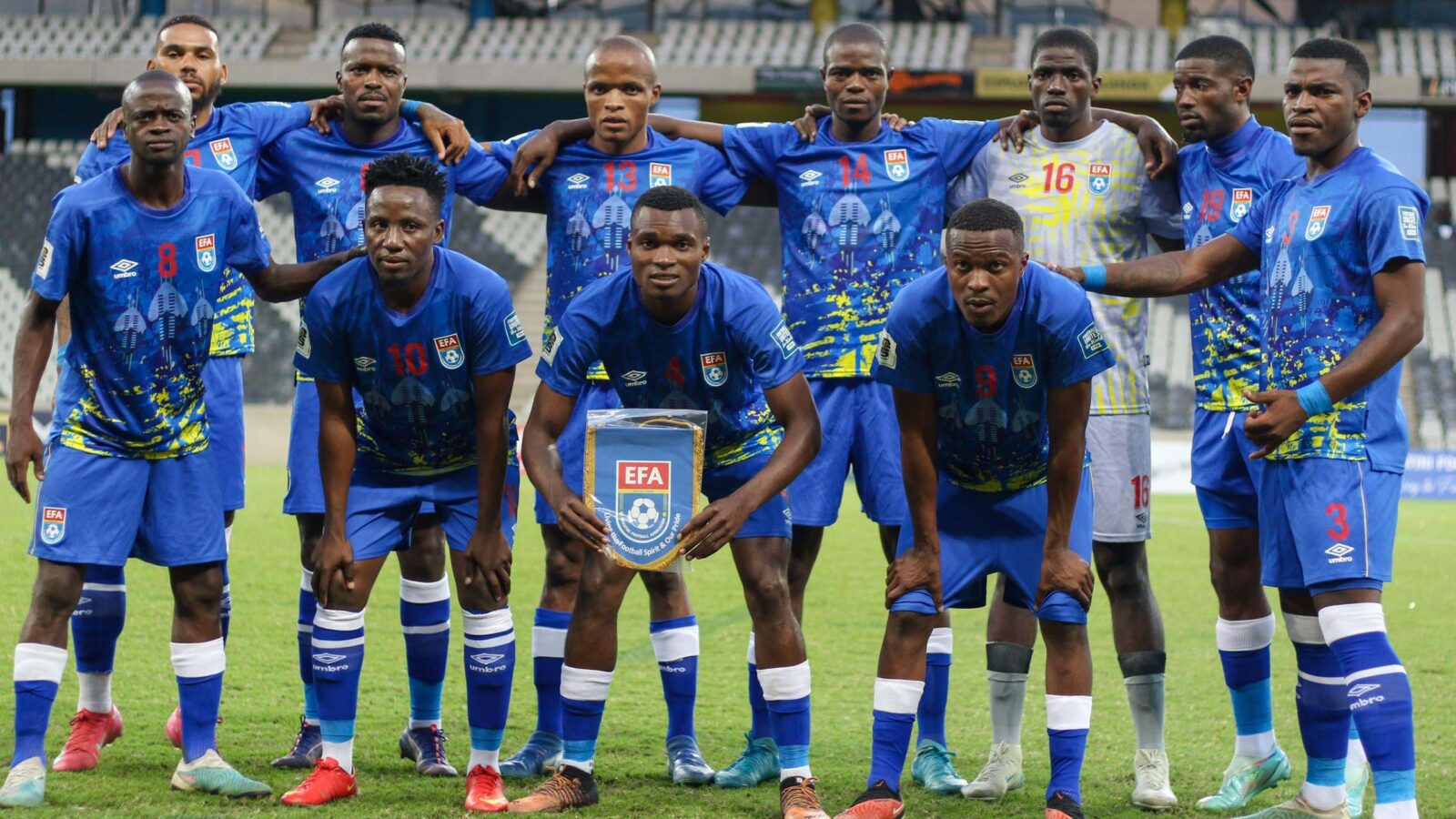
There is a quiet sorrow that settles over Eswatini every time our national team steps onto the pitch in a major tournament.
It is not just about losing. It is deeper than that.
It is the ache of watching a team we love, Sihlangu Semnikati, the Pride of the Nation, struggle year after year, not because they lack heart, but because the system meant to support them has failed. For over 50 years since independence, football in our country has remained stuck in a cycle of promise and disappointment, of passion and poor planning.
Football is more than a game here. It is in our blood. In every village, on every dusty field, you will find children kicking balls made of plastic bags, barefoot and laughing in joy, their feet dancing with natural flair. In the stands, fans wear their hearts on their sleeves—cheering, whistling, vuvuzelas blaring, voices rising in unison. That energy is real. That love is deep.
But when it comes to the international stage, that same fire meets cold reality. Tournament after tournament ends the same way: Early exits, broken hopes and the same excuses—not enough time, too strong opponents, bad luck, basiloyile, blah, blah, etc.
We have heard it all before. It is the same, old scratched song…
Our beloved Sihlangu Semnikati has just been eliminated—again—from an international tournament, the World Cup qualifiers by Libya. I will not mention the score.
What would be the point? It is not the first time the national team has been eliminated so early in an international tournament. Year after year, our beloved Sihlangu Semnikati more often than not goes through the same fate.
So, we have to ask: Isala kuphi? Sifa kuphi, kahle kahle? Where is the problem? And, more importantly, what are we going to do about it? Is anything being done? Has anything been done to address this ignominy?
The Truth We Need to Face
Let us be honest: This is not about talent. Eswatini has plenty of it. Watch any school match. Walk through a community game. You will see skills that rival any young player on the continent. This is not a nation lacking footballers. It is a nation failing its footballers.
The issue is not the players. It is what happens—or does not happen—after we see that spark.
Other countries in our region have shown us the way. Botswana first qualified for the Africa Cup of Nations in 2012, achieving a major milestone in the country’s football history. They topped their group during qualification, recording memorable victories over Tunisia both home and away. That campaign marked their debut on the continental stage and lifted national expectations for the game’s future. The men’s national team achieved another milestone by qualifying for the 2025 Africa Cup of Nations.
Neighbouring South Africa built a professional league that now feeds talent across the world. Following the fall of apartheid, their football experienced a period of remarkable transformation and growth. The creation of the South African Football Association (SAFA) in 1991 marked the beginning of a new, inclusive era. Just a year later, the country was welcomed back into FIFA, rejoining the global football community. This progress quickly translated into success on the field when South Africa lifted the Africa Cup of Nations trophy in 1996.
And what—as the kingdom of Eswatini—have we done to improve our football, specifically in making our national team a force to be reckoned with on the international stage? Strip away the excuses, and the fact remains: We have done almost nothing to advance our football. I know there are those too myopic, too allergic to honesty, who will attack me for saying this. But no amount of denial can change the fact—it is, and remains, the brutal truth.
Too often, we rely on last-minute training camps, a few friendlies—and hope. We send our boys out to battle with half the preparation, half the support and expect miracles. Is this fair to the players? Let us be clear: Football does not run on hope alone. It runs on systems. On planning. On visionary leadership.
Where Are We Losing It? What Is the Root Cause of Our Problems?: The problems are not hidden. They are visible at every level.
Government Support – Still a Step Behind
Let us be brutal with the truth: The institution that matters most, government, treats sports like an afterthought, not a national priority. Our stadiums need repair. Our youth programmes flicker in and out with each budget cycle. There is little or no long-term vision, no sustained funding and little coordination between the Ministry of Sports and football stakeholders. When sport is seen as entertainment rather than investment, progress becomes impossible.
Leadership – Stuck in the Past
Too many of the same faces remain in charge, year after year. New ideas are silenced. Accountability is rare. Decisions are often made based on loyalty or politics, not what is best for the game. When leadership becomes about holding onto power instead of building a future, the players—and the people—pay the price.
Youth Development – A Dream Denied:
This is where it hurts the most. Talented children kick balls on uneven fields with barely qualified coaches, no credible structures, no pathway. Schools have sports days, yes—but little or no follow-up; no or minimal scouting; no academies; no bridge between raw talent and professional opportunity. Imagine how many stars we have lost—not because they were not good enough, but because no one helped them grow.
The Voice of the People
We need the involvement of key stakeholders in finding solutions; and it is not just the football analysts or journalists saying this. It is the fans—the ‘12th man’ —who have carried this team through thick and thin. One supporter at Somhlolo National Stadium once said: “We love Sihlangu, but loving them has become an act of endurance.
We sing, we dance, we believe…and then we go home broken. Maybe we should just stop going.” Another recently wrote online: “Badlali bakhona la Eswatini, ngulokukhetsa umuntfu munye aguge solo nibambelele kuye kani njeke nebuholi betfu ebholeni abucaci kuyaconyiswana nje; kuphatsa Sihlangu kwagcina nga Victor Gamedze and bekubonakala kutsi kuyasetjentwa hhayi nayi imihlolo nayi…”
These are not angry rants. They are cries from the heart. They are calls for change. But there is hope. We do not need to look far to see that progress is possible—even for small nations like ours.
Countries like Botswana did not become competitive overnight. Lesotho did not rise by chance. They made choices. They invested. They built systems. And they stuck with them.
Eswatini can do the same. We already have the foundation: Passionate fans, talented youth and a culture that lives for football. What we need now is the courage to build on it.
Real change? It will not happen overnight—and that is okay. But it can happen, that is, if we are brave enough to do things differently.
If we stop going through the motions and start building with purpose. As I see it, this is how we should begin: “Play Like It Truly Matters.” Football is more than 90 minutes on a field. It is the game that unites families, inspires children and gives entire communities something to believe in. But if we want it to live up to its full promise, we have to treat it like more than just a pastime. That means proper investment: Real training grounds, year-round youth programmes and coaches who are supported and prepared to guide the next generation. This is not just about chasing trophies—it is about shaping confident, disciplined, purposeful young people.
Leadership with Vision, Not Ego
We do not need change for the headlines. We need leaders who see beyond the moment—leaders who listen, take responsibility and put progress before popularity. Success should not be measured only in medals, but in how many children get the chance to play, how prepared our teams are and how sustainably the sport grows. When football moves forward with purpose, our communities grow stronger too.
Start with the children – All of Them
No child should miss the chance to play because of where they were born. School sports should be the heartbeat of opportunity, not an afterthought. The search for talent must reach beyond big academies—into village pitches, dusty playgrounds, and rural backyards. Every boy and girl with potential deserves more than promises; they deserve real pathways, real opportunities, and real support.
Raising Standards Across the Board
From local leagues to the national squad, professionalism must be the baseline, not the exception. Regular training, proper medical care, long-term planning—these are not luxuries, they are essentials. Football is a craft that demands respect and commitment. If we want better results, we must raise the standard everywhere and give the game, and everyone in it, the dignity it deserves. This is not about perfection. It is about progress. And it starts with us—choosing to care enough to do it right.
Look at our school competitions. Watch the speed, the skill, the hunger in the players’ eyes. These are not just games. They are glimpses of what Eswatini football could be. With the right support, these young athletes could be the next generation of Sihlangu stars. But only if we create the system to lift them.
If we do not, we will keep asking the same question: Kwentekani kani ngempela nge bhola Eswatini? And the answer will always be the same—we have the talent, but we did not build the future.
It is time to choose. Fixing Eswatini football is not just the job of the Football Association (FA). Or the government. Or the coach. It is on all of us: Parents who encourage their children; teachers who organise matches; communities that maintain fields; fans who demand better; businesses that sponsor teams; leaders who choose courage over comfort.
Our supporters have waited long enough. Our young players deserve more than dreams—they deserve chances. And our nation? We deserve a team that reflects the pride we feel every time a ball is kicked in a village, a schoolyard, a stadium. Not a national team that donates crucial points to the opposition. Let us throw our weight behind the Pride of the Nation. Sihlangu Semnikati will rise once more not by chance, not by memories, but through unity, wisdom and patience.
Our strength is here. Our passion is alive. Our moment is now. Together, we can restore pride, lift our nation’s spirit, and make the game beautiful again in Eswatini.














Leave a comment