

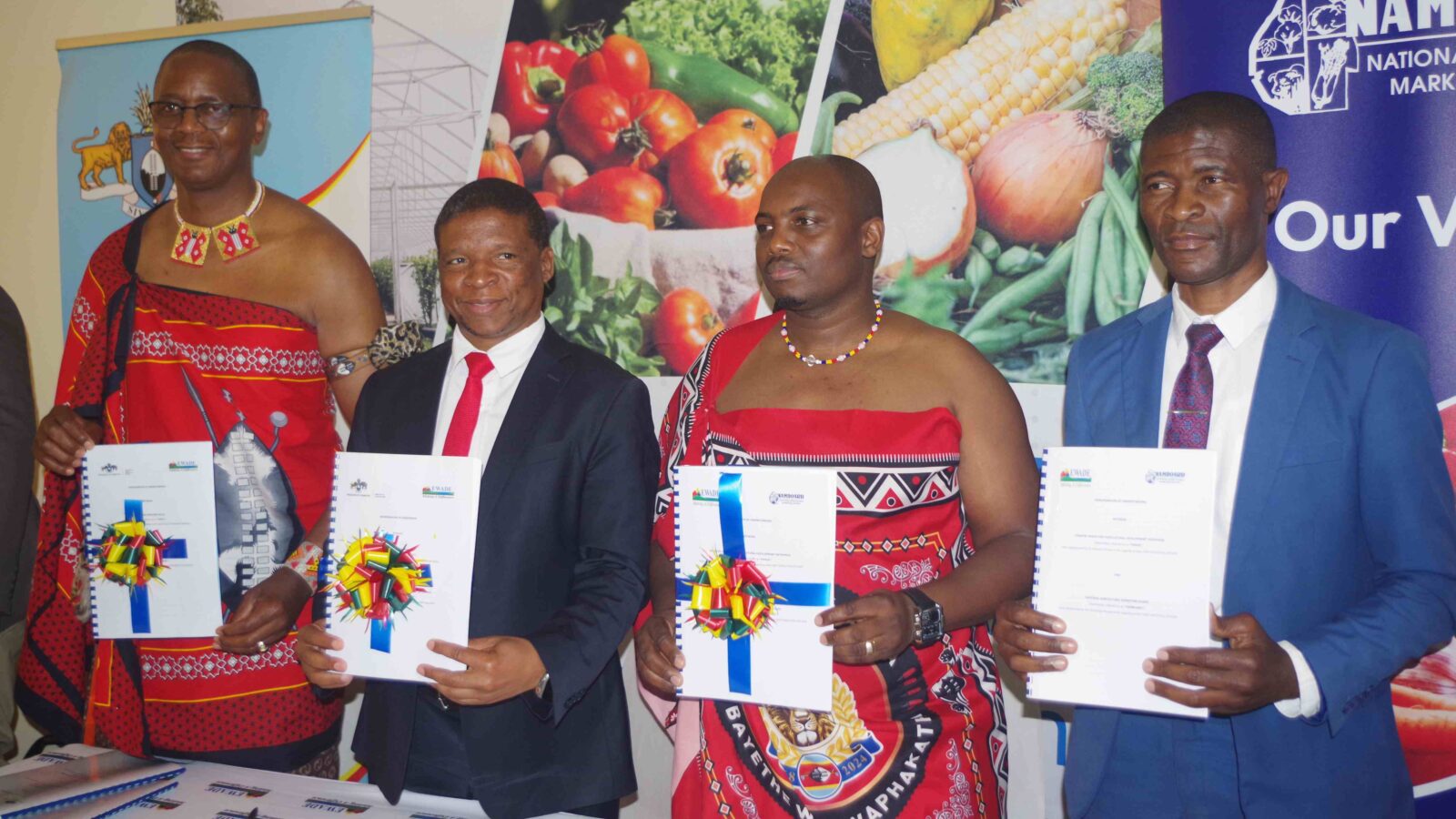
MBABANE – EWADE, NAMBoard and government have signed a landmark MoU marking the start of the E851 million SAPEMP rollout to transform Eswatini’s agriculture into a market-driven, climate-resilient sector.
The signing of a memorandum of understanding (MoU) between the Eswatini Water and Agricultural Development Enterprise (EWADE) and the National Agricultural Marketing Board (NAMBoard), under the leadership of the Ministry of Agriculture in partnership with the Deputy Prime Minister’s Office, marks the official start of the Smallholder Agriculture Productivity Enhancement and Marketing Project (SAPEMP) implementation.
The MoU, signed at Mountain View Hotel yesterday, follows the official launch of SAPEMP by the Minister for Agriculture, Mandla Tshawuka, on March 27, 2025.
This agreement brings together government institutions, development partners and the private sector to transform Eswatini’s agricultural sector into a market-led, climate-resilient and commercially viable system.
Backed by E851 089 000 (US$45.5 million) from the International Fund for Agricultural Development (IFAD), the Green Climate Fund (GCF), the Government of Eswatini and private sector players, SAPEMP will be rolled out nationwide across all four regions.
Its overarching goal is to boost food security, create jobs, empower women and youth, and elevate rural livelihoods in alignment with the Ministry of Agriculture’s Five-Year Strategy (2024–2028).
SAPEMP’s design focuses on three core components that will drive its success:
1. Climate-resilient, sustainable production
- Introduces climate-smart agricultural practices to mitigate droughts, floods and other climate risks
- Supports the Gender Action Learning System to empower women in agriculture
- Strengthens food security and nutrition through higher yields of crops like vegetables and legumes
2. Market linkages, financial access
- Connects smallholder farmers (SHFs) to structured domestic and export markets
- Improves financial services and aggregation capacity to drive commercialisation
- Strengthens production clusters, enabling smallholders to link directly with agribusinesses
- Policy, institutional support
- Builds an enabling environment through policy frameworks and institutional capacity building
- Enhances public service delivery and long-term agricultural sustainability
3. Policy, institutional support
- Builds an enabling environment through policy frameworks and institutional capacity building
- Enhances public service delivery and long-term agricultural sustainability
*…
SAPEMP to close 40 per cent supply gaps – NAMBoard
MBABANE – NAMBoard has admitted that Eswatini’s current agricultural output falls far short of both domestic and export market demands, with capacity at less than 40 per cent.
The National Agricultural Marketing Board (NAMBoard) Chief Executive Officer (CEO) Bhekizwe Maziya said the project would be a game-changer for the country’s horticultural sector.
“The major challenge we face as NAMBoard is the inability to satisfy market demand. We are currently less than 40 per cent in capacity to meet both local and export markets. This is the gap we believe SAPEMP will close,” Maziya said.
Maziya stressed that the MoU, signed between NAMBoard, EWADE and the Government of Eswatini, was not the beginning of their collaboration.
“The signing of this MoU marks the commencement of a great mile we are about to walk together with our sister parastatal, EWADE. This would not be the first time for us to journey together. We have previously implemented successful projects like the establishment of packhouses, the Smallholder Market Led Project and the Climate Smart Agriculture project—the list is endless,” he said.
He expressed confidence that SAPEMP would mirror the success of previous collaborations, citing the strong partnership between NAMBoard and EWADE as a key factor in achieving results.
*Full article available in our publication.


















Leave a comment