

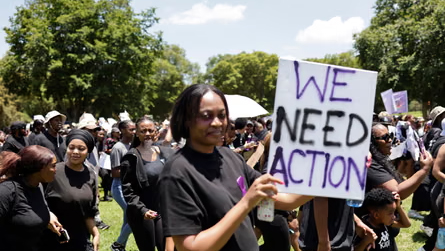
When South Africa recently declared gender-based violence (GBV) a national disaster, it made headlines and for good reason. This isn’t just a political stunt. It sends a simple but powerful message: GBV is not a personal misfortune or a ‘women’s issue’. It’s a serious crisis affecting the whole country.
That decision should echo loudly across Eswatini. By calling GBV a national disaster, South Africa forces all its government structures from police to health services to social development to work together with urgency. Simply because of that declaration, prevention efforts, victim support, courts and community safety systems become more coordinated. It also makes monitoring mandatory, so government can’t just pay lip service – people will have to report progress.
Importantly, this isn’t about giving government sweeping ‘emergency powers.’ Instead, what South Africa did was strengthen its existing systems. The national disaster label helps pull together all the necessary parts – policing, justice, healthcare, education, community leaders to treat GBV like the urgent, country-wide problem that it is.
Here at home, GBV is not a distant issue. According to Eswatini’s own National Strategy to End Violence, the problem cuts deep. For example, the Eswatini Violence Against Children and Youth Survey found that many young people, both boys and girls, face violence in their lifetimes. Yet, despite laws like the Sexual and Domestic Violence Act (SODV) of 2018, a number of cases go unreported.
United Nations (UN) Women’s data shows that about two-thirds of GBV survivors in Eswatini are women and many of the worst cases happen at home. That means it’s not just a crime problem – it’s a social, cultural and systemic one.
One extremely worrying recent case illustrates why this needs urgent, structural attention: Earlier in 2025, eight-year-old Tifezile Gwebu went missing from her home in Siguduma, Shiselweni. Her head was later found dismembered inside a homestead. The whole country was shaken. Community leaders, families and civil society cried out for justice.
Even though this kind of horrific act deserves a swift, strong response, our national systems – law enforcement, social services, victim support – are often slow or disjointed. That is exactly where a national-emergency style response could make a difference.
Declaring GBV a national emergency would be more than symbolic. Here’s what it could make happen:
l Urgent coordination: Government would be forced to work across departments – police, health, social welfare, courts – with a clear, nationally coordinated plan.
l Faster funding: Resources for shelters, counselling, safe spaces and legal aid could be ring-fenced and deployed quickly.
l Accountability: Officials would need to set public targets, report on progress and face real scrutiny.
l Prevention push: Campaigns to change social norms – especially targeting men and boys -would be scaled and urgently implemented.
l Stronger response systems: More shelters, child-sensitive investigations, trained officers and trauma services would become a national priority.
When governments declare something a national emergency, they’re essentially admitting: ‘This is too big to ignore and we must act now, not later.’
Tifezile’s case isn’t just tragic – it’s a wake-up call. It signals that GBV in Eswatini is not someone else’s problem, it’s ours. When people in communities lose trust in the police or social services, or when survivors don’t see any long-term follow-through, the cycle of violence continues.
By watching South Africa take this bold step, Eswatini’s leaders should ask: Why can’t we do the same? Why shouldn’t our government declare GBV a national emergency and match that declaration with real action?
We, citizens, community leaders, activists and civil society, must press this issue. We should call on our government to follow South Africa’s lead – not just with words, but with a clear, funded plan and real accountability. Let’s demand a system that sees GBV not as a scandal or a statistic, but as a crisis that destroys lives, families and our future.
Our people deserve to walk home without fear. Our girls, women and boys, deserve to grow up safe. Declaring GBV a national emergency is not a magic fix, but it is a powerful step. Right now, it’s a necessary one.














Leave a comment