

It would appear that our traditional institution of marriage is under attack. It has become more and more difficult to get young people to commit to marriage, particularly the young men, because it has become just too expensive. Whenever you speak of marriage, most young men just run away like it’s the plague. Unfortunately, traditionally, women can’t take the lead in the marriage proposal. We need to realise that we need marriages for the success of our nation. The very survival of emaSwati is dependent on good marriages to bring up strong, balanced children.
There are core principles within the traditional marriage systems that have fallen by the wayside, to the detriment of the marriage institution. On the other hand, there are new practices that have been adopted by society that are not encouraging marriage.
I feel that we are moving on autopilot, where everyone can do whatever they like, as long as it looks ‘traditional’, and no one can say anything. The various stages of our traditional weddings, from kucela, kulobola, umtsimba, and (now adopting the Zulu culture of sitsinjane), have all evolved into expansive exercises that prohibit the ordinary liSwati from getting into marriage in our traditional way. The traditional leaders from Their Majesties, emabandla, all the way down to bobabe tikhulu must find a way to bring order, otherwise we are losing this great tradition.
Families are making up their own rules on traditional marriages, as they go along. As elders pass on, families are left with fewer and fewer people who know the actual traditions and those with the financial muscle make the rules.
Please don’t get me wrong. I am not against modernising our traditional weddings, but I feel there should be limits and some form of guidelines, such that it encourages more traditional weddings, not discourages them. Particularly, because there is still the expectation of the Christian wedding, which is also not cheap. The reality is that the couples, in most cases, will find themselves heavily indebted in the first few years of their new marriage. These are very difficult years and starting a marriage with a debt burden is not helpful.
Kucela ceremony
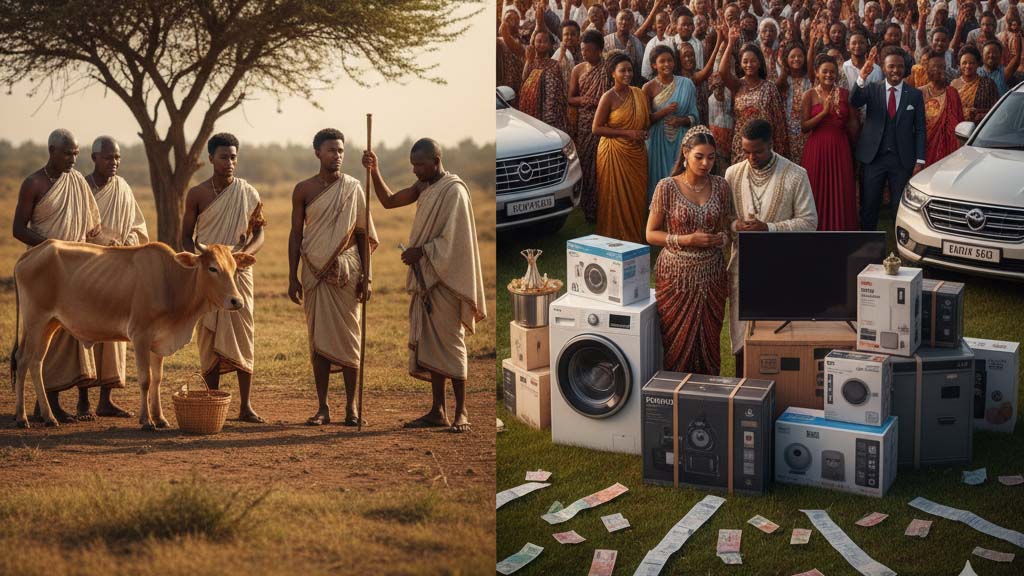
Kucela was traditionally a small family affair where three to five men and women were dispatched to accompany a young man to ask the hand of a lady in marriage. This marked the beginning of the official traditional wedding ceremony. They would bring along one cow or the equivalent in cash.
Their main aim was to obtain the hand in marriage and to establish the bride price in teams of emalobolo (lukhalo). This was basic and simple. However, today this involves an entourage which requires the bride’s family to prepare a feast for a multitude, costing more than the cow.
Lobola ceremony now expensive
The lobola ceremony has become more elaborate, not only for the groom’s family, who bring the cattle, but also for the bride’s family. Families are demanding any number of cattle when traditionally there was a standard, based on traditional principles and the royal households. The full lobola celebrations, lasting the entire weekend, are simply too costly. Traditionally, it was done this way, but today this ceremony requires no small tents, but serious marquees. The expenses start with the purchase of special emahiya for both Saturday and Sunday festivities. Why do we need to differentiate emahiya from the same family? Why new emahiya for every event within the same family?
The three-day event is catered for by the bride’s family and this requires upfront money, because the lobola itself might not be enough, given that they are not forced to bring all the cattle then. The groom’s family still has to provide blankets, kumbatsisa bomake. Again, the ceremony is beautiful, no doubt, but just too expensive for the new family. At traditional events, everyone is welcome, no invitations.
Christian wedding follows
The Christian wedding follows with its own expenses. Everyone knows just how expensive weddings these days are. In many cases, the bride’s family foots most of the bill. The groom’s family will pay for most of their side, but the bride’s family considers this their day. In many cases, the bride herself has had to take up a huge loan to assist the family, who themselves have to get money from somewhere.
Umtsimba ceremony
The umtsimba festivities are even more elaborate than the wedding and the emalobola ceremonies at times. This time, the groom’s family is hosting the bride’s family at their home. The groom cannot sit by and hope his parents will pay for the ceremony. He has to put together money to cater for this event. This is assuming he has finished paying for his lobola cattle loan.
We then get the umhlambiso gifts for the groom’s family. Gone are the days of simple blankets, dishes, imitsanyelo and small items. People now gift bedroom suites, kitchen appliances like stoves, dishwashers, washing machines and many expensive items. Again, it’s great for those families that can afford it, without excessive loans. However, the precedence is a deterrent to those who cannot afford.
Young men cannot afford to get married.
At an afternoon discussion with a group of young men, I was told in no uncertain terms that most young men cannot afford to get married, particularly if they don’t have rich parents. Marriage has been made too expensive, and the expectations from the young ladies are that the cheaper options like kuteka or getting married at the District Commissioner’s office (DC) are just not acceptable to the ladies. For some ladies, it’s actually an insult.
High rate of early divorce
The high rate of divorce has a lot to do with the start of the marriage. These marriages are starting on the wrong footing of debt, which puts a great deal of stress on a filled situation. We then all complain and wonder why such high rates of divorce, but we forget that we were happy to go through all those ceremonies and festivities at the expense of young couples.
The simple fact that young men are just not interested in marriage is not good for the country. The ladies are now even willing to pay for most of the expenses just to have a husband. This hurts the marriage going forward because the women always remind the men of this reality at some point. Comment: septembereswatini@gmail.com

















Leave a comment