

A few weeks ago, I received a text from one of the country’s ambassadors with a brief caution that his social media accounts had been ‘hacked’. A few days later, I received a WhasApp message under the ambassador’s name and number requesting that I urgently assist him send E5 000 to a relative of his as he was currently experiencing challenges. My forefinger had the greatest of pleasure in pressing the delete button.
This is just one of a thousand methods used by fraudsters in manipulating the advancements of technology to get rich, while condemning the gullible consumers to poverty. There is no disputing that technology has transformed life in Eswatini for the better. From mobile banking that allows a vegetable vendor at Manzini Market to receive payments without carrying wads of cash, to online learning platforms that keep students connected during disruptions, as well as digital communication tools that link families separated by distance.
However, while the law-abiding majority is busy reaping these benefits, criminal elements are racing ahead and exploiting the very loopholes that regulators and educators have been too slow to close.
The court reports from recent weeks suggest that the situation is getting worse and needs urgent attention. It requires an unprecedented massive nationwide awareness and education drive.
Take the case of the 25-year-old Mbadlane woman fined E9 000 for posting a man’s image on social media without his consent. She pleaded guilty to breaching the Computer Crime and Cybercrime Act No.6 of 2022. Her actions exposed the victim to cyberbullying, ridicule and reputational harm, all because she decided to weaponise a smartphone.
Police acted swiftly and made an arrest on the same day the matter was reported. However, this is one in a million. If every person who shared another’s private information without consent faced the dock, would our magistrates courts have room for any other business? Of course, not.
In another case this week, Sifiso Kunene, 25, of Kabhudla, who is the latest in the alleged ‘facata scam’ to appear in court, stands accused of running a cyber fraud and money laundering scheme that allegedly snared 25 victims to the tune of E459 552. Between August 2025 and April 2026, he is said to have posed as a bank official, convincing victims their accounts had been hacked, then walking away with their credentials and their cash.
Then there is the MTN Eswatini case – two former employees of a third-party service provider accused of siphoning over E10.2 million in airtime stock between January 2024 and January 2026.
Most alarming of all, we have been reporting on the transnational online gambling and fraud syndicate dismantled just weeks ago, with dozens of foreign nationals from mainland China and other Asian countries, arrested across the country.
The National Commissioner, Vusi Manoma Masango, has revealed that Eswatini was being used as a theatre of operation for sophisticated ‘pig-butchering’ scams, where victims are groomed over time before being defrauded.
Three of those arrested are on international red notices. They are wanted persons. And they were operating from Eswatini. All of these incidents prompt an uncomfortable question: Just how effective is the country’s education on online crime?
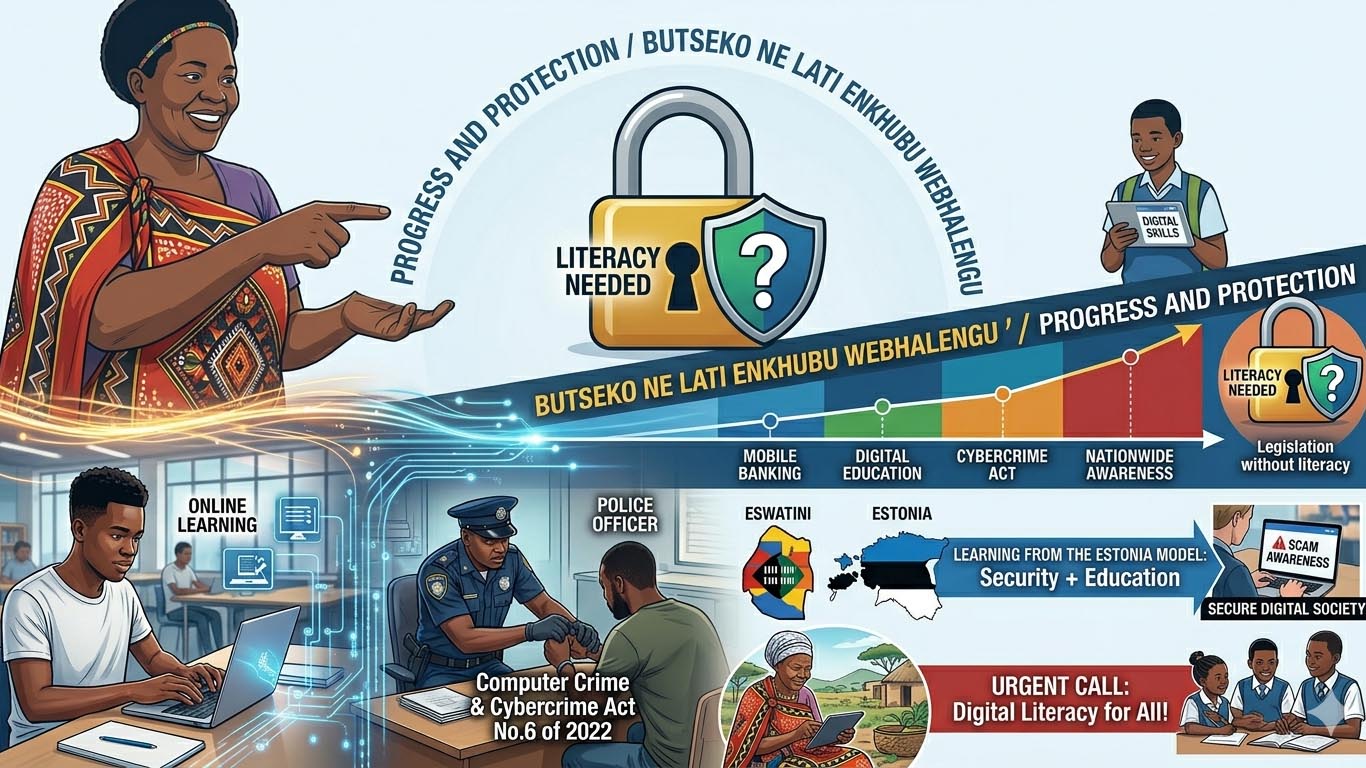
The Computer Crime and Cybercrime Act of 2022 is a fine piece of legislation on paper. However, legislation without literacy is a padlock without a door.
Every week, emaSwati receive scam messages promising lottery winnings, fake job offers and urgent requests to ‘verify’ banking details. Too many still click. Too many still share. The criminals understand human psychology better than the average citizen understands digital hygiene.
It is evident beyond doubt that we need more nationwide campaigns in siSwati and English that reach grandmothers in rural areas and young professionals in towns equally. We need a mandatory digital literacy curriculum in our schools.
The country has recently been grappling with a debate about a memorandum of understanding with Google and its possible threats to data sovereignty. There is vigorous political determination to ensure that any agreement protects emaSwati from exploitation by a global technology giant.
That vigilance is welcome. However, here is the uncomfortable truth: Every citizen who has ever opened a bank account, registered a SIM card or signed up for a mobile money service has entered into more than just an MoU but a binding contract.
Every time they tap or sign ‘I agree’ without reading the terms, they are trusting the provider to protect their data as well as committing themselves to play their part. Signing is one thing; fully understanding the fine print is another.
We need to look at how countries like Estonia, a small nation of our size in population with about 1.3 million people, has built one of the world’s most advanced and secure digital societies. Estonians vote online. Their health records are digital. They start companies in 18 minutes.
Most importantly, their rate of cybercrime victimisation is reportedly very low, not because criminals are not trying, but because the system is designed with security as the foundation of the technological advancement, not an afterthought. Estonia was among the first to embrace the Budapest Convention on Cybercrime and ranks among the top 10 countries in the Global Cybersecurity Index and the National Cyber Security Index (NCSI).
According to the National Cyber Security Index, Estonia holds an NCSI score of 96.67, ranking third globally and second on the Global Cybersecurity Index.Eswatini need not copy Estonia’s model exactly. Instead, we can learn from its principle that technology adoption and citizen protection must advance together, not one lagging dangerously behind the other to the detriment of our people. We do appreciate the cyber security awareness drives in the country, but they are few and far between. The damage that this crime is doing to our society requires that no cost be spared in ensuring that education and awareness is carried out every day through every media platform available.



















Leave a comment