

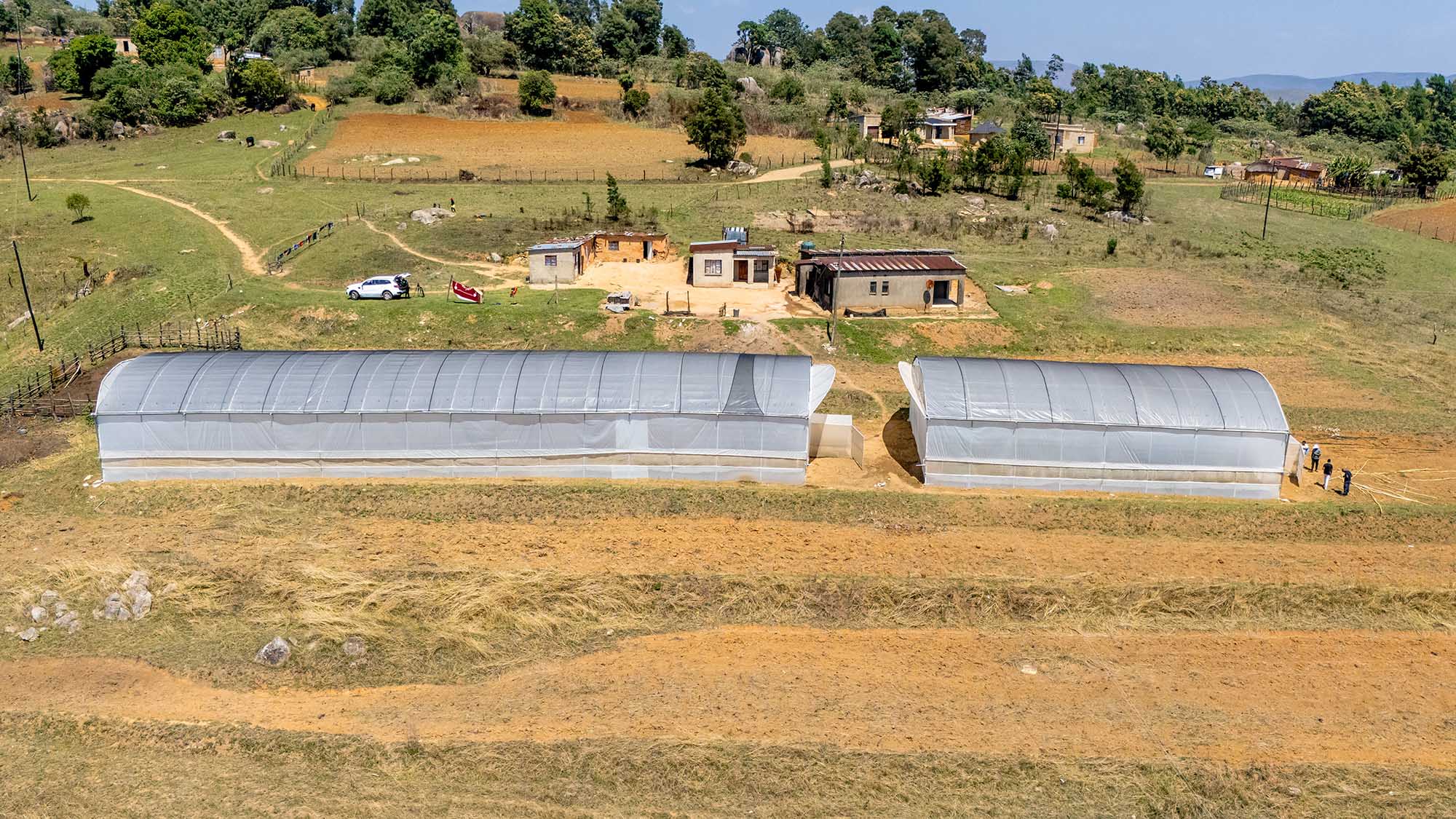
A new wave of innovation has taken root across Eswatini’s agricultural landscape as the Food and Agriculture Organisation of the United Nations (FAO), in partnership with the Ministry of Agriculture and the United Nations Development Programme (UNDP), continues to empower young farmers through shade net-farming technology. The project is under the ‘Promoting the adoption and upscaling of innovative and nature-based horticultural production for improved resilience to climate change in Eswatini’. This project aims to contribute to a more efficient and sustainable food system in Eswatini by promoting the adoption and upscaling innovative and nature based horticultural production for improved food security and resilience to climate change.
To date, 12 greenhouse tunnels (30m x 10m) have been constructed for three farmer groups (55 youth farmers), UNESWA and Taiwan Technical mission to support skills development, training and production of high value crops have been completed early this year. Youth groups are: Frosti Fresh at Hawane (4), Manga Manga Multipurpose Co-operative at Nkhaba (2) and Kukhanya Vegetable Association at Nzongomane (2), University of Eswatini, Luyengo Campus (2) and Taiwan Technical Mission (2). The project has further supported youth smallholders with 32 shade net structures and FAO received complementary support to the project from UNDP.
FAO focuses on empowering young men and women in rural Eswatini to participate in the export of baby vegetables value chain under the One Country One Priority Product (OCOP) initiative. The support from FAO is valued at US$1 million (E18.1 million).
UNDP provided complementary support under the Eswatini Youth Empowerment Programme (EYEP) – a Government of Eswatini initiative funded by the Ministry of Economic Planning and Development. EYEP aims to create sustainable jobs and livelihoods for young people across the country, directly addressing the challenge of youth unemployment.
Production
Under EYEP, FAO received US$200 000 (E3.4 million) to support 12 youth groups, a total of 127 individuals, engaged in high-value horticulture production. The project focuses on baby vegetables such as patty pans, green beans, baby marrow and peas, cultivated under protected farming systems. To date, 11 shade nets (each measuring 2 000m²) and one 3 000m² greenhouse tunnel have been installed nationwide.
The project aims to improve the resilience and profitability of baby vegetable production, helping emaSwati farmers adapt to climate change while opening new income opportunities.
Under this project, 32 youth farmer groups have each been equipped with 2 000 square-metre shade net structures. At Nhlambeni, Njelu Youth in Action have been supported with solar-powered irrigation systems and fencing from UNDP and World Food Programme (WFP) respectively. This protected cultivation approach shields crops from harsh weather, pests and diseases, common challenges that have long reduced yields for smallholder farmers.
“As a specialised agency of the United Nations, FAO is responsible for providing technical assistance to small-scale farmers, value chain actors and governments, especially in the context of climate change,” said FAO Sub-Regional Agrofood Systems Investment Specialist, Cuthbert Kambanje.
From struggle to success
For many farmers, the impact has been life changing.
A smallholder farmer Temalangeni Dlamini from Manga Manga Multipurpose Co-operative shared how the innovation turned her fortunes around: “One of the many challenges I faced in my area was that it was extremely cold, which would dry out the vegetables.
My tomatoes used to be affected by early blight, but now with this structure, they are completely free of it. Since I now earn a better profit, I’ve even been able to return to school and continue my education.”
At Luve, Farmer Margaret Mhlanga from Bancobi Support Group expressed relief at finally seeing her crops thrive: “We plant a variety of vegetables, but they were often damaged by heavy winds. Now, with the shade net, we are truly grateful. It gives us hope that our harvests will finally be secure. We can now say goodbye to poverty because we are confident that whatever we plant will thrive.”
Farmer Celumusa Mhlanga from Likusasa Foundation at Nhlambeni echoed the same sentiment: “The birds used to eat our green peppers and sunburn reduced our harvest by up to 50 per cent. With this technology, our yields are protected.”
Meanwhile, Bandile Marrime, from Marrime Farms, also from Luve, noted that the new system protects crops from hail and extreme weather. “In the past, hail destroyed most of our crops.
“This technology not only secures our produce, but also promotes entrepreneurship. It’s increasing our income as a business.”


















Leave a comment