

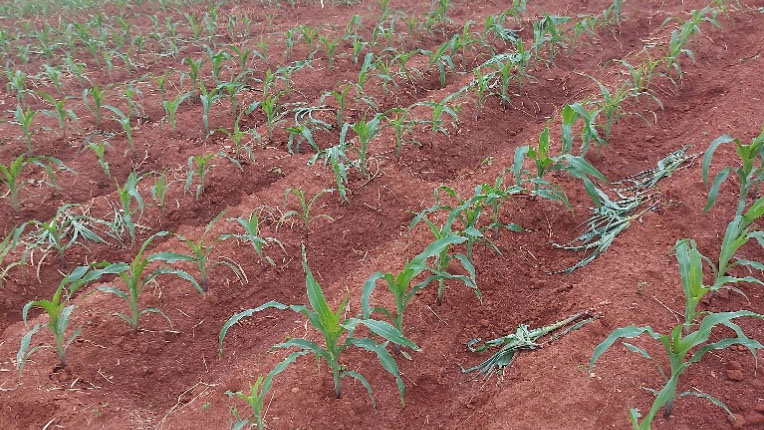
In-field water harvesting refers to simple, low-cost farming practices that capture, store and retain rainwater within croplands.
“Instead of allowing rainfall to run off the field, these techniques ensure that more water infiltrates the soil, remains around the root zone and supports crop growth throughout the season.
For maize production, in-field water harvesting focuses on reducing water losses, improving soil moisture availability and enhancing plant resilience during dry spells and drought periods,” mentions Soil Science and Plant Nutrition Research Officer at the Department of Agricultural Research and Specialist Services in the Ministry of Agriculture Bongani Mvubu.
Why is in-field water harvesting done?
To increase soil moisture for maize growth: Rainwater captured and stored in the soil provides a stable water supply for the crop, improving germination, emergence, tillering, cob formation and grain filling.
To reduce runoff and soil erosion: Practices such as tied ridges protect topsoil, reduce nutrient loss and maintain soil structure key for high maize yields.
To improve fertiliser use efficiency: With more water infiltrating the root zone, nitrogen, phosphorus and potassium are better utilised by maize plants.
To improve drought resilience: In-field water harvesting acts as insurance against mid-season dry spells, which often cause severe yield losses in maize.
To maximise yields in both good and poor rainfall seasons: By ensuring water is used efficiently, farmers can push yields upward even in marginal rainfall zones.
How is in-field water harvesting done?
Several practical methods are suitable for different environments and slope conditions. These techniques can be used individually or in combination.
Conservation tillage (minimum or reduced tillage)
- Maintain crop residues as mulch.
- Use ripping or shallow ploughing instead of deep mouldboard ploughing.
- Reduces evaporation and increases infiltration.
How it works: Mulch slows down runoff, reduces soil crusting and keeps the soil moist.
- Planting basins (Zai/Planting Pits)
- Dig pits 15–20cm deep and 15–20cm wide.
- Spacing commonly 75cm × 60 cm or according to seed rate.
- Apply manure or fertiliser in the basin.
- Plant maize in the basins.
Benefits: Basins concentrate both water and nutrients around each plant, improving establishment and survival.
Tied ridges (cross-tied ridges)
- Create ridges 60–90cm apart along the contour.
- Add cross-ties (small bunds) every 1–1.5m to form ‘mini-dams’.
- Prevents runoff and holds water between ridges.
- Best for: Low to medium rainfall areas (400–800mm annual rainfall) and sloping fields.
- Contour farming and grassed strips
- Plough, plant and cultivate along the contour lines.
- Establish grass or vetiver strips to reduce runoff velocity.
- Benefit: Reduces erosion and improves infiltration throughout the field.
Mulching and cover crops
- Use crop residues, grass or legume cover crops.
- Reduce evaporation and improve infiltration.
- Additional benefit: Adds organic matter to improve soil structure, water-holding capacity and suppresses weeds.
Deep placement of manure or organic matter
- Mix manure into planting basins or ridges.
- Improves soil structure, porosity and moisture retention.
How in-field water harvesting maximises maize yields
- Improved seedling emergence and uniform stand: Moist soil ensures quick and even crop emergence.
- Better nutrient uptake: Water enables dissolution and movement of soil nutrients into maize roots.
- Enhanced tolerance to dry spells: Fields retains more moisture, protecting against mid-season drought.
- Higher cob weight and grain filling: Consistent soil moisture increases kernel size and reduces abortion.
- Reduced erosion losses: Conserved topsoil maintains high fertility essential for maize.
- Better returns on fertiliser investments: More water means more efficient nutrient utilisation and better response to applied fertiliser.
In-field water harvesting is a low-cost, highly-effective strategy for improving maize yields, especially under climate variability and unreliable rainfall patterns.
Techniques such as tied ridging, planting basins, mulching, ripping, conservation tillage and contour farming help retain rainwater in the field, reduce erosion and improve soil moisture. Farmers adopting these practices consistently achieve higher, more stable yields, better drought resilience and improved use of fertilisers and inputs.


















Leave a comment