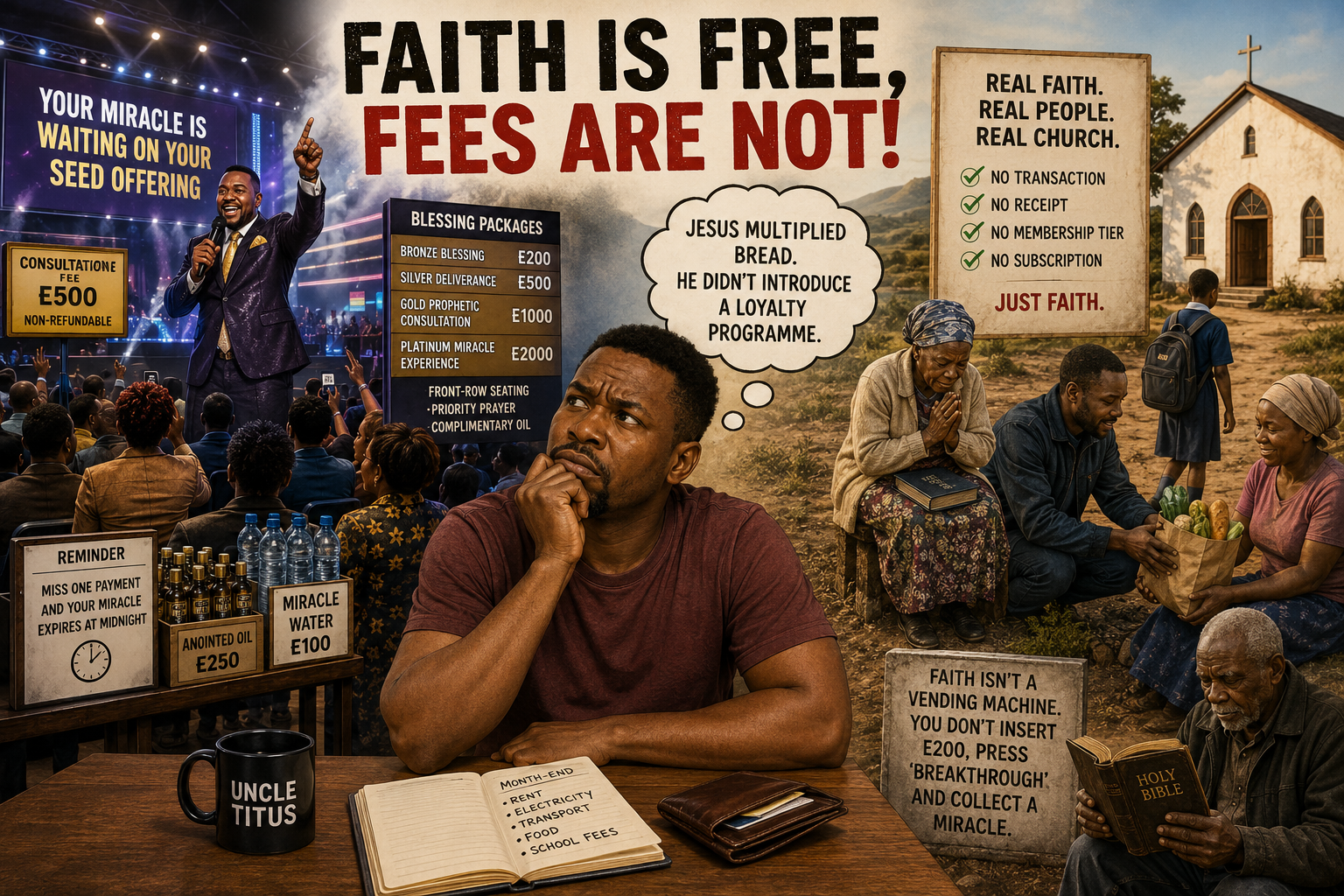
I grew up in church. Not the kind where your mother threatened to pray the stubbornness out of you, but the kind where Sunday was incomplete without a hymn, a sermon and one auntie singing so passionately in the back row that even heaven probably considered introducing a volume control.
I remain an ardent believer in spiritual well-being. At its best, the church comforts the grieving, restores broken families and reminds us that life is bigger than bank balances, egos and WhatsApp arguments.
Somewhere along the way, though, salvation started looking suspiciously like a subscription service.
I quietly drifted away when consultations began carrying non-refundable E500 price tags, miracles arrived in bottles of water with mark-ups that would make luxury retailers blush. Every blessing appeared to require a speed point. Some churches now process payments faster than municipalities process service complaints.
It is as though somebody discovered an eleventh commandment: Thou shalt never let a miracle leave the premises unpaid for.
Naturally, I took my confusion to Uncle Titus.
By now, you know Titus. Diplomat. Speaks five languages. Drinks coffee as though negotiating a peace treaty. He never tells you that you’re wrong; he simply asks questions until your argument quietly resigns. We were sitting on the verandah on Saturday afternoon when I shared my latest spiritual revelation.
“Bru,” I sighed, “I’m done with organised church. I haven’t lost my faith. I just refuse to finance it through monthly instalments. Jesus multiplied bread. He didn’t introduce a loyalty programme.”
Titus slowly lowered his mug.
“So, your breaking point wasn’t temptation, sin or the state of the world. It was olive oil?” he asked.
“It’s the principle,” I replied.
“Month-end arrives, salaries disappear before the 25th, electricity units still need buying, children still need transport money and bread doesn’t pray itself onto the table. Then someone tells a desperate family that their financial breakthrough is waiting on a seed offering.” Titus nodded. “Desperation has always been profitable. Long before influencers were selling detox teas, somebody was selling shortcuts to heaven.” I laughed. “Churches are starting to resemble mobile networks.” He raised an eyebrow.
“How?” “Think about it. Bronze Blessing Package. Silver Deliverance. Gold Prophetic Consultation. Platinum Miracle Experience. The premium package includes front-row seating, priority prayer and a complimentary bottle of anointed oil. Miss one payment and your miracle expires at midnight.”
Titus nearly spilt his coffee. “You forgot the renewal SMS.” “And the weekend promotion. Bring three friends and receive double favour,” I added.
We both laughed, but only because the joke felt uncomfortably close to reality. Drive through almost any community in Eswatini and you’ll find a church before you find a supermarket. Every weekend, buses leave for overnight crusades. Gogos wake up before dawn to board kombis in full church uniform. Prayer mountains fill with believers seeking healing, restoration and hope. Faith is alive. So why does integrity seem permanently absent? I pulled out my phone. “Bishop Zwanini Tshabalala says about 85 per cent of corruption in Eswatini is committed by Christians.” Titus adjusted his spectacles and asked: “And what percentage of emaSwati identify as Christians?” “About 90,” I said. He smiled and said: “So Christianity isn’t the problem.” “What do you mean?”I quipped. “If almost everybody claims Christianity, then the real question isn’t why Christians are corrupt.” He paused. “It’s why our Christianity isn’t making us less corrupt.” That landed harder than a fully loaded kombi hitting a speed hump in Ezulwini.
The tragedy isn’t that corrupt people attend church. The tragedy is that some have discovered church can become the easiest place to repair a damaged reputation. A businessman under investigation sponsors a church bus. Suddenly, people stop asking uncomfortable questions and start applauding generosity.
A politician who disappears during the week suddenly appears in the front pew on Sunday, lifting both hands just high enough for the cameras to notice. If an ordinary company director loses company money, shareholders demand audited accounts. Yet, when certain celebrity prophets face uncomfortable questions, accountability mysteriously becomes ‘an attack from the devil’. Meanwhile, some churches have become productions worthy of international award ceremonies. Smoke machines. LED screens. Designer suits. Merchandise tables. Wristbands. Premium seating. If Noah were building the ark today, somebody would probably sell VIP boarding passes with guaranteed window seats. Titus chuckled. “You know what’s interesting?” I quipped: “What?”
“Nobody sells bottled humility,” he said.
He had a point. This isn’t an attack on Christianity.
The real church isn’t always found behind flashing lights and giant billboards. Sometimes it’s the gogo in Nhlangano who wakes before sunrise every morning to pray over grandchildren leaving for school. Sometimes it’s the neighbour quietly paying another family’s grocery bill without posting about it online. Sometimes it’s the elderly man who walks kilometres to church carrying nothing but a worn Bible and unwavering faith. No transaction. No receipt. No membership tier. No subscription. Just faith. The problem has never been God. The problem is the growing number of people who market access to Him as though heaven operates a customer rewards programme. Faith isn’t a vending machine.
You don’t insert E200, press ‘Breakthrough’ and collect a miracle seven working days later.
Titus stood up and picked up his mug.
“Mfowethu,” he said, “people keep confusing God with everyone holding a microphone.”
He paused before walking inside.
“God never asked for your bank card.”
I looked down at my wallet. It had survived the sermon. So had my faith.