

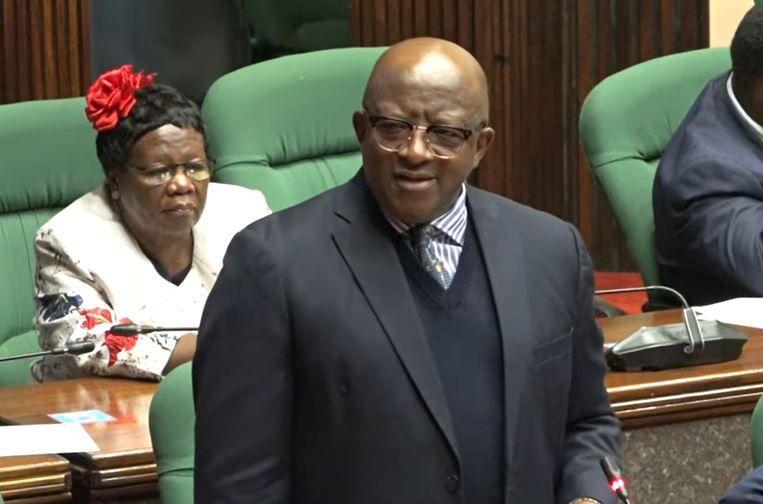
MBABANE — Members of Parliament (MPs) have passed a motion for the establishment of a fund into which levies will be collected and channelled towards the fight against serious diseases.
The motion was moved by Lobamba Lomdzala MP Marwick Khumalo and seconded by Somntongo MP Sandile Nxumalo.
It was moved that the minister for Finance, working with the minister for Health, should, within 90 days and in light of the scarcity of resources resulting from the discontinuation of technical assistance by donors for health programmes, table a Bill in the House aimed at establishing a fund into which levies to be introduced, such as a communication levy, among others, can be channelled.
The fund would exclusively prioritise diseases such as tuberculosis (TB), HIV/AIDS and cancer, which MPs said deserve special attention.
When motivating the motion, Khumalo said Parliament had previously played a role in establishing mechanisms to ring-fence funding for important national priorities.
“I will be very brief, usually so. It is this Parliament that today we have seen the Eswatini National Petroleum Company because this Parliament decided that it must work after years of being non-operational. It was this Parliament that came up with a levy, which helped create a fund. Today, a big project, the strategic oil reserve facility, is ongoing,” he said.
Khumalo also cited the establishment of the Roads Authority as another example of Parliament creating a mechanism to ensure that funds collected for a specific purpose are protected from delays in the release of money from the Consolidated Fund.
He said the country was facing a serious challenge following the withdrawal of donor funding for certain health programmes, but argued that government could explore alternative sources of financing.
Khumalo said the proposed fund could be financed through levies on sectors that had not yet been tapped, including communications.
He noted that other countries had introduced communication-related levies to support health financing and said Eswatini could explore a similar approach.
“There are communication levies that exist in other countries, where a few monies can be extracted for the creation of the fund to prioritise the diseases so that we can address the issue that we are faced with,” he said.
He urged the minister for Finance to engage his ministry’s technical teams, assess possible sources of revenue and determine the appropriate levies before bringing the Bill before Parliament.
Khumalo said the urgency of the matter was underscored by uncertainty over future donor support, particularly following changes in the United States administration and the resulting reduction in international health assistance.
He said establishing a domestic source of funding would allow the country to take greater responsibility for financing programmes targeting major diseases.
Seconding the motion, MP Nxumalo said Parliament should consider a range of potential levies, including those linked to tobacco and alcohol products. The Somntongo MP said such sources could be considered because of the country’s efforts to combat diseases such as cancer and heart disease, while also addressing the health consequences associated with alcohol abuse. He said increasing numbers of people being diagnosed with serious diseases were placing an additional burden on the Ministry of Health, whose budget was already limited.
The proposed fund, he said, should be separate from the Consolidated Fund to ensure that money raised for health was retained for that purpose.
Nxumalo said the fund could support clinics, antiretroviral treatment, rehabilitation centres and trauma care, among other services.
He said the country had set itself the target of ending TB by 2030, but declining donor support meant that government needed to find sustainable domestic sources of funding.
LaMgabhi MP Sicelo Jele also supported the motion, saying recent HIV/AIDS statistics showed that the country could not afford to slow down its response to the epidemic.
Jele said he had attended a presentation by the National Emergency Response Council on HIV and AIDS (NERCHA), where he was presented with the latest statistics on HIV/AIDS and new infections.
He said the figures, including 4 223 new infections, were alarming and suggested that the country could no longer rely heavily on donor funding to sustain its response.
Jele said the proposed levy and establishment of a dedicated fund would assist the country in responding to the growing health burden.
Rijkenberg said while the Public Finance Management Act provides for the Minister for Finance to be responsible for public funds, initiatives relating to the health sector should be driven by the ministry responsible for health.
He, therefore, asked the mover of the motion to amend it to make it clear that the minister for Finance and the minister for Health would work together in establishing the proposed fund and determining how it would be administered.
Rijkenberg said this would ensure that the Ministry of Finance did not undertake actions that fell within the portfolio of another ministry.
“I can move to accept the motion on that condition,” Rijkenberg said.
The minister said the proposed arrangement would allow the two ministries to work together while ensuring that each remained within its respective mandate.
He explained that although the Public Finance Management Act places responsibility for public funds with the minister for Finance, expenditure and programmes relating to a particular ministry must be initiated by the minister responsible for that portfolio. In this case, Rijkenberg said, the Ministry of Health would need to identify and initiate the health-related interventions to be supported by the proposed fund, while the Ministry of Finance would deal with the financial administration and mechanisms required to make the fund operational.
Meanwhile, research by this publication reflects that the proposal for a communication levy to support health is not without precedent in the region. Zimbabwe provides an example of how a telecommunications-related levy can be structured to generate dedicated funding for health.
Zimbabwe introduced its Health Fund Levy in 2017 through legislation providing for a special excise duty on airtime.
The law sets the special excise duty at 10 per cent of the sale value of airtime, with five percentage points designated as the Health Fund Levy.
The levy is credited to a fund established under the Public Finance Management Act and is earmarked for the purchase of drugs and equipment for government, provincial, district and general hospitals.
In practical terms, this means that where the taxable sale value of airtime is US$10 (approximately E200), the 10 per cent special excise duty amounts to US$1 (approximately E20). Of that US$1, an amount equivalent to five per cent of the airtime sale value, US$0.50 (approximately E10), is designated for the Health Fund.
The arrangement therefore does not mean that an additional 10 per cent is charged specifically for health. Rather, five percentage points of the 10 per cent special excise duty on airtime is ring-fenced for the Health Fund.
The Zimbabwean model also demonstrates why a communication levy can be attractive to governments seeking a broad-based source of health financing.
Telecommunications services are widely used, allowing a relatively small charge on communication services to generate revenue from a large pool of users. The levy has also previously translated into direct health-sector financing.
In January 2018, the Zimbabwean Government released US$7.6 million to the Health Development Fund for the purchase of essential medicines and equipment for government health institutions.
UNICEF reported that the government contribution came from the Health Fund Levy, with five per cent of the duty charged on airtime ring-fenced for improving access to healthcare.
The funds were channelled through the Health Development Fund, a pooled financing mechanism supporting Zimbabwe’s health sector. UNICEF said the money was used to purchase essential medicines and equipment, with procurement supported through its systems and supplies distributed through Zimbabwe’s National Pharmaceutical Company.
The Zimbabwean example also illustrates the principle behind the motion passed by Eswatini’s Parliament: Rather than relying entirely on allocations from the national budget or external donors, government can create a dedicated revenue stream linked to a specific public need.
However, experts warn that a communication levy would need to be carefully designed to determine who is liable for the levy, whether it applies to airtime, data or other telecommunications services, how much would be charged, who would collect it and, most importantly, how the money would be ring-fenced and accounted for.












Leave a comment