

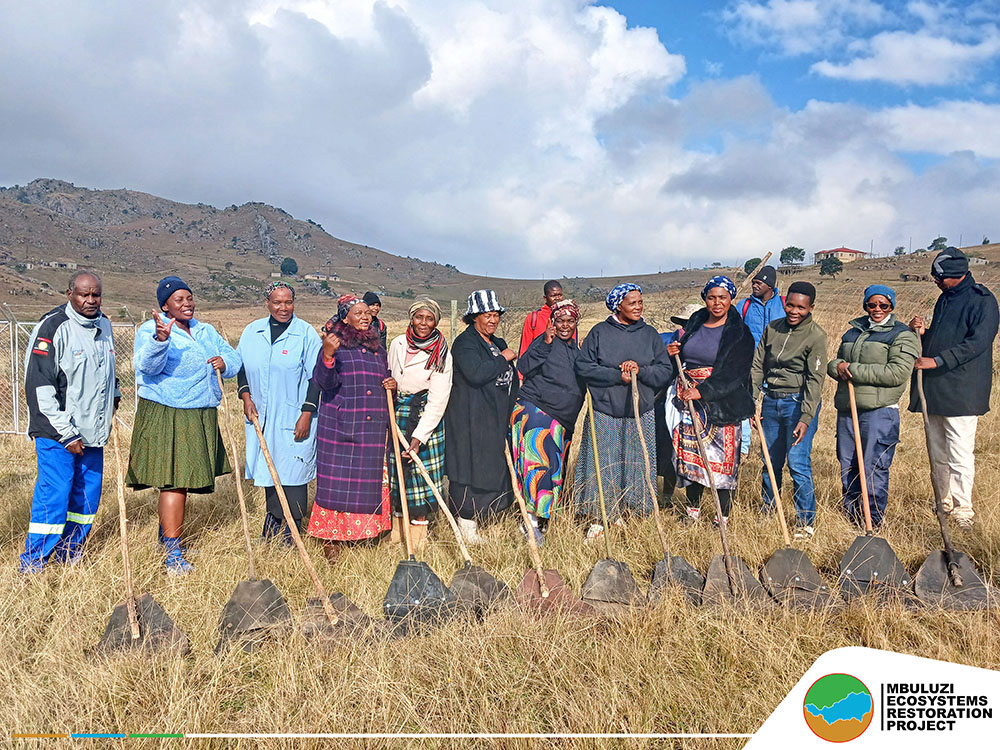
For farmers in the Mbuluzi River Basin, a Farmer Field School is more than a place to grow crops. Challenges such as water scarcity, declining soil quality and changing weather patterns require farmers to learn, experiment and find practical ways of responding to them.
This is the approach being advanced through the Mbuluzi Ecosystems Restoration Project (MERP), executed by the Eswatini National Trust Commission (ENTC), implemented by the United Nations Environment Programme (UNEP) and funded by the Global Environment Facility (GEF). Through Farmer Field Schools, MERP is bringing sustainable land management practices out of manuals and into farmers’ fields, where they can be tested and adapted to local conditions.
At Dvokolwako, farmers are already seeing how better water management can support crop production. A drip irrigation system supplied by a 5 000-litre storage tank, filtration unit and drip lines has been established at the demonstration site. About 0.6 hectares have been planted with carrots, with mulch used to retain moisture in the soil.
For farmers, the demonstration provides an opportunity to see the difference that simple changes in farming practices can make. Instead of simply being told about efficient irrigation, they can see where the water goes, how it reaches the crop and how practices such as mulching can help reduce water loss.
SYSTEM
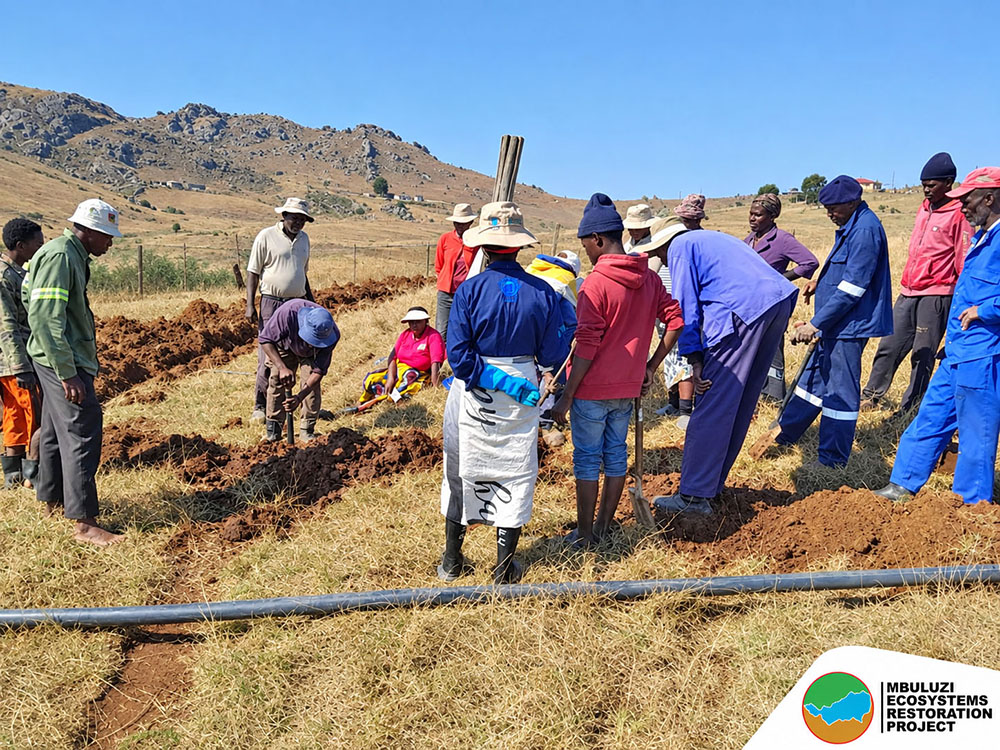
At Hawane, Nkhaba, MERP is taking this learning further through the development of a gravity-fed irrigation system for the Hawane-Eyethu Farmer Field School, in collaboration with the Ministry of Agriculture. The system will support approximately 0.85 hectares and draw water from a small perennial stream through a concrete diversion weir. Water will then be conveyed through about 1.2 kilometres of 75mm HDPE supply pipe to three 10 000-litre storage tanks before being distributed through a drip irrigation network.
The infrastructure is important, but its greatest value lies in what farmers will be able to learn from it. The Hawane site is designed as a demonstration and learning platform, showing farmers how water can be used more efficiently while maintaining crop production.
Nxumalo, Irrigation Engineer at the Ministry of Agriculture, explains: “The restoration of the Mbuluzi Ecosystem demands a shift from consumptive water use to productive water stewardship. Through the practical training provided in our Farmer Field Schools, we are showcasing that efficient irrigation technology is the most powerful tool for climate adaptation.”
This is one of the ways MERP is helping farmers connect ecosystem restoration with their everyday livelihoods. The project is not only restoring land and improving water management; it is creating spaces where farmers can learn practices that they can apply on their own farms.
The results are therefore not measured only by the crops harvested from the demonstration plots. They are also reflected in the knowledge, confidence and practical skills farmers take home with them. For the farmers participating in these schools, the real impact is the opportunity to learn by doing and to see that protecting natural resources and improving agricultural production can go hand in hand.
















Leave a comment