

BY BONGANI MVUBU
ACROSS the Kingdom of Eswatini, from the cool slopes of the Highveld to the moisture-stressed plains of the Lowveld, farmers face an increasingly unpredictable climate. Erratic rainfall, sudden dry spells and intense heatwaves mean that traditional farming methods alone can no longer guarantee food security.
To safeguard the national grain basket and secure household livelihoods, local producers must embrace a three-pillar survival strategy: harvesting every drop of water, building resilient soil and diversifying field crops.
As meteorologists issue firm warnings over the developing ‘Super El Niño’ phenomenon, local farmers across all four regions of the Kingdom of Eswatini are being urged to pivot immediately towards climate-smart resilience. With sea-surface temperatures rising in the Pacific and rainfall projected to be erratic and below normal, relying on conventional rain-fed farming alone is no longer an option.
The upcoming season will test our agricultural systems, but proactive adaptation through water harvesting and crop diversification can mean the difference between a total harvest failure and a resilient, profitable yield.
Here is a practical roadmap for smallholder and commercial farmers to turn climate risk into agricultural resilience this season.
PILLAR 1 — Collect every drop: Water harvesting at all levels
In times of rainfall scarcity, water is far too valuable to be allowed to wash away as surface runoff. Farmers must capture, channel and store water from every available source during rainfall events.
Rooftop rainwater capture
- Gutter and tank systems: Ensure all roof gutters on homesteads, livestock sheds and storage structures are clear of debris. Direct downspouts straight into plastic tanks or lined masonry storage cisterns.
- First-flush diverters: Install simple PVC diversion pipes to flush out the initial dirty roof runoff, ensuring clean water is retained for livestock and household food gardens.
In-field and conservation structures
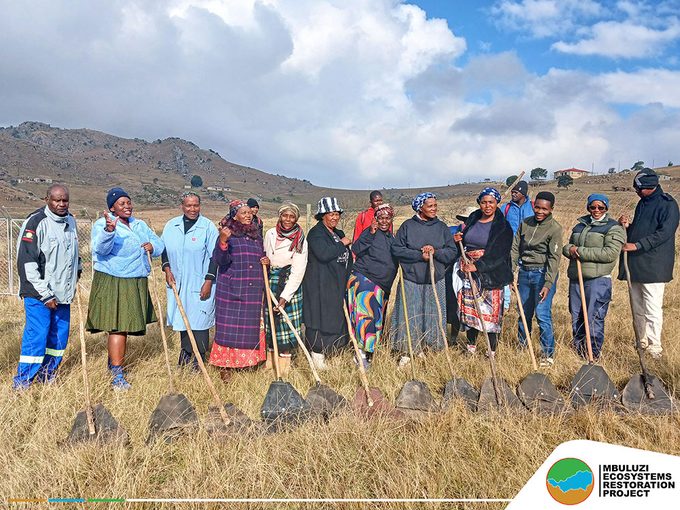
- In-field planting basins: Instead of ploughing entire fields (which causes rapid soil moisture evaporation), dig micro-basins or contours. These small basins catch and hold rainwater directly around the plant root system.
- Contour ridges: Dig contour trenches across slopes to slow down runoff, allowing water time to sink into the soil profile rather than eroding topsoil. Plant deep-rooted vetiver grass along contours to anchor the soil.
- Mulching: Keep fields covered with organic crop residue, dry grass, leaf litter, sawdust or compost and plastic mulch. A thick layer of mulch reduces soil moisture evaporation by up to 70 per cent.
Road runoff and runoff harvesting
- Road-ditch traps: Water flowing off roads and access tracks carries high volumes during storms. Dig divert channels leading from roadside ditches into on-farm storage ponds or percolation pits (check dams).
- Earth ponds and swales: Construct simple, plastic-lined or clay-compacted earth dams at low points on your land to capture overland flow.
Flooded rivers and streams
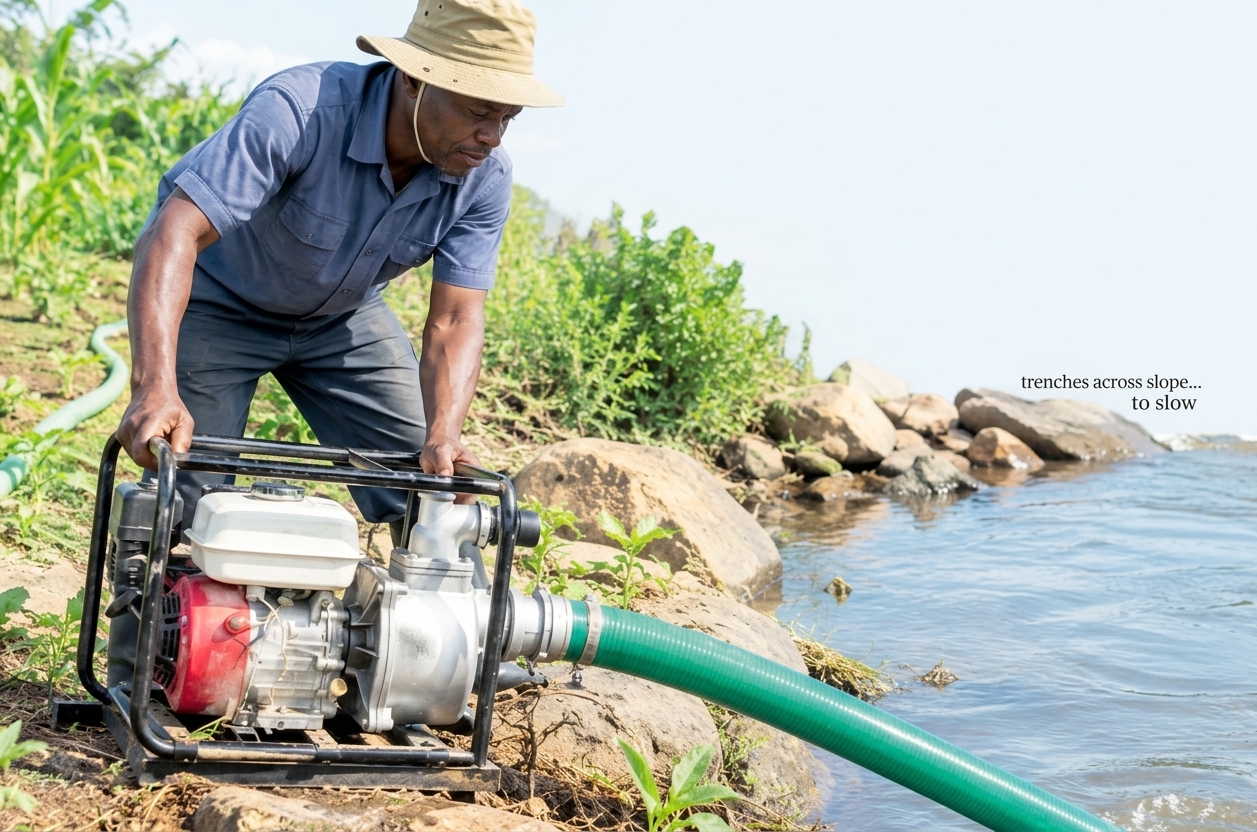
- Pumping to off-stream storage: During brief periods when local rivers swell, use portable solar or diesel pumps to transfer floodwaters into secure, elevated farm dams or storage bladders before levels drop.
- Sand dams: For farmers along seasonal rivers (spruits), building low-cost concrete or stone sand dams holds water behind accumulated river sand long after the surface stream dries up.
PILLAR 2 — Protect your soil: Keeping moisture and nutrients in place
Water capture is only half the battle; the other half is keeping moisture in the soil where crop roots need it. Unprotected soil bakes under the sun, loses organic matter and repels water.
- Apply organic mulch: Cover exposed soil between rows with dry grass, crop stalks or leaf litter. A 5–10cm layer of mulch lowers soil temperatures and cuts evaporation losses by up to 70 per cent.
- Practice minimum tillage: Avoid deep ploughing. Tilling shatters the soil structure, accelerates evaporation and exposes vital soil organisms to heat. Minimal soil disturbance preserves natural capillary channels that absorb rainwater.
- Anchor with vetiver grass: Plant rows of deep-rooted vetiver grass along contour lines. Vetiver forms a dense hedge that filters sediment, prevents gullying and anchors fragile topsoil during sudden downpours.
PILLAR 3 — Diversify your fields: Spread your climate risk
White maize remains a national staple, but during severe dry spells, monoculture maize fields bear the brunt of severe heat stress. Diversifying your fields spreads climate risk across multiple hardy crop varieties.
- Drought-tolerant grains: Plant at least 40–50 per cent of your grain acreage with sorghum (Mabele) or pearl millet. These grains can suspend growth during dry spells and recover when moisture returns, unlike maize.
- Legumes for soil fertility: Intercrop or rotate with cowpeas, Bambara groundnuts (Jugobeans) or sugar beans. Legumes fix nitrogen into the soil, require minimal water and provide vital family nutrition.
- Resilient root crops: Expand plantings of cassava and orange-fleshed sweet potatoes. Cassava stores well underground for over a year and survives under extreme temperature conditions.
Crop diversification table
| Drought-hardy grains | Legumes | Roots and tubers |
| Sorghum | Cowpeas | Cassava |
| Pearl millet | Groundnuts | Sweet potato |
| Finger millet | Jugo beans | |
| Early maturing maize varieties | Pigeon pea |
Actionable steps before the first rains
- Clear and inspect all roof gutters, downspouts and storage tanks.
- Establish contour lines and dig road-runoff diversion channels before the rains begin.
- Collect and store organic mulching material across your homestead.
- Source certified, early-maturing and drought-hardy seed from local agricultural suppliers.
We cannot control the weather, but we can control our level of preparation. Collect every drop, protect your soil, and diversify your fields to safeguard your family’s harvest.

















Leave a comment