Education has once again taken centre stage in our national discourse. Gathered at the National Education Indaba and Joint Education Sector Review, stakeholders, policymakers and frontline educators have been confronting uncomfortable realities. From the Ministry of Education and Training pushing forward with curriculum reforms and the National Curriculum Centre embedding Competency-Based Education (CBE), to delegates assessing the rollout of the Eswatini Qualifications Framework (ESQF), education policy is driving fierce public debate.
Education is naturally a hotly contested space and it should come as no surprise that these structural shifts produce heated discussion. But one fundamental truth on which we can all agree is our collective desire to ensure high and rising standards in our national education system. Whether we are discussing the ambitious promises of CBE, moving away from traditional rote learning towards practical skill acquisition, critical thinking and real-world application or evaluating national examination results, ‘raising standards’ remains our common rallying cry.
But what do we actually mean when we talk about ‘standards’? We need to be crystal clear about that every time we use the term, both to guide the practical focus of educational policy and to avoid slipping into political posturing or empty slogans.
Standards broadly refer to a comparative level of quality. Fundamentally, educational standards concern outcomes for young people, arising from educational inputs. If we as a nation invest in providing young people with high-quality knowledge, practical competencies and skills, we must examine how many of them successfully gain these assets, as indicated by national qualifications, assessment metrics and post-school destination data.
However, standards also relate to the instruments of measurement and their application. An increasing number of young people passing an exam does not automatically equate to rising standards; it can simply indicate grade inflation or lowered benchmarks. It is the job of our national bodies, such as the Examinations Council of Eswatini, alongside our curriculum regulators, to ensure that national examinations and competency assessments genuinely reflect our young people’s true knowledge, skills and understanding.
This distinction was also emphasised sharply at the Education Sector Review by ECESWA’s Dr Sifiso Hlanze. Presenting a 10-year analysis of examination performance, Dr Hlanze raised a critical red flag: While national pass rates appear high on paper, the quality of those results is dwindling. Passes are increasingly concentrated in lower grades, with fewer candidates achieving C or above.
When a nation records high overall pass marks yet reveals that passes are clustered around minimum benchmarks and only one in every eight candidates qualifies for tertiary education, we must pause. Passing an exam is not the same as achieving mastery. If our system churns out school-leavers who cannot cross the threshold of higher education or satisfy the demands of the labour market, high pass rates are merely a comforting illusion.
Furthermore, performance in foundational subjects like Mathematics and Science at the lower secondary level remains deeply concerning. As Minister for Education and Training Owen Nxumalo and European Union Ambassador Karsten Mecklenburg both emphasised, our education system must directly link learning to the job market and vocational training. If we intend for CBE to build a modern, technocratic economy, we cannot afford to let core scientific and mathematical competencies slip.
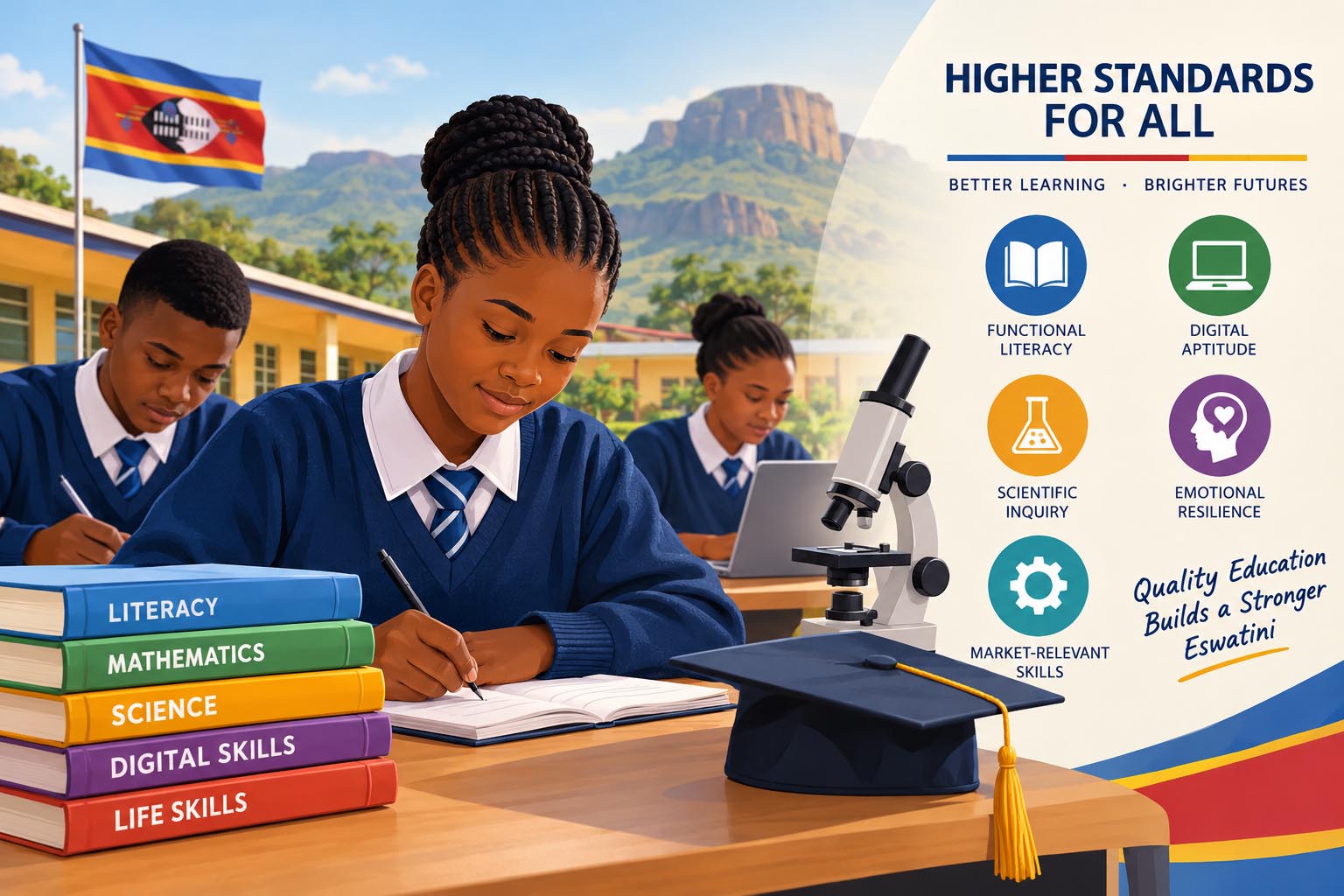
Our overriding ambition must be ‘high standards for all’. We must aim high, drive up standards for all our young people and ensure that none are left behind. As Minister Nxumalo candidly challenged educators, we need to speak openly about the uncomfortable realities confronting schools if we are to move from planning to delivery.
The stark truth is that high standards cannot exist in a vacuum. Standards are inextricably linked to equity, social protection and learner well-being. We cannot demand higher academic standards from our learners while turning a blind eye to the severe societal and systemic barriers dismantling their education.
Findings from the Ministry’s Guidance and Counselling Programme paint a troubling picture regarding learner retention. Secondary school departures linked to teenage pregnancy surged by 39 per cent, while primary school cases more than doubled with a 105 per cent spike, bringing total pregnancy dropouts to 1 516 girls in 2025 alone. When combined with sharp rises in dropouts triggered by domestic abuse, substance misuse and bullying, it becomes clear that broader social crises are denying children their right to education. Alarmingly, the ministry has no tracking system to establish how many young mothers eventually re-enrol after childbirth. Compounding this problem are severe structural and financial deficits within the system itself. Although we expect educators to maintain high academic standards while simultaneously offering psycho-social support, the guidance and counselling sector receives no dedicated funding line and dedicated counsellor positions do not exist. Instead, teachers also shoulder counselling duties without adequate time or professional training.
If a ‘standard’ in a CBE framework implies that a learner can demonstrate functional literacy, digital aptitude, scientific inquiry, emotional resilience and market-relevant skills, then our national metrics must measure those competencies fairly and holistically. As Principal Secretary Nanikie Mnisi rightly highlighted, improving education requires practical decisions and better-equipped teachers, not turning a blind eye to fundamental bottlenecks.