MBABANE – Eswatini’s economy is facing mounting cost pressures following a 51.2 per cent increase in fuel prices since April 2026, threatening business competitiveness, household purchasing power and economic recovery.
The Ministry of Economic Planning and Development has warned that persistent increases in domestic fuel prices, against the backdrop of geopolitical tensions and disruptions to global supply chains, have significantly increased production costs, weakened export competitiveness and contributed to inflationary pressures that are constraining consumption demand.
This is contained in the ministry’s FY2026/27 Second Quarter Performance Report, which provides an assessment of the domestic and international economic environment, highlighting both the economy’s resilience and emerging vulnerabilities. The report attributes the pressure largely to the ongoing Middle East crisis, which has disrupted international supply chains and driven up prices of essential commodities, particularly crude oil.
This presents a considerable challenge for Eswatini, whose dependence on imported energy exposes businesses and consumers to international price movements.
Despite the challenging operating environment, Eswatini’s economy recorded strong growth during the second quarter of 2026.
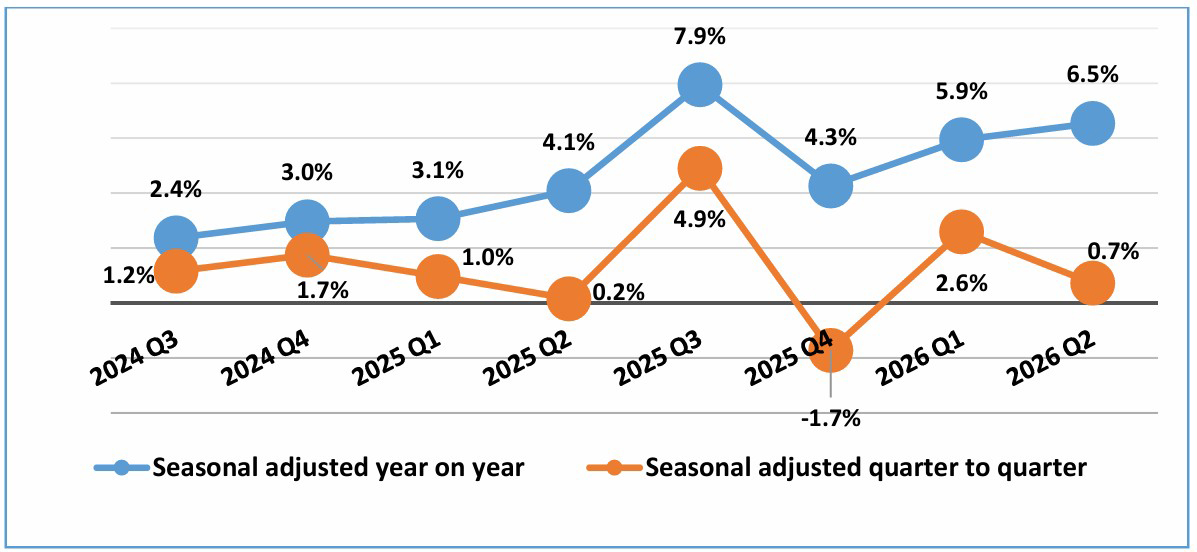
Real Gross Domestic Product (GDP) expanded by 6.5 per cent in the second quarter of 2026 compared to the corresponding period in 2025, representing an improvement from the 4.1 per cent recorded during the same period in the previous year.
The growth was broad-based, with all three major economic sectors recording positive performances.
The primary sector expanded by 9.3 per cent, supported by improvements in agriculture, forestry, mining and quarrying.
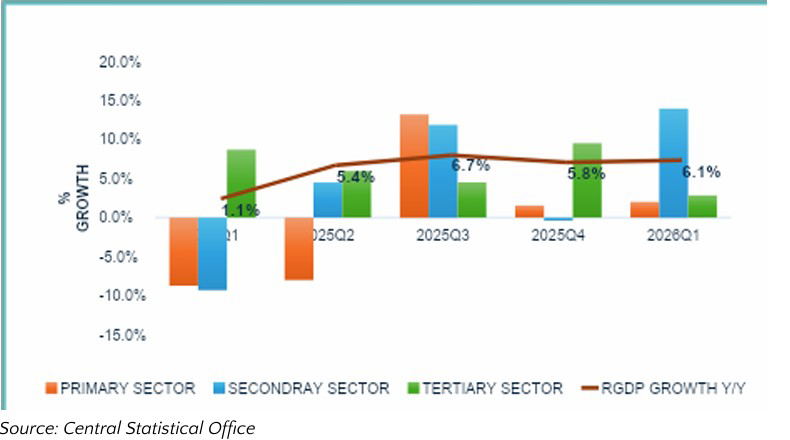
Agriculture and forestry rebounded by 5.2 per cent, reflecting improved output from crop production and forestry activities. Mining and quarrying registered an even stronger performance, expanding by 24.3 per cent, largely supported by improved external demand, particularly for coal.
The secondary or industrial sector recorded the strongest overall sectoral growth, expanding by 11.6 per cent. Manufacturing output increased by 14 per cent, while electricity supply grew by 21.8 per cent, providing considerable support to industrial activity.
However, not all components of the industrial sector performed positively. Construction contracted by 7.9 per cent, while water supply declined by 10.7 per cent.
The contraction in construction is particularly noteworthy given, the importance of infrastructure development and capital investment in stimulating economic activity, creating employment and supporting demand for local building materials and services.
Meanwhile, the tertiary or services sector expanded by 4.1 per cent.
Accommodation and food services grew by 19.6 per cent, while information, communication and technology recorded a substantial 55.6 per cent expansion. Professional services also increased by 8.1 per cent.