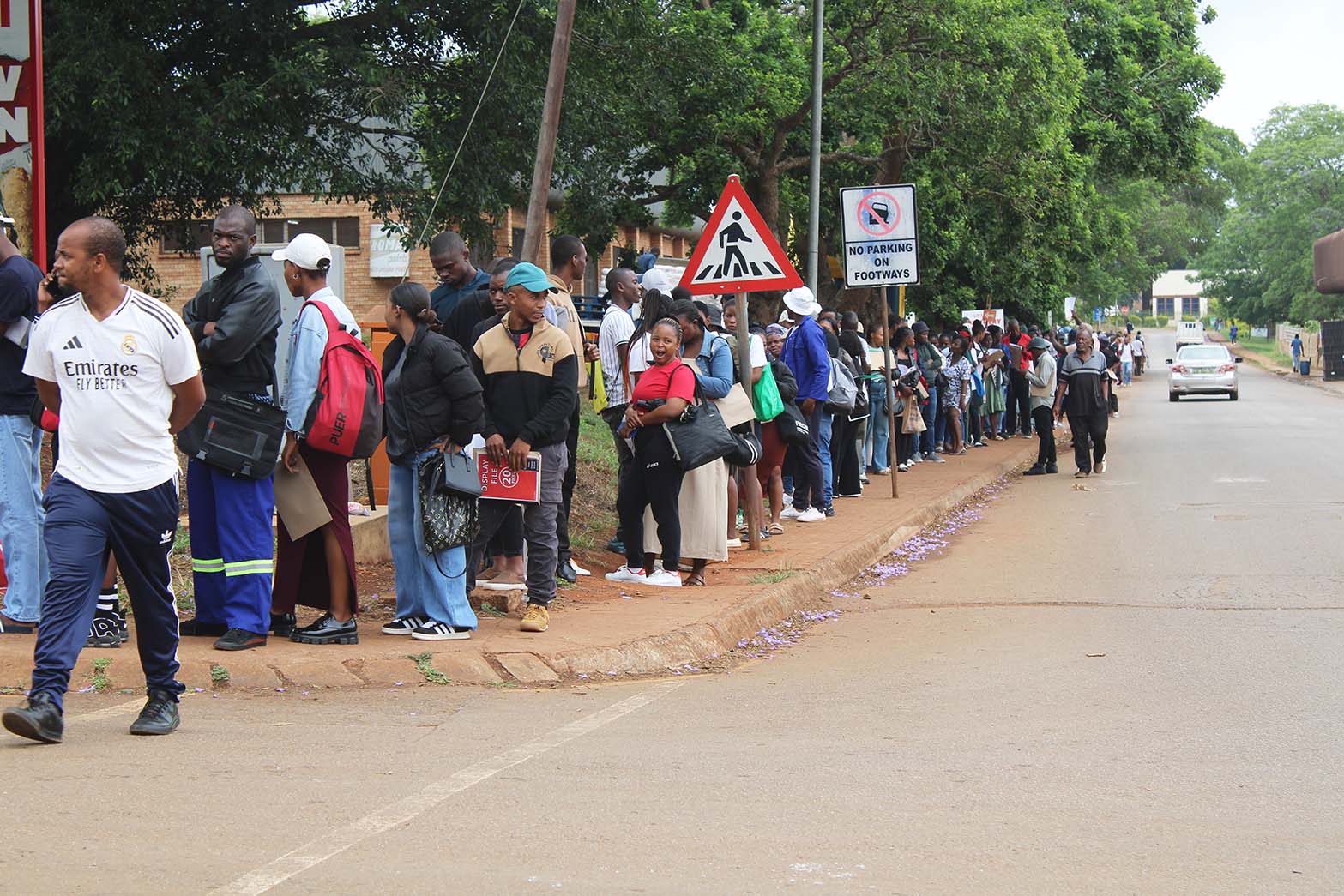
Eswatini’s youth unemployment is a leading national emergency that requires urgent action from all sectors of society.
The long, winding queues wrapping around recruitment centres across Eswatini’s four regions tell a sobering story of modern Eswatini. When over 2 000 desperate young men and women queue up in a single region to apply for a handful of advertised entry-level posts in the Royal Eswatini Police Service (REPS), it is no longer just a routine recruitment exercise. It is a visual manifestation of a national emergency.
Youth unemployment in Eswatini sits at alarmingly high levels, with recent official data and global reports estimating that over half of young emaSwati (ages 15–24) remain out of work. For a nation where young people make up the bulk of the demographic structure, this state of economic exclusion is quickly transforming from a socio-economic strain into an existential threat.
The overwhelming turnout during recruitment drives highlights three underlying realities of the Eswatini labour market:
There is a distorted demand vs supply. Thousands of university graduates, vocational certificate holders and high school leavers are competing for jobs that require basic entry qualifications. When degree holders apply for general constable positions, it signals severe underemployment and a structural mismatch between education outputs and market needs.
There is over-reliance on public sector employment. This is due to the fact that Eswatini’s private sector remains constrained by high operating costs, limited access to capital and modest regional expansion. As a result, government remains the perceived primary employer, carrying a burden it cannot sustain indefinitely.
Surveys, including data from Afrobarometer, reveal that half of young emaSwati have actively considered emigrating in search of livelihoods abroad due to dissatisfaction with local economic conditions.
Why the status quo is a ‘ticking time bomb’
Characterising youth unemployment as a ‘ticking time bomb’ is not sensationalism; it is a reality. We have recently seen thousands graduating from various institutions of higher learning, where graduates were conferred degrees and diplomas. Eswatini has in recent years expanded training institutions that have churned out graduates in various fields of study. To this end, thousands of new youths enter the workforce each year without corresponding job creation, which has heightened frustration among the youth.
This crisis results in social vulnerability where prolonged inactivity and a lack of hope in finding a job fuel substance abuse, mental health struggles and rising crime rates across urban and semi-urban centres. Tragically, some resort to suicide as they lose hope. Unfortunately, government also ends up being a loser too, as a large unemployed demographic narrows the national tax base and stifles domestic consumption, limiting broader economic growth.
Imperative for a focused national dialogue
It is clear that this problem is not just a government problem, but a national challenge that requires all sectors of society to converge in a dialogue to figure out how to navigate this national crisis. Addressing this crisis requires more than temporary public sector hiring sprees or isolated youth enterprise funds. Eswatini urgently needs an inclusive, outcome-driven National Youth Employment Dialogue bringing together government leaders, private sector representatives, civil society, academic institutions and youth delegates.
What are some key agenda issues the national dialogue should focus on?
There is a need to provide an enabling environment for the private sector to make a meaningful contribution. This entails a shift in focus from public sector absorption to creating an aggressive incentive environment for small businesses, technology startups, green energy and commercial agriculture.
We need to empower young people not only to be trained for employment, but to create jobs. We appreciate that government and partners like the European Union are investing in TVET. It is critical to intensify investment to modernise technical and vocational education (TVET) to match the skills needed in the digital economy and regional supply chains across SADC and Africa, taking advantage of the African Continental Free Trade Area.
The issue of access to finance to unleash entrepreneurship cannot be overemphasised. To this end, streamlining and scaling existing mechanisms (such as the Youth Enterprise Revolving Fund) to provide accessible capital and mentorship for young entrepreneurs without prohibitive collateral requirements is a crucial intervention.
There is a need to strengthen Public-Private Partnerships (PPPs) as the country has relevant policies in place. There is a need to institutionalise formal internship programmes and wage subsidies that would encourage private companies to onboard first-time job seekers, where they will gain some experience as well as allowances.
There is a need for coordinated economic reforms to open economic pathways for the youth to avoid the risk of squandering the country’s most valuable resource. There is a need to explore leveraging digital platforms, climate-smart agriculture and renewable energy as new avenues for economic participation for young people.