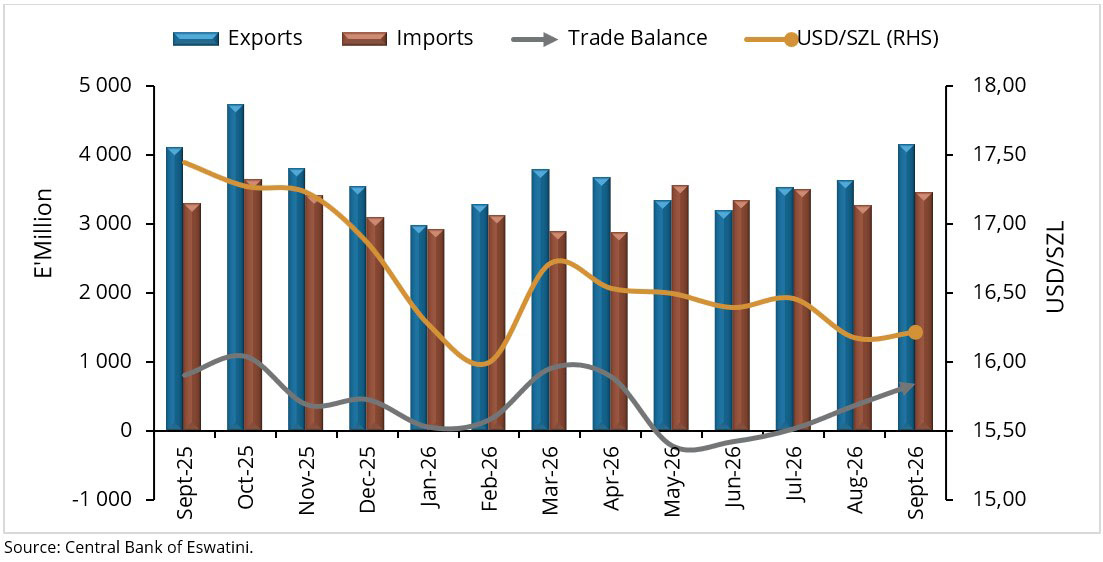
MBABANE – Eswatini’s trade surplus widened to E687.9 million in September as stronger sugar and soft drink concentrate exports outpaced rising imports.
The country’s external trade position recorded a notable improvement during the month, with the positive trade balance increasing from E372 million recorded in August 2026, representing an increase of E315.9 million.
According to the Central Bank of Eswatini’s August/September 2026 Recent Economic Developments (RED) report, the improvement was largely attributable to stronger export earnings, particularly from sugar and sugar products, which recorded a substantial increase in both monthly and annual comparisons.
Exports increased by 14.1 per cent month-on-month to E4.2 billion in September, while registering a marginal year-on-year growth of 1 per cent.
The performance was supported by higher receipts from sugar exports, alongside an improvement in exports of soft drink concentrates, which benefited from increased production.
On the other hand, imports also increased during the month, although at a slower pace than exports. They grew by 6 per cent month-on-month to E3.5 billion, representing a 5 per cent increase compared to September 2025.
When adjusted for seasonal variations, exports amounted to E3.7 billion, while imports stood at E3.4 billion, resulting in a seasonally adjusted trade surplus of E317.9 million.
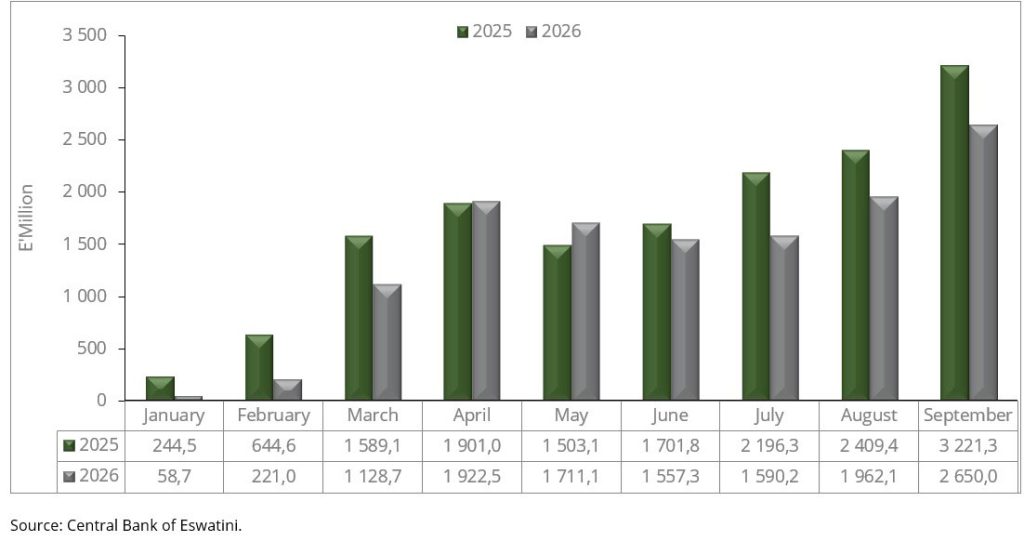
Despite the improvement recorded in September, the country’s cumulative trade performance remained weaker than that of the corresponding period last year. The Central Bank reported that the trade surplus for the January to September 2026 period stood at E2.7 billion, compared to E3.2 billion recorded during the same nine-month period in 2025.
This was against a relatively subdued performance in both exports and imports over the period under review. Cumulative exports declined marginally by 1.2 per cent year-on-year to E31.6 billion, down from E32 billion recorded between January and September 2025.
Imports, meanwhile, increased by just 0.7 per cent year-on-year to E29 billion, compared to E28.8 billion in the corresponding period last year.
A closer examination of the country’s major export commodities shows that sugar was the strongest performer in September, with earnings increasing significantly on both monthly and annual comparisons.
The Central Bank noted that the country’s four primary export commodities collectively accounted for 84 per cent of total exports during the month.
Soft drink concentrates, which remain Eswatini’s leading export product, generated E1.8 billion in September, representing a 12.2 per cent increase from the previous month.
The improvement was attributed to higher production. However, despite the monthly recovery, earnings from the commodity remained 5.7 per cent lower compared to September 2025.
Sugar and sugar products recorded an even stronger performance, with export earnings increasing by 24 per cent month-on-month to E1 billion.
Compared to the same month last year, sugar exports registered a substantial growth of 43.4 per cent, supported by stronger export volumes to most African markets.
The performance of the two commodities highlights their importance in supporting the country’s export earnings, particularly given the significant contribution they make to total merchandise exports. Meanwhile, the textile and textile apparel industry also recorded an improvement in export performance.
Exports from the sector amounted to E402.6 million in September, reflecting a notable 27.4 per cent increase month-on-month.
The Central Bank attributed this improvement largely to increased consignments of both knitted and non-knitted apparel.
On an annual basis, textile and textile apparel exports grew by 9.7 per cent, indicating an improvement compared to September 2025.
In contrast, the wood and wood articles category recorded a decline in export earnings.
Exports from the sector were valued at E272.5 million, representing a 2 per cent decrease month-on-month and a 2.8 per cent decline year-on-year.