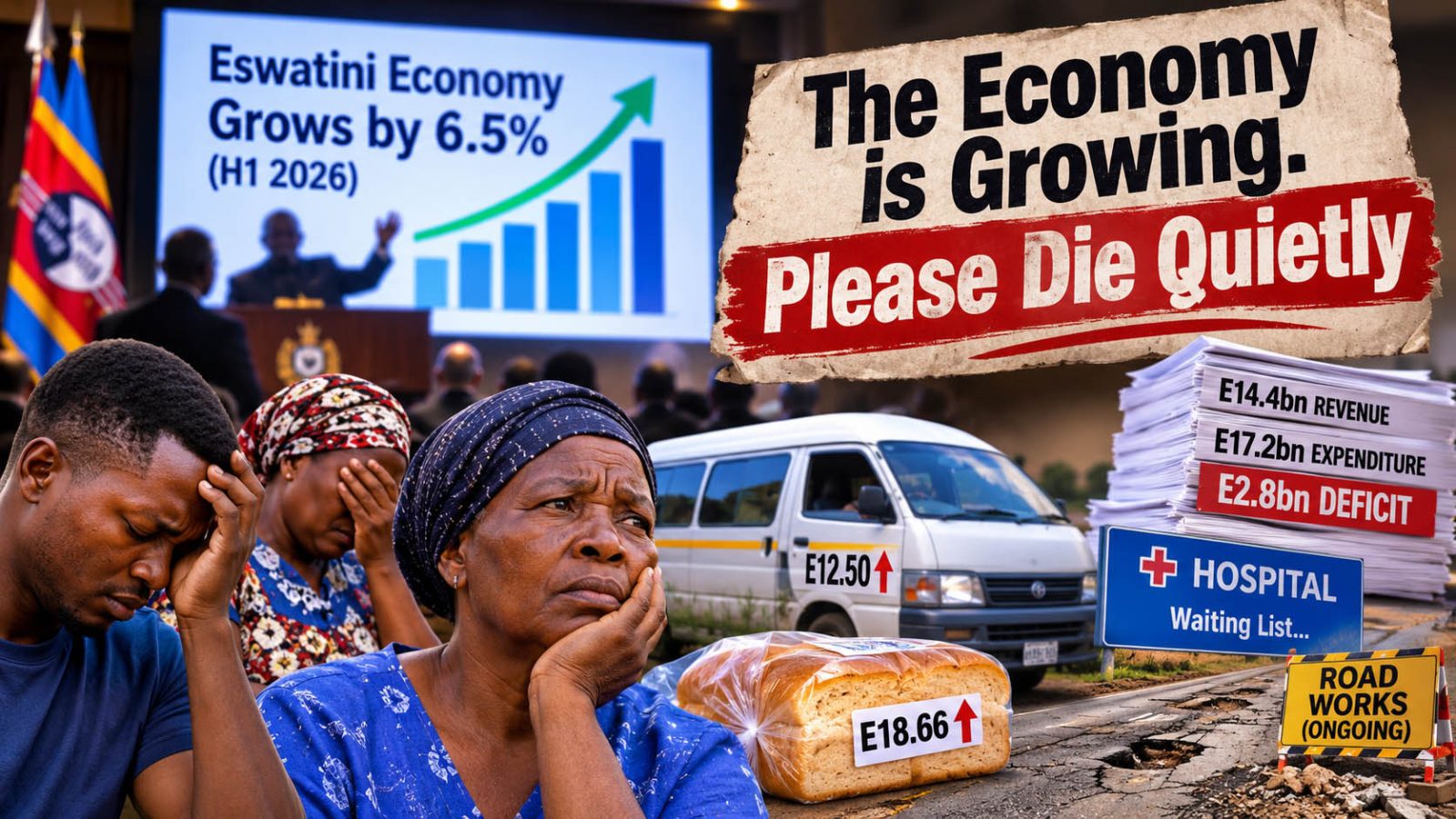
Eswatini’s economy grew by 6.5 per cent in the first half of 2026.
Nobody asked what it was feeding on.
While the economy grew, bread climbed. Kombi fares rose. Contractors waited for payment. Roads remained unfinished. Patients waited for referrals that never came.
The economy was growing. The people keeping it alive were being consumed.
Somewhere, a government official is preparing a PowerPoint presentation to celebrate.
Perhaps the first slide should explain why the patient is getting healthier while the people paying for its treatment are getting sicker. And the bill for keeping this miracle alive keeps growing.
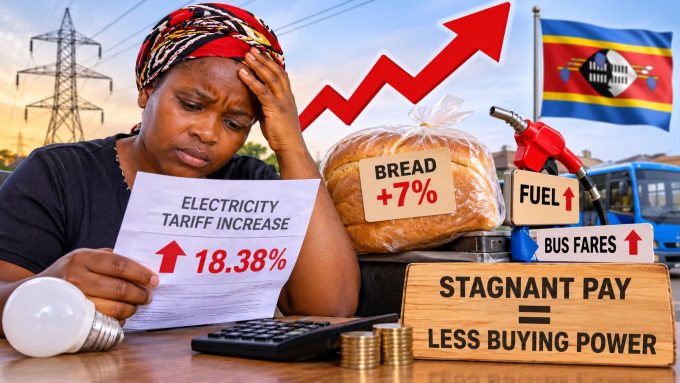
Government collected E14.4 billion and spent E17.2 billion in the first six months of the financial year. That leaves a E2.8 billion hole. Last year’s hole was smaller. We are not managing a deficit anymore. We are excavating a tourist attraction. Come and see the Eswatini crater. Admission is free. Getting out requires a loan. Bread climbed from E17.90 to E18.66. A loaf a day costs E22.80 more each month. The first eight kilometres on a kombi rose from E10 to E12.50. Two journeys over 20 working days cost another E100. That is E122.80 extra a month to eat the same bread and reach the same job, on the same road, with the same pothole waiting to swallow your wages through the suspension.
In Eswatini, commuting is a pre-existing condition. The minister has a microphone. The commuter has a fare increase. One explains the crisis. The other finances the explanation. This is a subscription to your own inconvenience. The deductions are automatic. The services are optional.
Take Siteki. Two roads measuring 390 metres need E4 million. Designs and tender documents were completed years ago. Yet cash flow problems have kept construction at procurement.
A dead man travels further than that on his way to be buried. The only thing moving faster than the funeral is the excuse.
The Messiah is coming, Siteki. Unfortunately, the Messiah is stuck in procurement.
Government budgeted E7.79 billion for capital projects. By September, E1.87 billion had been spent; 24 per cent. An allocation is not available cash, but try explaining that distinction to a worker whose project has stopped. Parliament warns payment delays can increase future costs. We may pay more for roads we have spent years not driving on.
We are buying our coffins on lay-by. Delivery depends on cash flow. Meanwhile, debt servicing reached E2.57 billion in one quarter. Creditors have payment schedules. Citizens have waiting lists. Guess whose paperwork moves faster. Now comes healthcare, where the joke stops being funny and starts filling out a death certificate. Fewer than 33 per cent of cardiac referrals were completed. That does not tell us how many patients died. It tells us that people needing specialist care were left waiting. Government can extend a deadline. Your heartbeat cannot. Your heart cannot submit a revised implementation plan. It just beats, hoping the Treasury eventually develops a pulse.
The Phalala Fund had E189.83 million. By September 22, E178.79 million had been spent, including E101 million on previous debts. Yesterday’s bills are eating today’s treatment budget. Even illness has inherited arrears. Central Medical Stores dispatched 1 724 of 3 240 orders. Laboratories faced broken equipment and shortages of reagents. Only one facility could test for chlamydia and gonorrhoea.
Your STI needs a visa. Your private parts must travel before government can acknowledge their suffering.
Childhood immunisation faced transport, fuel and staffing difficulties. Vaccines can sit cold in a fridge while children remain unreached. The fridge is working. The system surrounding it is not.
Sorry, madam. The vaccine cannot arrive. Have you tried curing measles with a PowerPoint?
The slides will be beautiful. The child will be waiting.
Even the state broadcaster has struggled financially, relying on an overdraft while operating from borrowed studio space. The institution reporting national progress is surviving on credit.
Even the good news needs a loan.
None of this makes the growth figure false. An economy can expand while families become poorer and public services deteriorate. That is what makes the celebration distorted.
Official language helps. An unpaid bill becomes a liquidity constraint. An unfinished road becomes an implementation delay. A stranded patient becomes an outstanding referral. Nobody dies in a spreadsheet. They simply fail to meet a performance indicator.
The spreadsheets are thriving. The debt has a payment schedule. The patient has a waiting list. The economy grows. The cemetery grows faster. Perhaps we misunderstood the miracle. We thought economic growth meant better lives. But the numbers have learnt to prosper without asking whether the people behind them are still breathing.
You are not a citizen. You are fuel. You burn your wages, your health and your years keeping the economy warm. And when the fuel runs out, the presentation continues. Somewhere, an official is adjusting the font size on a slide celebrating 6.5 per cent growth. The numbers look beautiful. The people behind them are disappearing from the conversation. Perhaps that is the secret of our economic miracle. The economy has learnt to grow without keeping us alive. Please die quietly. The presentation is still in progress.