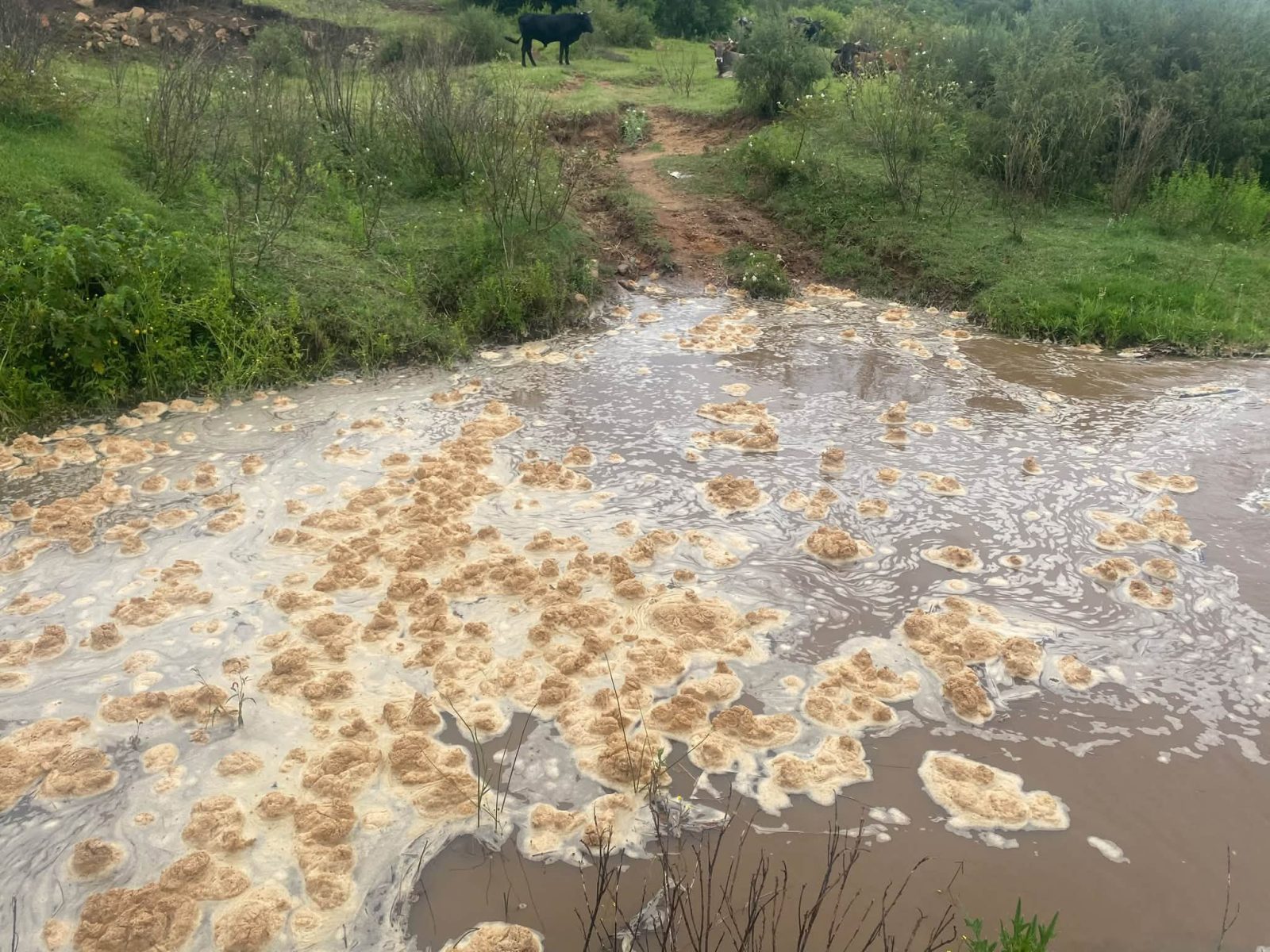
Ngwempisi – The Eswatini Environment Authority (EEA) has detected elevated pollution levels in the Ngwempisi River after residents reported foam.
Laboratory tests revealed high levels of chemical oxygen demand (COD) after an unusual foamy substance was spotted in the water, raising concerns about possible contamination.
The discovery caused panic among residents who depend on the river for domestic purposes, including drinking water and watering their livestock.
Although investigations have established that the water contains higher-than-normal levels of substances that require oxygen for chemical oxidation, the authority has yet to identify the substance responsible or establish the source of the suspected contamination.
EEA Acting Director Mxolisi Maphanga confirmed that water samples collected from the river had been subjected to laboratory testing, which revealed a COD reading of about 28 milligrammes per litre (mg/L). He described the reading as significantly higher than the recommended level of 10mg/L for treated drinking water.
According to Maphanga, the elevated reading suggests that an organic or other oxidisable chemical substance may have entered the river. COD is a scientific measurement used to determine the amount of oxygen required to chemically oxidise organic and inorganic substances present in a water sample. It is commonly used by environmental authorities to assess the presence of substances that may contribute to water pollution.
Concentration
A higher COD reading generally indicates a greater concentration of oxidisable material in the water.
Maphanga said the results indicated that the Ngwempisi River had a higher concentration of such substances than would normally be expected.
He, however, emphasised that the investigations had not yet established the exact nature of the substance. He also ruled out fertiliser and sewage as possible explanations based on the investigation so far, although the authority was still working to establish what could have entered the river.
The findings have raised questions about the safety of water used by communities living along the river, particularly those who depend on it for drinking and other household needs. When asked whether the water was safe for human consumption, Maphanga said it was not possible to make an outright determination at this stage.
He explained that although the COD reading was high, this measurement alone could not conclusively establish whether the water was safe or unsafe to drink.
The authority would, therefore, need to conduct further investigations before making a definitive assessment. His response leaves residents who depend on the river awaiting more information about the possible health and environmental implications of the suspected contamination. The distinction is important because COD measures the oxygen demand created by oxidisable substances in water. It does not identify individual chemicals or establish whether a particular substance is toxic to humans or animals.
A river can, therefore, record elevated COD without the reading alone revealing the specific health risks associated with its water.
Further laboratory analysis would be necessary to identify the substances present and determine whether they pose a danger to people, livestock or aquatic organisms.
Maphanga said the investigation was also examining where the suspected contamination could have entered the river.
He revealed that samples taken upstream recorded a COD level of about five mg/L, while those collected further downstream recorded about 28mg/L.This difference, he explained, suggested that the source of the contamination was likely to be somewhere between the two sampling points.
The upstream reading was considerably lower than the downstream result, indicating that the substances contributing to the elevated COD were entering the water along that stretch of the river. However, the results had not yet identified the exact location or activity responsible. The authority would consequently need to narrow down the possible sources through further investigations and testing.
Warning to river users
Maphanga also cautioned residents against assuming that the river was free from contamination simply because its water might appear clean.
He explained that the river was flowing, meaning that the visible appearance of the water could change as the suspected pollutants moved downstream. According to him, contamination in a river is not always immediately apparent, as substances can be present even when the water does not have an unusual colour or appearance. He urged members of the public to report any unusual substances, discolouration, foam or other suspected pollution in rivers to the EEA without delay.
Maphanga said the authority responded promptly to reports of suspected environmental contamination and encouraged communities to alert it whenever they noticed something unusual.
The warning is particularly relevant to communities that rely on rivers for their daily needs, as visible changes in water quality may be an indication that something has entered the water.
The foamy substance observed in the Ngwempisi River was what initially attracted the attention of residents and raised concerns about the possibility of pollution.
While the laboratory results have confirmed elevated COD levels, the investigation is yet to establish whether the substance responsible for the reading is the same material that caused the visible foam.
Despite the uncertainty surrounding the safety of the river, some residents who use its water said they were still drinking it while awaiting further information.
They indicated that they were also waiting for clarity from the relevant authorities regarding the findings and what the elevated COD levels meant for their health.
Their continued use of the water highlights the difficulties faced by communities that depend on natural water sources and may not have readily available alternatives.
For households that use the river for drinking, cooking and watering livestock, uncertainty over its quality can have serious implications. The situation also raises questions about how quickly communities can be informed when possible contamination is detected, particularly when laboratory investigations are still underway.
The Ngwempisi River incident comes amid recent concerns about possible contamination of another water source, the Phophonyane River, where illegal mining activities have been linked to fears of mercury pollution.
Concerns have been raised that illegal miners could be using mercury during mining activities, potentially exposing nearby water sources to contamination.
Mercury is a toxic heavy metal that can pose serious risks to human health and the environment when released into water systems.
Exposure to mercury can affect the nervous system, kidneys and other organs. In aquatic environments, certain forms of mercury can also accumulate in fish and other organisms, potentially exposing people and animals through the food chain.
However, the concerns surrounding the Phophonyane River should be distinguished from the findings in the Ngwempisi River.
In the Ngwempisi case, the EEA has confirmed elevated COD levels, but has not identified the chemical responsible. The available findings do not establish that mercury is present in the river.
Globally, the protection of rivers from chemical pollution remains a major environmental concern, with the United Nations warning that deteriorating water quality threatens human health, ecosystems and access to safe drinking water. Industrial discharges, agricultural runoff and untreated wastewater are among the pressures affecting freshwater resources in different parts of the world. Environmental monitoring, including COD tests is, therefore, important in identifying possible pollution and guiding investigations into its sources.