

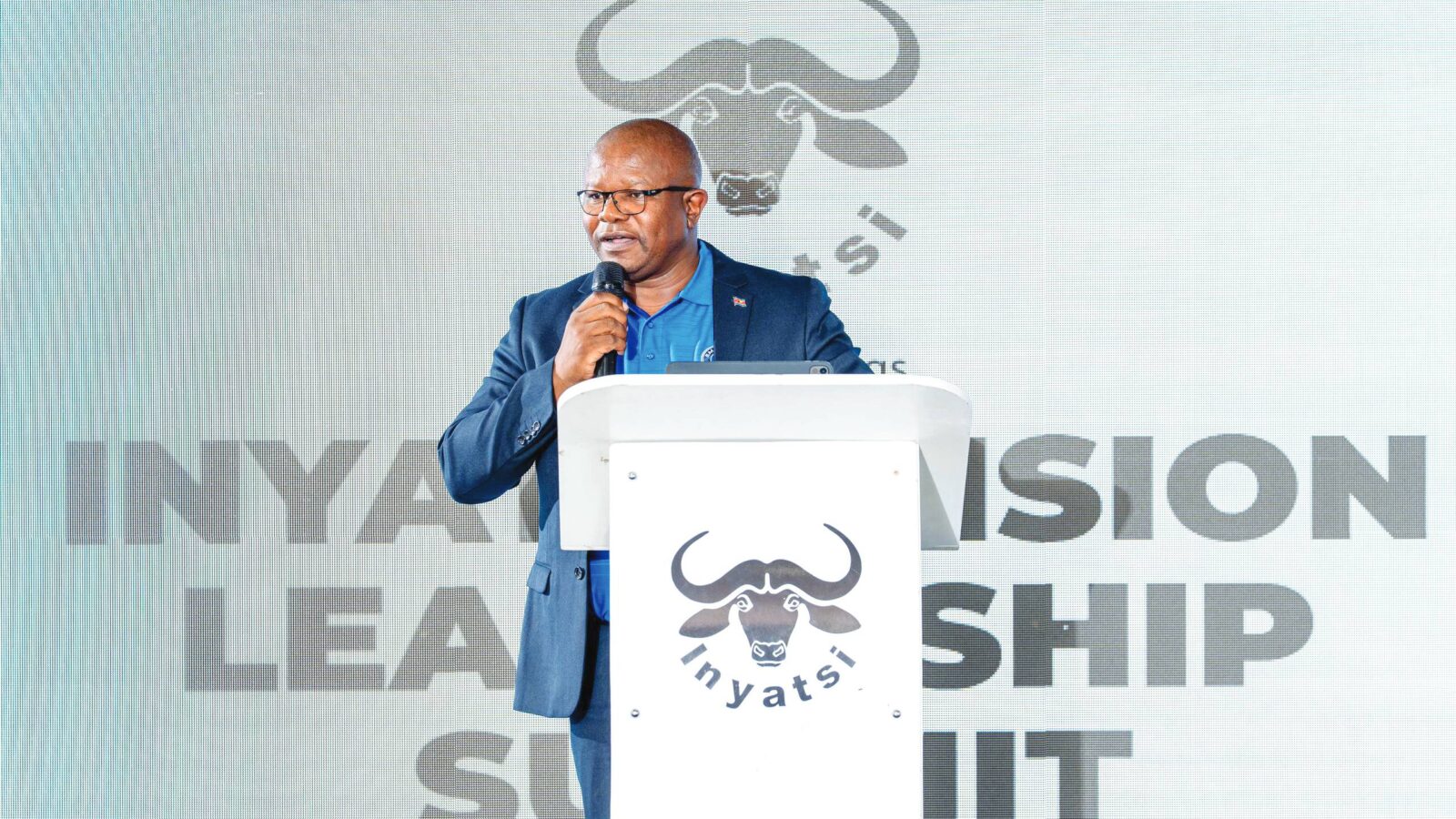
The Minister for Commerce, Industry and Trade, Manqoba Khumalo has made a strong plea to his fellow Cabinet ministers to give local empowerment top priority when making decisions if it really wants this country to realise His Majesty King Mswati III’s vision of transforming Eswatini into a First World country.
This was during the Inyatsi Group Holding’s Leadership Summit on Tuesday. The Inyatsi Group, an example of what local businesses can accomplish when given the chance to thrive, served as the focal point of his speech.
With more than 6 000 employees and more than 2 200 local suppliers and subcontractors, Inyatsi is undoubtedly a major contributor to job growth in the kingdom. Thousands of households are directly supported by its yearly wage bill of about E700 million. It has made a significant contribution to the national coffers in recent years, paying out over E1.1 billion in taxes and dividends.
Inyatsi has a diverse portfolio that includes businesses in construction, telecommunications, mining, insurance and meat processing increases its impact on GDP and shows how local businesses can promote resilience and economic diversification. We need not be reminded that it is these funds that drive the King’s vision for a prosperous Eswatini, by enabling support for social programmes, infrastructure and public services.
The minister correctly emphasised the necessity of policies that give local companies priority, especially in view of the Citizens Economic Empowerment Act. This law is a critical step in safeguarding small and medium-sized businesses (SMEs) by giving local companies a 15 per cent competitive edge when selling to Eswatini’s markets.
Larger locally-owned corporations, whose size increases their economic impact, must also be covered by this protection. We should discourage the outflow of profits that arise when large government contracts are given to foreign companies, leaving little benefit for emaSwati.
We should push for companies to reinvest locally, to boost employment, growth and community development. This is where Cabinet support becomes critically important.
Many other governments do the same. Malaysia and South Korea are among examples of how government assistance for locally owned enterprises can propel national prosperity. In 1971, Malaysia’s New Economic Policy (NEP) sought to empower the country’s indigenous Bumiputera population by implementing affirmative action in the fields of education and business. By giving local businesses preferential access to contracts, funding and training, Malaysia developed a strong class of indigenous business owners, greatly increasing GDP and lowering poverty.
These days, Malaysian companies like Petronas, a State-backed but locally based oil and gas behemoth, employ thousands of people and generate billions of Dollars in economic output. Similarly, through subsidies, tax breaks and shielding from overseas competition during their early years, the South Korean Government was instrumental in fostering chaebols or family-owned conglomerates like Samsung and Hyundai.
With locally owned businesses promoting innovation, exports and job creation, these policies turned South Korea from a developing country into a major economic force on a global scale. By taking inspiration from these models, Eswatini can guarantee that local businesses are protected from unfair competition and given the opportunity to achieve greater success while maintaining the quality of their products and services.
However, government is not the only entity accountable for Eswatini’s economic transformation. EmaSwati must support locally made products and services, putting the prosperity of the country above personal preferences.
Purchasing goods from local businesses supports jobs, keeps wealth in the kingdom and builds communities. This patriotic change in consumer behaviour has the potential to boost local companies’ influence and have a positive knock-on effect on the economy as a whole. Each purchase is an investment in the future of the country.
It is also important that regular forums for interaction between the public and private sectors takes place in order to avoid the clash between the Ministry of Works and local contractors over an AfDB-funded road project.
Industry leaders should be able to express their concerns, offer solutions and coordinate their plans with the objectives of national development on a regular basis. Too frequently, tensions that impede progress result from misalignments between the needs of the private sector and government policies. Instead of creating rifts, a structured conversation aimed at resolving issues like unfair competition, regulatory barriers and financial access would promote partnerships. Together, businesses and government can build an ecosystem that supports local businesses and spurs economic growth, employment and innovation.
The accomplishments of Inyatsi, such as the construction of the Nhlangano-Sicunusa Road and the introduction of Eswatini Mobile, which now has over 800 000 subscribers, demonstrate the potential of local business.
The company’s ambitious plans to invest more than E1 billion in mining, manufacturing and telecommunications show a strong commitment to Eswatini’s future. However, local businesses require a supportive policy environment, equitable access to opportunities and a society that supports their endeavours in order to maintain this trajectory.
The minister’s commitment gives hope and serves as a pertinent reminder that empowering its own citizens is the first step towards Eswatini becoming a developed country.



















Leave a comment