

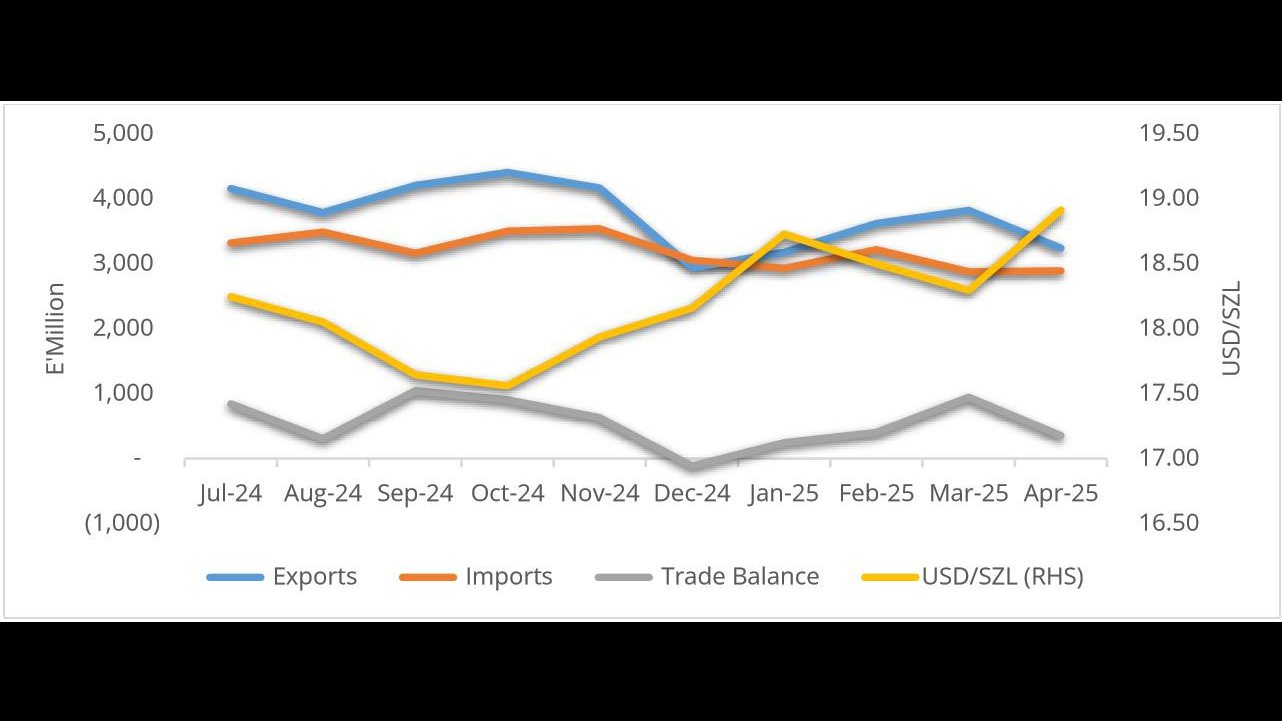
MBABANE – The Kingdom of Eswatini recorded a reduced trade surplus in April 2025, according to the Central Bank of Eswatini’s (CBE) Recent Economic Development report covering May–June 2025.
The trade account posted a surplus of E351.5 million in April, significantly down from the E944.5 million surplus recorded in March 2025. This decline was largely attributed to a sharp fall in exports, particularly sugar, during the period under review.
Total exports for April 2025 amounted to E3.2 billion, representing a 15.2 per cent month-on-month decrease. Despite this contraction, exports were up 24.7 per cent on a year-on-year basis, indicating some recovery compared to the same period in 2024.
Imports, meanwhile, were valued at E2.9 billion, increasing marginally by 0.4 per cent both month-on-month and year-on-year.
When seasonally adjusted, the trade balance for April stood at E799.5 million. Seasonally adjusted exports were E3.9 billion, while imports totalled E3.1 billion. South Africa continued to dominate Eswatini’s trade portfolio.
Exports to South Africa made up 66.7 per cent of total receipts in April, while imports from the neighbouring country accounted for 72.8 per cent of Eswatini’s total import bill.
For the first four months of 2025, Eswatini recorded a cumulative trade surplus of E1.6 billion, more than double the E773.4 million surplus registered in the same period in 2024. This wider surplus was mainly due to shrinking imports over the period.
Total exports from January to April 2025 reached E13.9 billion, which marked an 8.4 per cent increase compared to the same period the previous year. On the other hand, imports amounted to E11.9 billion, reflecting a slight year-on-year decline of 0.8 per cent.
The report notes that the decline in imports was influenced by a reduction in meat imports. This was linked to the ongoing foot-and-mouth disease outbreak, which has led to a ban on meat imports into Eswatini.
In terms of export commodities, soft drink concentrates remained the top earner, despite a slight monthly decline. In April 2025, these exports were valued at E1.5 billion, falling by 0.4 per cent month-on-month and by a significant 52.8 per cent year-on-year.
Sugar and sugar product exports saw a sharper contraction. They amounted to E658.8 million in April, reflecting a 40.9 per cent decline from the previous month.
This was due to the seasonal first-quarter halt in sugar production, which typically leads to inventory depletion and reduced export volumes. Nonetheless, on a year-on-year basis, sugar exports rose by 29.5 per cent.
Textile and textile apparel exports recorded a month-on-month decrease of 8.1 per cent in April, and a more pronounced year-on-year decline of 19.4 per cent. Exports of wood and wood articles stood at E210.5 million, declining by 11.2 per cent month-on-month and marginally by 0.5 per cent year-on-year.
Fuel and electricity imports dropped by 4.6 per cent month-on-month in April, amounting to E534.7 million. However, on a year-on-year basis, they rose by 3.7 per cent, driven by a reduction in electricity volume purchases.
Animal and vegetable product imports increased to E329.4 million, up 1.4 per cent month-on-month and 6.7 per cent year-on-year. While meat imports continued to decline due to the ban associated with foot-and-mouth disease, there was a noticeable increase in the importation of oil seeds and oleaginous fruits.
Textile and textile apparel imports also rose to E224.3 million, marking a sharp month-on-month increase of 38.0 per cent and a 17.2 per cent increase year-on-year. Vehicle imports rose to E209.0 million, reflecting a month-on-month increase of 11.7 per cent and a year-on-year rise of 24.4 per cent.
Machinery and electrical equipment imports, however, experienced a downward trend. These amounted to E299.2 million in April, representing a 1.4 per cent decrease month-on-month and a 21.3 per cent decrease year-on-year.
…govt makes E316.7m on bond issuance
MBABANE – Turning to the domestic bond market, the Central Bank of Eswatini (CEB) reported that it had issued plain vanilla bonds of various maturities in June 2025 through the government bond programme.
A total of E200 million was offered during the auction. The market exhibited strong demand for the securities, with total bids received amounting to E316.7 million. This translated to a bid-to-cover ratio of 158.3 per cent, indicating robust investor appetite. Allotments reached E296.7 million, yielding an allotment ratio of 93.7 per cent. However, the performance of the bonds varied by maturity. Medium-term bonds—specifically the 3-year and 5-year papers—were allotted below the offered amount. In contrast, the longer-term bonds—7-year and 10-year maturities—were issued under the green shoe option, allowing for additional allocation beyond the original offer due to excess demand.
Non-bank financial institutions (NBFIs) remained dominant in their holdings of government securities. They continued to hold a significant share of bonds on both the shorter and longer ends of the yield curve.
Commercial banks, meanwhile, maintained their strong presence at the short end of the curve, reflecting their preference for shorter-duration assets in the current environment.
…Lilangeni remains steady against Dollar in June
MBABANE – During the month of June 2025, the Rand/Lilangeni appreciated against the US Dollar, the Pound Sterling and depreciated against the Euro.
When compared against the US Dollar, it appreciated from an average of E18.11 in May 2025 to close the month of June 2025 at E17.84 on average.
The Rand’s appreciation in the month was driven by a combination of global and domestic factors. Generally, the appreciation was attributed primarily to the weaker US Dollar, which has lost ground amid the de-escalation in the Middle East, renewed economic volatility and ambiguity surrounding US tariffs.
Given the volatile environment, global investor sentiments responded negatively by investing in higher-yielding emerging market assets.
On the domestic front, the Rand held steady as the South African Treasury committed to fiscal spending discipline and debt containment. Elevated global gold prices also supported the Rand’s performance, following an improvement in the mining sector. Concurrently, the South African Reserve Bank (SARB) has maintained high interest rates relative to developed economies, a move which has yielded positive results for yield-seeking investors amid the low global interest rate environment.
Looking at the other major currencies, the Lilangeni appreciated by 0.1 per cent against the Pound Sterling and depreciated by 0.6 per cent against the Euro to average E24.18 and E20.55 in June 2025, respectively.
Notwithstanding the negative political developments within the government of national unity (GNU), driven in part by disagreements between the African National Congress (ANC) and the Democratic Alliance (DA), the Rand is expected to appreciate.
The expected appreciation mainly derives from the wave of momentum driven by the favourable commodity prices, broadly weaker US Dollar and positive investor sentiments towards the risky emerging market economies’ assets, amid the highly volatile global economic environment. The domestic unit closed the month of June 2025 trading at E17.74 to the US Dollar, E24.36 to the Pound Sterling and E20.83 to the Euro.
Public debt up by 4.9%
MBABANE – The country’s total public debt stood at E38.4 billion at the end of June 2025, equivalent to 40.2 per cent of GDP, depicting an increase of 4.9 per cent from the preceding month.
This was mainly driven by developments in both domestic and external debt in the review period.
At the end of June 2025, external debt stood at E17.8 billion or 18.6 per cent of gross domestic product (GDP), reflecting an increase of 9.4 per cent relative to the E16.3 billion recorded end of May 2025.
Despite the sustained mild strengthening of the Lilangeni against the US Dollar, which supported Dollar-denominated debt service costs, the increase in external debt was broadly driven by the disbursement of E1.8 billion budget support loan to pay down arrears, among others.
Public domestic debt also reflected a slight increase of 1.3 per cent and was reported at 20.6 billion, about 21.6 per cent of GDP in June 2025.
The increase in domestic debt was attributable to the Central Bank of Eswatini (CBE) advance to government as well as the issuance of plain vanilla bonds in the period.
At the end of May 2025, net foreign assets stood at E7.5 billion, depicting a month-on-month decrease of 13.2 per cent and 15.9 per cent year-on-year. Both the official sector and other depository corporations contributed to this contraction.
Net foreign assets of the official sector fell to E6.3 billion at the end of May 2025, down by 14.4 per cent from the previous month and 2.6 per cent compared to the previous year. This decline was primarily due to net outflows of foreign currency resulting from transactions with local banks and government fiscal payments.
Net foreign assets held by other depository corporations fell by 6.2 per cent month-on-month and 51.8 per cent year-on-year, to close at E1.2 billion at the end of May 2025.
The reduction was reflected in a decrease in banks’ investments within the Common Monetary Area. In terms of Special Drawing Rights (SDR), net foreign assets stood at SDR 306.6 million, marking a decline of 10.1 per cent month-on-month and 14.7 per cent year-on-year.
Gross official reserves decreased by 12.6 per cent month-on-month and increased by 2.2 per cent year-on-year, to reach E8.2 billion at the end of June 2025.
The month-on-month decline was largely driven by the outflow of Rands from trades with banks combined with payments of fiscal obligations. The reserves were estimated to cover approximately 1.9 months of imports of goods and services, down from 2.1 months observed in May 2025.




















Leave a comment