

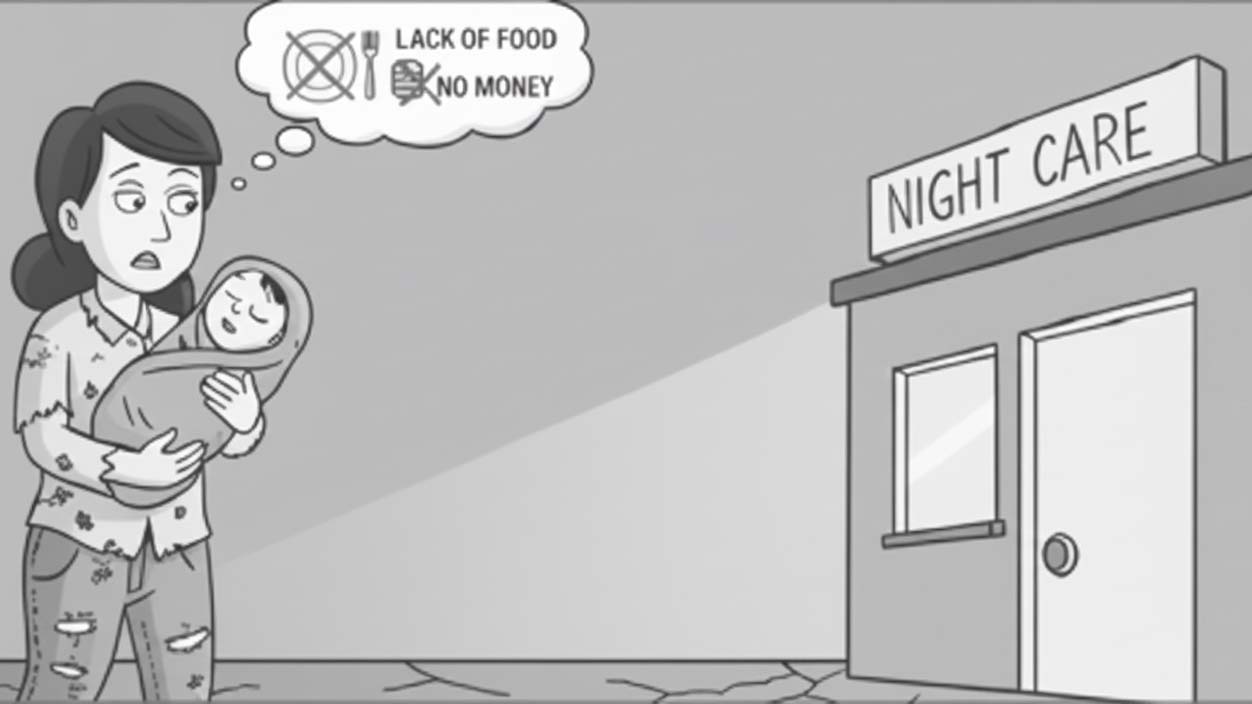
As the cost of living climbs and wages remain frozen, parents opt to work longer hours into the night or take on double shifts in their quest to provide for their families, but who takes care of their children while they toil in the night?
The question leads us straight into one of the quietest, least-acknowledged crises in Eswatini: The rise of night care.
For Eswatini, that place might just be the night-care centre, a small, often cramped room where children fall asleep under dim bulbs while their parents chase a living that no longer stretches far enough. In these makeshift sanctuaries, lined with thin mattresses, the nation’s economic fractures reveal themselves more honestly than any statistic or policy statement ever could.
Last Saturday, Eswatini News carried a front-page story about such informal facilities.
Night care is not a symbol of parental neglect; it is the final refuge for families cornered by an unforgiving economy. It is where the working poor leave pieces of their hearts while serving an era that demands their labour but overlooks their lives.
We have found it easy to judge these parents. We whisper about mothers who ‘abandon’ their children overnight or fathers who ‘should be home’ instead of working night shifts. Before we point fingers, we must examine the environment that forces this pattern. The truth is blunt: Night care exists because the economy has made it impossible for many families to survive without it.
Over the past few years, the cost of living in Eswatini has soared far faster than wages. Groceries, transport, school fees and rent prices climb each quarter, yet salaries remain unmoved. In the lives of ordinary citizens, this creates a dangerous arithmetic.
When a parent earns the same amount for years while everything around them becomes more expensive, they are not living; they are sinking.
To avoid drowning in debt and expenses, many take on two jobs. Others extend their hours deep into the night. Some sell at the market after formal work or even engage in sex work. Others clean offices once everyone else has gone home. These are not choices made out of ambition; they are choices made out of desperation.
When the parents disappear into these late-night economies, who holds the fort at home? Who tucks the children in, checks their homework, comforts them through the night? These unanswered questions gave birth to night care. A structure created not by policy, but by necessity.
Critics often frame night care as evidence that the family unit is collapsing or that parents are failing in their responsibilities, but such criticism rarely acknowledges the broader context: Poverty dictates behaviour far more powerfully than personal values ever could. A mother working a night shift at a supermarket is not abandoning her child; she is ensuring the child eats the next day.
A security guard stationed overnight is not choosing work over parenthood; he is taking the only job available to him. A domestic worker sleeping in her employer’s house is not neglecting her toddler; she is complying with employment demands that offer no flexibility. We must challenge the narrative that parents who use night care are irresponsible. More often than not, they are the most responsible people in the room.
They are doing what the economy forces them to do: Survive. Judgement becomes a luxury for those who have never had to choose between a child’s emotional comfort and a child’s next meal.
The night-time economy has grown more rapidly than the systems meant to support it. Eswatini has seen a sharp rise in longer hours in service sectors, supermarkets, transport, hotels, casinos, cleaning companies, factories, call centres and security firms.
These industries extend the working day far beyond the traditional nine-to-five schedule. Yet, ironically, the nation’s childcare policies remain rooted in a daylight world. There are clear standards for day-care centres, licensing requirements, staffing ratios, infrastructure guidelines, but night care operates in a regulatory vacuum.
Many facilities run informally. Caregivers are untrained. Safety checks are minimal or non-existent. Inspections are rare. Children sleep in overcrowded rooms with no heating in winter and no emergency protocols when something goes wrong.
Yet still, these centres remain full. Why? Because they are the only option available to working parents.
For children, night care can be confusing.
They sleep in unfamiliar spaces, surrounded by other babies and toddlers crying through the night. Many do not understand why their parents are absent during the darkest hours. They form secondary attachments to caregivers who, though well-meaning, are overworked and under-prepared. Young children need stability, familiarity and nighttime reassurance.
Yet, thousands now fall asleep in conditions shaped more by economic demand than developmental needs. We must confront an uncomfortable reality: Children are paying the emotional price of a struggling economy. We should also recognise that children are incredibly resilient. What they lack is not parental love—for their parents love them enough to sacrifice rest, dignity and time—but a system that supports their families.
Night-care workers themselves navigate impossible tasks. Some are grandmothers doing their best to help neighbours. Others are young women trying to earn an income through babysitting. Very few have formal training. They cook, teach, comfort, change nappies, mediate fights and soothe fears that erupt in the early hours.
They occupy a paradoxical place in society: Critical, yet invisible. They carry the emotional burden of dozens of children, often without recognition, support or fair compensation, and they witness things the rest of us rarely consider: The tears children shed when their parents leave, the exhaustion mothers hide behind brave smiles, the fear that creeps in when a sick child wakes up gasping at 1am in a room of 20 others.
If we want to understand the emotional landscape of poverty, speak to a night-care worker.
The biggest tragedy in this situation is how preventable it is. In other countries that have grappled with similar issues, night care is formally recognised, caregivers are trained, centres meet safety standards and working parents receive support through flexible hours, transport subsidies and living wages.
Could Eswatini not follow suit? Could the State formally acknowledge night care and provide oversight that ensures children are safe and families are supported? Could employers who benefit from night-time labour contribute to solutions that allow parents to care for their children without risking their livelihoods? Could communities, NGOs and civil society create networks of support to bridge the gaps left by policy?
It is tempting to focus on the parents because they are visible, but as long as we keep blaming individuals, we will never fix the system. Night care is merely a surface symptom.
The deeper disease is unemployment, stagnant wages, rising prices, informal labour, inadequate social protection and the absence of a national childcare framework. When the foundation is broken, we should not be surprised when families struggle to stand upright.
We must ask ourselves: What does it say about a nation when children are raised in the care of strangers at night, not because parents prefer it, but because they cannot afford anything else?
Do we want to be a society where parents work until midnight for wages that barely sustain them? Where children sleep in overcrowded rooms so the economy can function? Where childcare remains a private burden rather than a shared responsibility? Or do we want to build a nation where families are supported, childhood is protected and work does not cost people their bond with their own children?
The answer will shape the next generation. This is not a call to shut down night care as that would be punishing the victims, not the system. Instead, we must look deeper, beyond the centres themselves, and ask how Eswatini can ensure that no parent must choose between feeding their child and tucking them into bed.
Could regulation, oversight and investment make night care a safe, supportive extension of the family rather than a desperate substitute? Could we create a system where parents are not forced into impossible choices and children are never left to sleep in spaces defined by economic failure rather than love?
It is easy to blame parents for relying on night care, but blame is lazy thinking. It focuses on the visible actor while ignoring the invisible forces shaping their decisions.
Night care is not the failure. The failure is an economy that forces parents into impossible choices. The failure is a system that leaves children in the care of strangers because it refuses to support families. The failure is poverty, persistent, punishing and entirely man-made.
If we truly care about children, we must look beyond the night-care centre and consider what we, as a society, are willing to do.
Can we, collectively, create conditions where survival does not demand the sacrifice of parental presence? Can we ensure that childhood is a time of security rather than compromise? Can we finally confront the uncomfortable truth that poverty, not parenting, is shaping the future of our nation?



















Leave a comment