

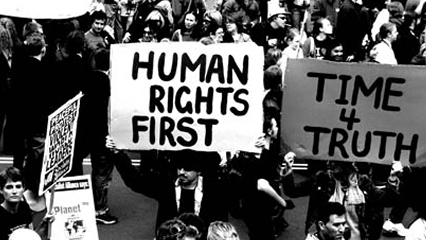
Eswatini and the global community commemorated Human Rights Day on December 10. It’s a culmination of 16 Days of Activism Against Gender-Based Violence campaign, launched on November 25, 2025. It also included other commemorations such as HIV/AIDS Day on December 1, 2025 and Disability Day on December 3, 2025.
The theme for Human Rights Day was: ‘Our Everyday Essentials,’ highlighting that human rights are not abstract, but fundamental aspects of daily life, like food, shelter, peace and dignity; focusing on them being positive, essential and attainable. This theme aims to reconnect people with human rights principles by showcasing their relevance and impact in daily experiences, encouraging action for a more just future.
Key aspects of the theme
Human rights bring joy, safety and well-being into daily life; they are the basic needs and freedoms we rely on (food, water, security, non-discrimination); they are achievable through collective action and everyday choices.
The campaign’s goal is to bridge the gap between human rights ideals and real-life experiences, showing that rights are for everyone, every day, especially during turbulent times.
This year’s UN Human Rights Day campaign, seeks to reaffirm the enduring relevance of the Universal Declaration of Human Rights(UDHR) and its core values – equality, justice, freedom and dignity – reminding us that human rights remain a steadfast promise for society.
The commemoration of human rights occurs at a time when human rights progress has been tremendously reversed, especially by countries that were viewed in many respects as beacons of hope in fighting for human rights globally. Disregard for human life by some governments has sent shockwaves globally.
The war in Gaza was a classic example where over 70 000 civilians perished, while thousands were maimed and millions were left with no shelter, starved, deprived of medical care, water supply and electricity. This undermines the preamble of the Universal Declaration of Human Rights which states: ‘Whereas disregard and contempt for human rights have resulted in barbarous acts which have outraged the conscience of mankind’. Unfortunately, these barbaric acts have re-emerged in recent times.
One government has launched strikes killing fishermen at sea, suspected of being drug cartels This was done without any due process, where perpetrators ideally should instead be brought to court to be formally charged. In Sudan accusations of genocide have emerged on both sides of the warring parties.
The UN secretary general noted in his speech: ‘ nearly eighty years ago, the Universal Declaration of Human Rights defined what every person needs to survive and thrive. It was a philosophical and political breakthrough – and it has been the bedrock of our global community ever since.
xHuman rights – civil, political, economic, social and cultural – are inalienable, indivisible and interdependent. Nonetheless, recent years have brought a shrinking of civic space. We have grave violations that signal a flagrant disregard for rights, and a callous indifference to human suffering”. This is indeed a sad situation for humanity’.
UN Human Rights Chief, Volker Türk, marking the launch of the 2025 Human Rights Day campaign noted that ‘Human rights are our compass in turbulent times – guiding and steadying us through uncertainty. In 2025, the very foundations of human rights have been put to the test. Inequalities are rising, conflicts are raging, the climate emergency is mounting and some are creating and trying to deepen divisions within societies and between countries. However, we must not give up’. His message also underscores a changed human rights environment globally. He made this call: ‘We need more solidarity and more human rights to address the current challenges. It is crucial to keep advocating for our fundamental rights’.
The UN secretary general has made a call for all of us to act, saying, ‘this work depends on all people, everywhere, taking a stand. When we protect the most vulnerable, when we refuse to look away, when we speak up for the institutions that speak up for us, we keep human rights alive.
In Eswatini, since the launch of the Human Rights Society of Eswatini in October, over 100 human rights violations have been recorded. It was shocking to read in the Times of Eswatini that an acting chief announced that the chief’s stamp will only benefit those seen to be loyal to umphakatsi. The question one asks is, has loyalty been defined? What happens to children who seek the stamp to apply for scholarships? Our rights should never take second place for profit or power.
Let us congratulate the Human Rights Commission for hosting the human rights event at the Mbabane Theatre Club. The Human Rights Commission chair, the partners, civil society discussed the state of human rights in Eswatini. Evictions and torture concerns were engaged on.
Human rights are God-given, hence our daily essentials!


















Leave a comment