

MBABANE – Swaziland Property Investments Limited (SWAPROP) has signalled a robust strategic shift for the upcoming 2026 financial year.
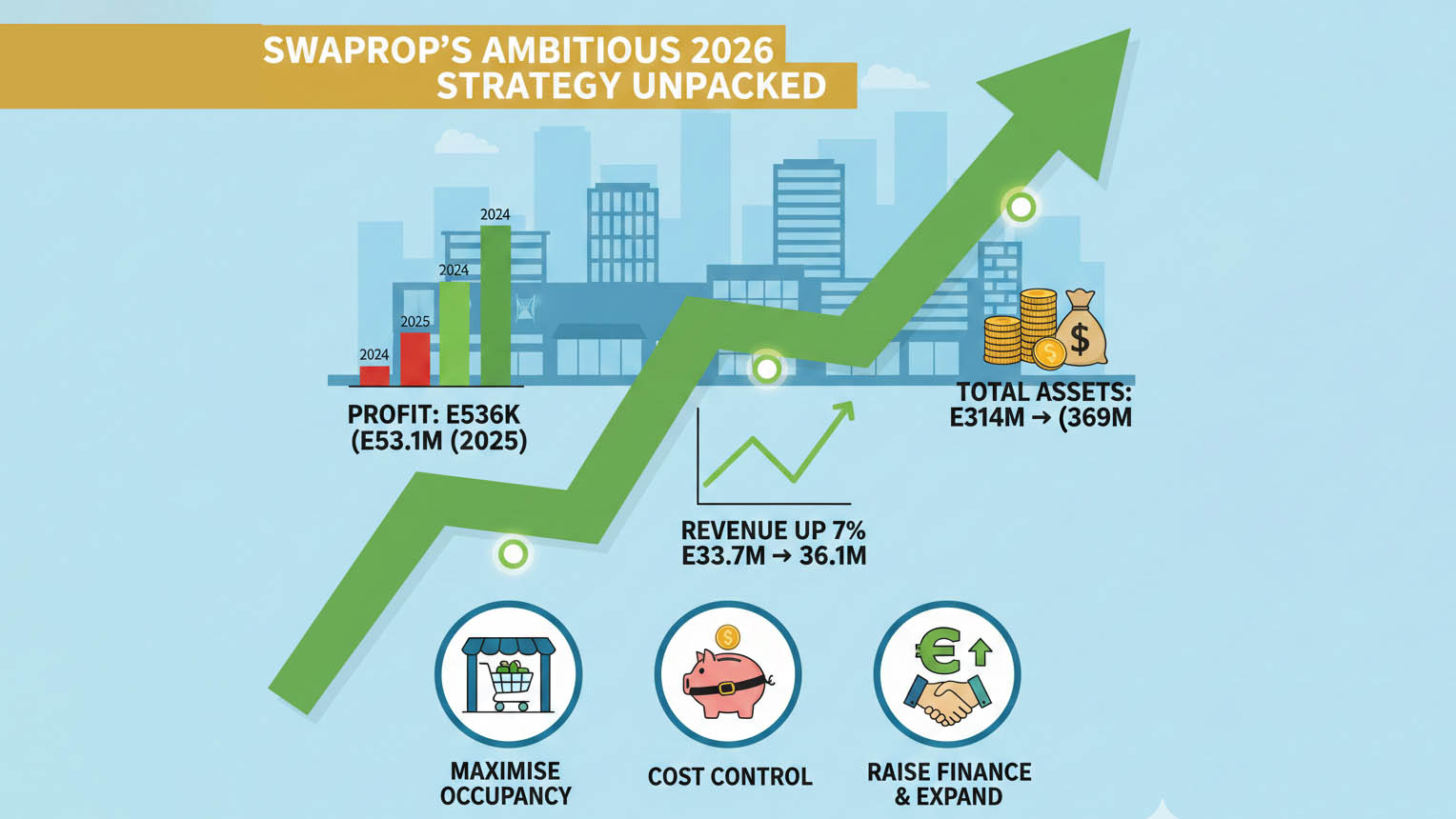
In the 2026 financial year, the group plans to focus on maximising occupancy levels its centres, controlling costs and raising additional finance to restructure group borrowings and to fund future expansion.
The Eswatini Stock Exchange (ESE)-listed property giant, released its annual results for the year ended June 30, 2025, revealing a dramatic swing back into profitability and a significantly strengthened balance sheet.
SWAPROP operates as a premier property investment holding company, generating income primarily from interest on loans with its subsidiaries and investment accounts. Its portfolio consists of high-profile, wholly-owned subsidiaries, including Plaza Park Limited, The Hub Limited, Nhlangano Mall Properties and Elwandle Properties Limited.
The company maintains strong institutional backing, with the Industrial Development Company of Eswatini (IDCE) holding a strategic 20 per cent interest in the group.
The group reported a stellar performance for the 2025 financial year, with net profit after tax soaring to E53.1 million, a massive recovery from the E536 000 loss recorded in 2024.
This resurgence was primarily fueled by:
Property revaluations: An external valuer applied the income capitalisation method to the portfolio, resulting in a E55.8 million favourable fair value adjustment.
Revenue growth: Group revenue climbed 7 per cent to E36.1 million, up from E33.7 million the previous year.
Operating profit: Increased by 8 per cent to reach E17.8 million.
Reduced costs: Lower finance charges also contributed to the E68.8 million net profit before taxation.
Despite these gains, the group noted that expenditure increased due to higher property management accounting fees and general inflationary pressures.
Looking ahead, the Board of Directors, has laid out a clear three-pillar strategy for the 2026 financial year:
Maximising occupancy: A primary focus will be placed on maximising occupancy levels at its various centres.
Cost containment: Management aims to maintain tight control over costs to protect margins.
Capital restructuring: The group plans to raise additional finance specifically to restructure group borrowings and to fund future expansion.
*Full article available in our publication
















Leave a comment