

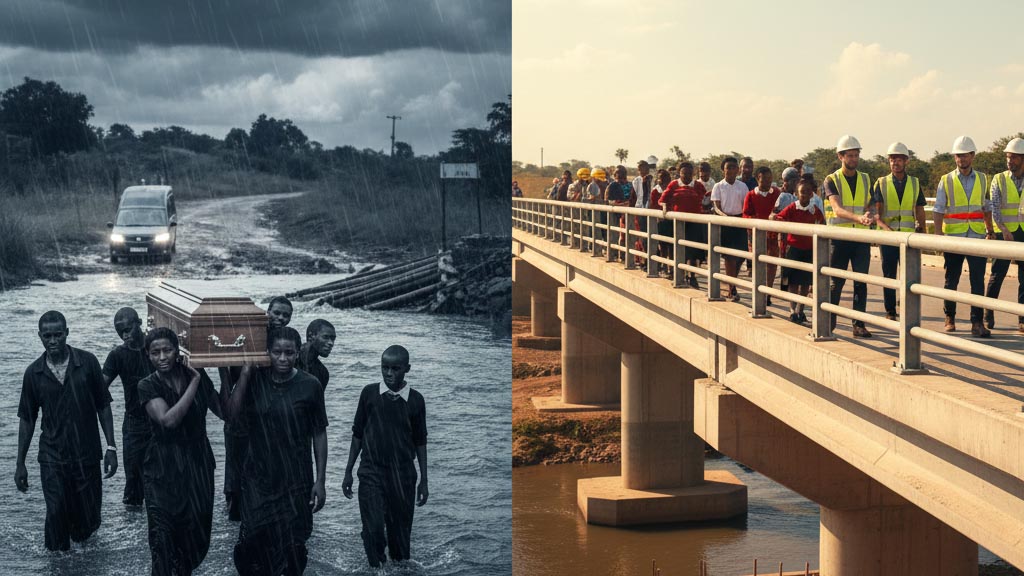
Recent headlines out of Vusweni in northern Hhohho, where a grieving family was forced to carry the body of a 10-year-old boy through waist-deep river waters because there was no bridge, should shake us to our core. With funeral vehicles stranded and the only ‘link between that community and the outside world washed away by relentless rains, the family had no choice but to wade the river on foot in one of the most harrowing journeys any human could make.
This is not simply an isolated moment of human tragedy. It is a profound indictment of how rural isolation, worsened by climate-driven weather extremes, continues to exact a toll on Eswatini’s people. It is high time we broaden our understanding of ‘infrastructure’ – not merely in terms of roads and bridges on paper, but in terms of real lives connected or cut off by those very links. Rivers that in the dry season may be easy to cross can become hazardous or impassable during rains. Families like the one at Vusweni know this all too well. What was once a minor inconvenience has become a daily matter of safety, survival and dignity. When traditional log crossings fail, the consequences are not abstract inconveniences, they are loss of life, isolation from essential services and added suffering at the most vulnerable moments. For years, Eswatini has relied partly on international goodwill and volunteer partnerships to fill this gap. Non-profit programmes like Engineers in Action, often partnered with foreign universities, have helped rural communities design and build footbridges that provide safe crossings during flood seasons. These efforts send engineering interns and students from the United States, Canada and other countries to live with Eswatini communities, raise funds for materials, and construct bridges that connect villages to schools, clinics and markets.
These collaborative efforts deserve praise. The bridges built through such international engagements have dramatically reduced isolation for thousands of rural residents. In some cases, footbridges now allow children to reach school safely year-round and give farmers and parents reliable access to services previously cut off by rising waters. However, let us be clear: International assistance must be supportive, not the backbone of our national infrastructure strategy. While student engineers bring skills, enthusiasm and global solidarity, Eswatini cannot afford to rely on charitable projects to ensure its citizens’ safety. Today’s tragic news shows exactly why: When communities face immediate crises – when a funeral must be conducted or a sick person needs medical care – they should never be left at the mercy of seasonal rivers and unreliable crossings.
Even where footbridges exist, they are sometimes rudimentary, vulnerable to extreme weather or limited in their load-bearing capacity. To ensure resilience and long-term reliability, Eswatini needs strategic investment in all-weather bridges, designed and built with the specific needs of each rural area in mind and grounded in robust engineering standards. That requires national political will, budgetary commitment and technical leadership.
Critically, this is not just a matter of hardware. It is a matter of equity. Rural communities have the same rights to safety, economic opportunity, education and health as those in urban centres. When children and adults risk their lives crossing flooded rivers – or worse, pay the ultimate price – because there is no proper bridge available, we are witnessing a moral failure of infrastructure policy.
International partners are willing collaborators. However, the onus cannot continue to fall on them to pick up the slack. Development should empower local engineers, local masons, local planners and local leadership to take ownership of vital connections across the country. Government must ensure that basic infrastructure like bridges is not left to community fundraising or ad-hoc initiatives when people’s lives are at stake. We can and should, learn from the spirit of cooperation that has brought international interns and volunteers here. However, that spirit should catalyse sustainable national action, not substitute for it. Let this heartbreaking story at Vusweni be a turning point. Let it be the last time a family has to carry their child’s body through dangerous waters because there was no bridge. Every community – whether in Hhohho, Shiselweni, Lubombo or Manzini – deserves reliable access to the outside world, rain or shine.

















Leave a comment