

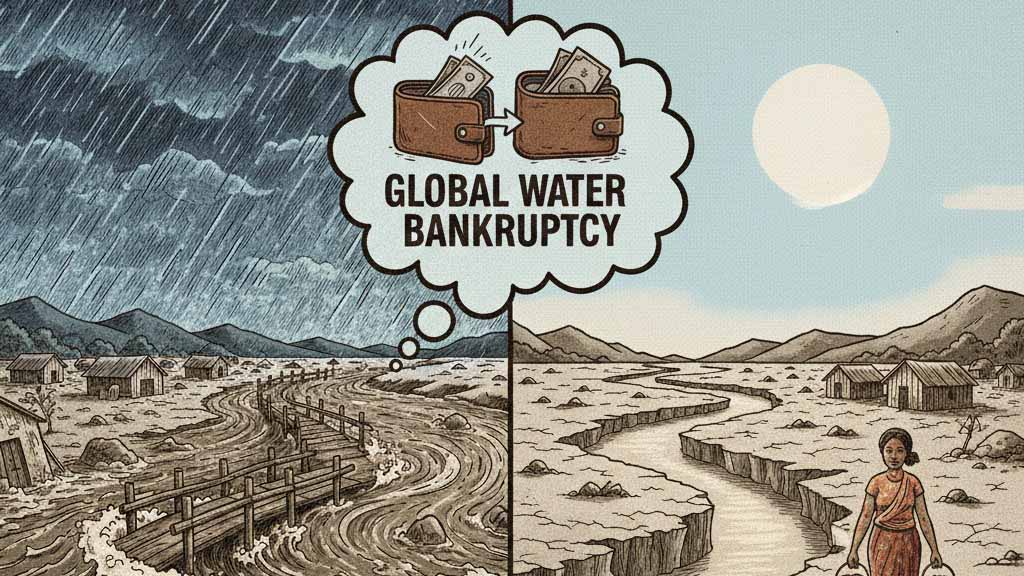
Just a couple of weeks ago, I was writing about heavy rains and flooding, now we are told the world is facing ‘global water bankruptcy’.
This strikes me as such an odd statement to make while standing in Eswatini, as just recently recovering from being ankle-deep in floodwater, watching rivers spill over their banks, bridges surrender to the current, and roads quietly disappear.
If this is what bankruptcy looks like, then it is certainly not the empty-wallet variety we are accustomed to.
In recent weeks, the rains have arrived with enthusiasm and very little restraint. Rivers have swollen beyond recognition. Communities have been cut off. Children have stayed home from school because crossing a flooded stream is not part of the curriculum. Farmers have watched fields drown just months after worrying about drought.
It is a special kind of irony to experience a water crisis while surrounded by water. However, this contradiction sits at the heart of what experts now call global water bankruptcy.The lack of rain is not the cause of water bankruptcy. It has to do with not managing, distributing, storing, safeguarding and appreciating the water we are given. Globally, humanity is consuming freshwater faster than ecosystems can replenish it, polluting what remains and dismantling the natural systems that once regulated its flow. Least developed countries such as Eswatini have played an almost invisible role in driving climate change. Although our carbon footprint is modest and our industrial emissions are minimal, we are still expected to absorb the consequences of a destabilised climate with quiet resilience, often without the resources that make resilience possible. In wealthy countries, climate stress triggers investment. New dams are planned, pipes are replaced and digital monitoring systems are installed. In poorer countries such as our beloved Eswatini, climate stress triggers workshops, pilot projects and well-meaning advice about rainwater harvesting, often delivered while the pipes continue to leak and treatment plants struggle to cope.
Southern Africa is increasingly defined by extremes. Long dry spells are punctuated by intense rainfall events. In fact, we are expecting an extremely hot dry few days this very week. Rivers will overflow, infrastructure fail and homes damaged. Yes, I have seen first-hand an entire wall collapse in on family at Mahebedla (near Pine Valley) and then, almost abruptly, the rain stops again. It’s a viscous cycle.The problem is not that Eswatini lacks water. The problem is that we lack systems capable of turning rainfall into long-term security. Worth noting is that climate change did not invent these weaknesses, but merely exposed them.Water insecurity also has a remarkable talent for magnifying inequality. When water is scarce, it is women and girls who walk further to fetch it. It is rural communities that wait longest for repairs. It is informal settlements (skomplas’) that experience outages first and longest. Globally, water insecurity is often framed as a future risk. For countries like Eswatini, that future has already arrived. What makes the current situation particularly absurd is the timing. Heavy rains should be a moment of relief. They should refill dams, recharge groundwater and ease pressure on households. Instead, they highlight how unprepared we are to capture and manage abundance. Global water bankruptcy may be a global concept, debated in international forums and policy papers, but its consequences are paid locally. They are paid in hours spent fetching water, in crops lost to floods and droughts alike, in school days missed, and in the quiet frustration of turning a tap and hearing nothing but air. At some point, the irony stops being funny. The jokes dry up faster than the reservoirs and eventually, the bill comes due, sadly paid by the most vulnerable members of society.


















Leave a comment