

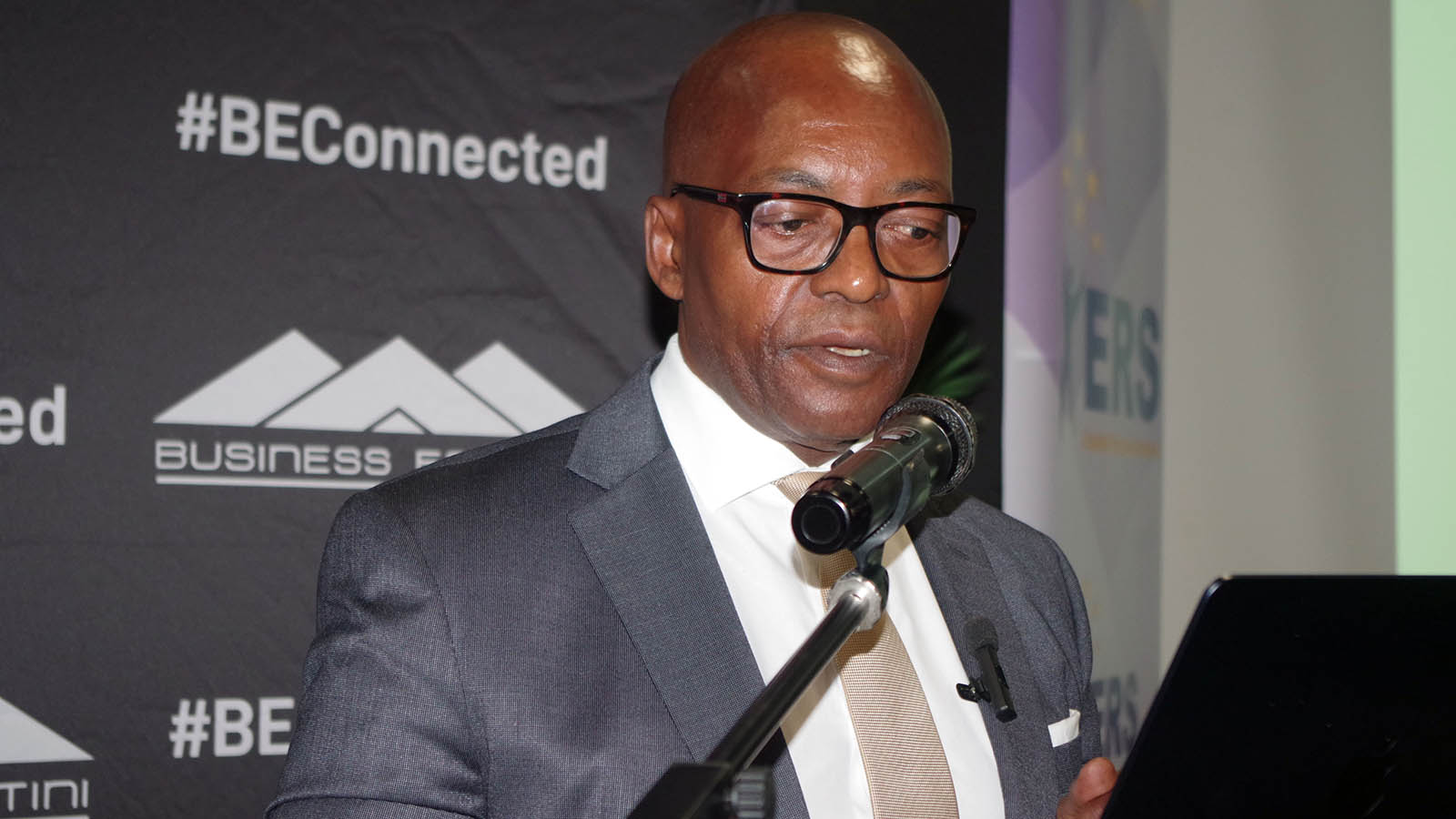
EZULWINI – Government’s push to strengthen domestic resource mobilisation is not simply about raising revenue, but about safeguarding Eswatini’s sovereignty in a constrained fiscal environment.
This was the central message delivered by Finance Minister Neal Rijkenberg during his keynote address at the 2026 Business Eswatini Tax Indaba held at The Happy Valley Hotel yesterday.
Addressing captains of industry, tax professionals and government officials, Rijkenberg said dovernment is operating within tight fiscal limits, making domestic revenue mobilisation a national imperative rather than a mere technical objective.
“Government operates within a constrained fiscal environment, therefore, domestic resource mobilisation is not merely a fiscal objective, but a sovereignty imperative,” he said.
“It is about strengthening our ability to finance our own development priorities, reduce vulnerability to external shocks and build a resilient, inclusive economy for future generations.”
The Indaba, convened by Business Eswatini, centred on the Practice Note on the Taxation of Benefits-in-Kind and Certain Allowances, which has triggered concern among employers over valuation methods and compliance requirements.
Rijkenberg said the issuance of the practice note reflected government’s commitment to strengthening tax administration, enhancing clarity in the interpretation of tax law and safeguarding the integrity of the tax base.
However, he acknowledged concerns raised by businesses regarding interpretation, transitional arrangements and the practical application of valuation tables and formula-based calculations embedded in the practice note.
“This is precisely why engagements such as today’s Indaba are important,” he said. “Government remains committed to ensuring that implementation is reasonable, administratively workable and consistent with the law.”
He noted that the practice note provides mechanisms for directives and review in instances of disagreement on valuation, demonstrating that the framework allows for structured engagement within the law rather than rigid enforcement.
The minister outlined three strategic pillars guiding government’s tax reform agenda: Expanding the tax base through growth, strengthening compliance and protecting fairness, and digitalisation and simplification.
On expanding the tax base, Rijkenberg said a narrow tax base unfairly overburdens compliant taxpayers and discourages formalisation.
*…
Tax certainty, competitiveness
EZULWINI – While reaffirming government’s commitment to revenue integrity, the Minister for Finance, Neal Rijkenberg, was careful to acknowledge the competitive pressures facing businesses.
He noted that tax policy does not function in isolation from economic realities, especially in a regional and global environment where investment decisions are influenced by predictability and administrative burdens.
“Tax certainty is a competitiveness issue,” he said. “Investors prefer jurisdictions where the rules are clear and consistently applied, and where incentives are targeted and compliance processes are streamlined.”
However, he cautioned against equating competitiveness with a ‘race to the bottom’ in tax rates.
“Competitiveness does not mean a race to the bottom. It means designing policies that broaden the tax base, minimise distortions and reward productivity, innovation and value addition,” he said.
He added that the focus remains on creating a balanced system that encourages entrepreneurship, supports small and medium enterprises and attracts strategic industries, while safeguarding revenue for national development.
Rijkenberg outlined three guiding principles for the reform process: Equity, simplicity and collaboration.
“First, equity – remuneration should be taxed fairly regardless of its form. Second, simplicity – compliance systems should not be unnecessarily burdensome. Third, collaboration – policy refinement benefits from structured consultation,” he said.
He stressed that the success of the reform would not be measured solely by additional revenue collected, but by the extent to which it enhances transparency, fairness and trust in the tax system.
He encouraged participants to engage constructively and contribute technically grounded proposals, noting that Business Eswatini intended to consolidate stakeholder inputs into a formal position paper.
“Government welcomes structured, technically grounded proposals that strike a balance between revenue integrity and administrative efficiency,” he said.
In his remarks, Business Eswatini Chief Executive Officer Nathi Dlamini struck a lighter but pointed tone, framing the theme of the Indaba as a reality check for businesses.
*Full article available on Pressreader*














Leave a comment