

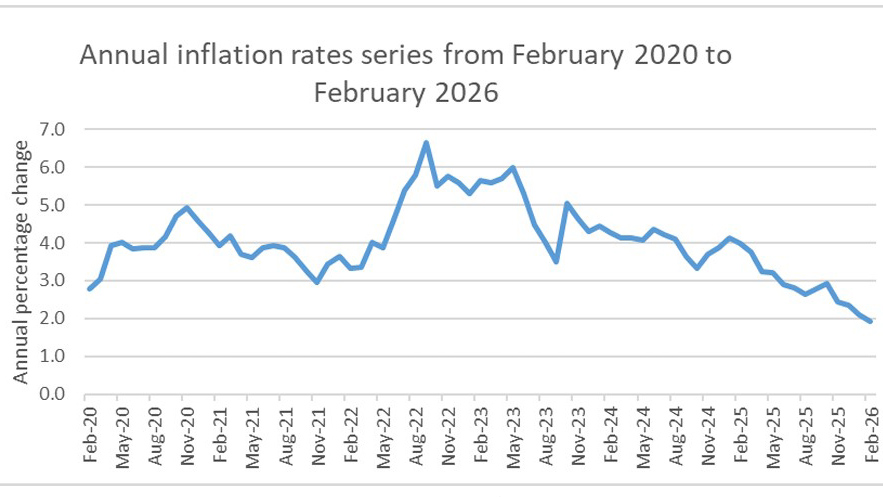
MBABANE – Eswatini’s headline inflation continued its downward trajectory in February 2026, easing to 1.9 per cent, signalling sustained price stability in the economy and offering relief to consumers and businesses alike.
According to the latest Consumer Price Index (CPI) report released by the Central Statistical Office (CSO), the 1.9 per cent annual inflation rate represents a 0.2 percentage point decline from the 2.1 per cent recorded in January 2026.
More significantly, it marks a sharp drop of 2.1 percentage points from the 4.0 per cent recorded in February 2025, highlighting a notable moderation in price pressures over the past year.
The continued easing of inflation comes at a time when the country has been navigating a complex economic environment, with policymakers closely monitoring price developments to maintain macroeconomic stability.
On a month-on-month basis, prices declined slightly by 0.1 per cent in February, compared to a 0.3 per cent increase recorded in January.
This indicates that not only is inflation slowing on an annual basis, but prices are also stabilising in the short-term.
The decline in monthly inflation was largely driven by reductions in key consumer categories such as education and miscellaneous goods and services, both of which recorded slower or zero growth rates during the month.
Economists often view such trends as an early indication of softening demand pressures or improved supply conditions, both of which can contribute to stabilising the cost of living.
The report shows that inflation for goods stood at 1.9 per cent, while services inflation was slightly higher at 2.0 per cent in February.
This near parity between goods and services inflation suggests a broad-based slowdown in price increases across the economy, rather than being concentrated in a few sectors.
Goods inflation has been particularly influenced by subdued price movements in food and transport-related items, while services inflation reflects relatively stable costs in areas such as education and communication.
Despite the overall moderation, certain categories continued to exert upward pressure on the headline inflation rate.
*Full article available on Pressreader*




















Leave a comment