

MBABANE – The latest merchandise trade statistics released by the Eswatini Revenue Service (ERS) for February 2026 present a complex portrait of a nation navigating shifting global currents.
While the headline figures indicate a cooling of international trade activity compared to the previous year, a closer look at the data reveals a strategic pivot towards regional markets and significant growth in specific industrial niches.
As the kingdom approaches the end of the 2025/26 fiscal year, the balance between global volatility and regional stability has never been more critical for Eswatini’s economic trajectory.
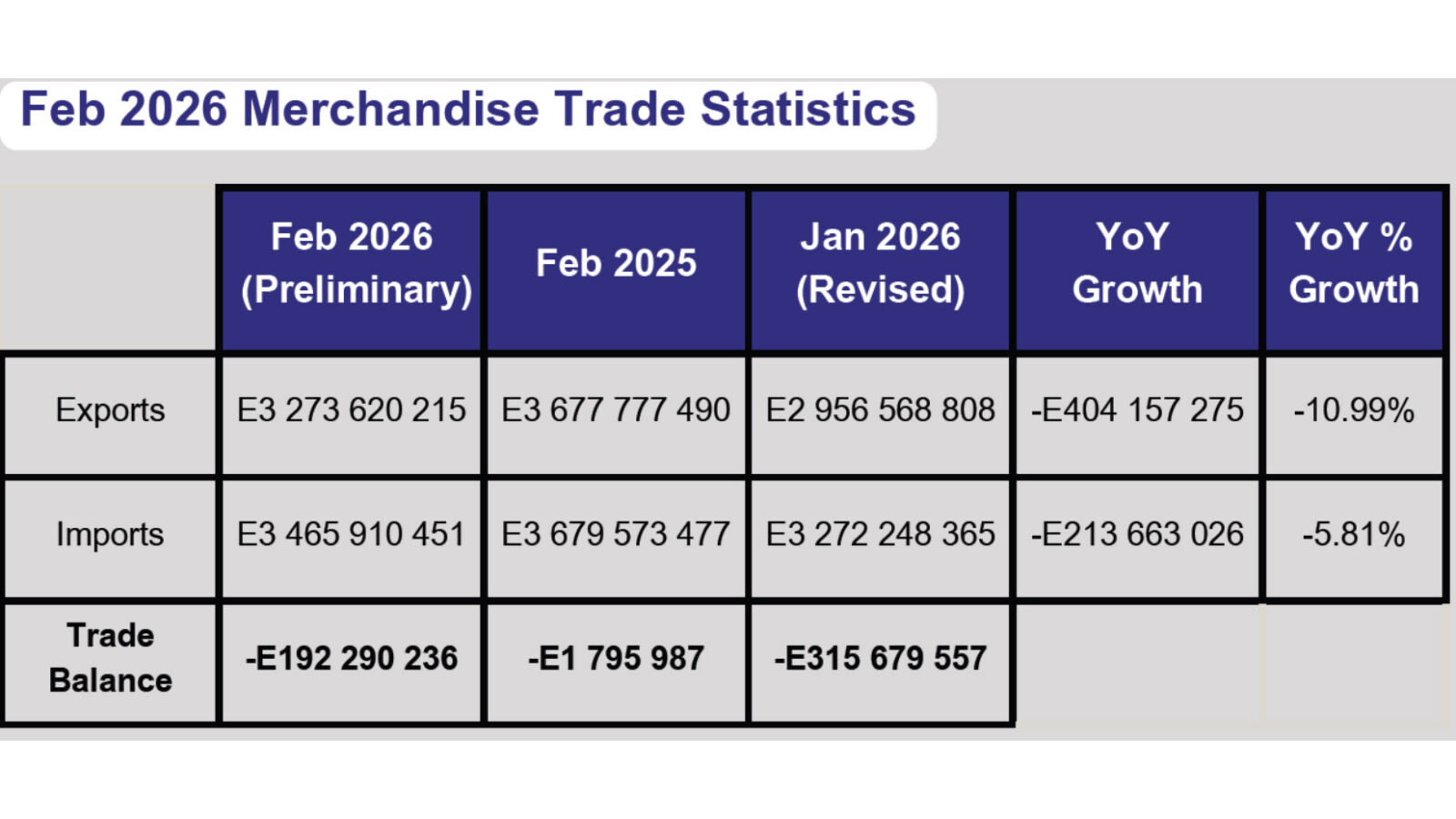
In February 2026, Eswatini’s total exports stood at E3.274 billion, representing a notable 10.99 per cent contraction compared to the E3.678 billion recorded in February 2025.
This decline in outward shipments was accompanied by a more moderate 5.81 per cent decrease in imports, which fell from E3.680 billion a year ago to E3.466 billion in the current period.
The result of these movements is a monthly trade deficit of E192.3 million. While any deficit requires careful monitoring, there is a silver lining when looking at the revised figures from January 2026; the deficit has actually narrowed from the previous month’s E315.7 million gap, suggesting a month-on-month improvement in the kingdom’s net trade position.
For the cumulative fiscal year (April 2025 to February 2026), the data shows a remarkably tight race.
Total year-to-date (YTD) exports reached E39.400 billion, a slight 2.49 per cent dip from the E40.408 billion seen in the same period last year. Conversely, YTD imports rose by 1.88 per cent to E39.369 billion.
This leaves the kingdom with a razor-thin fiscal year trade surplus of E31.4 million, a sharp decline from the E1.765 billion surplus maintained during the previous 11-month cycle.
Perhaps the most striking takeaway from the February report is the diverging performance between Eswatini’s global trade and its trade within the Southern African Customs Union (SACU).
While total global exports are down, Eswatini’s exports to its SACU partners rose by 2.09 per cent year-on-year, reaching E2.455 billion.
*Full article available on Pressreader*




















Leave a comment