

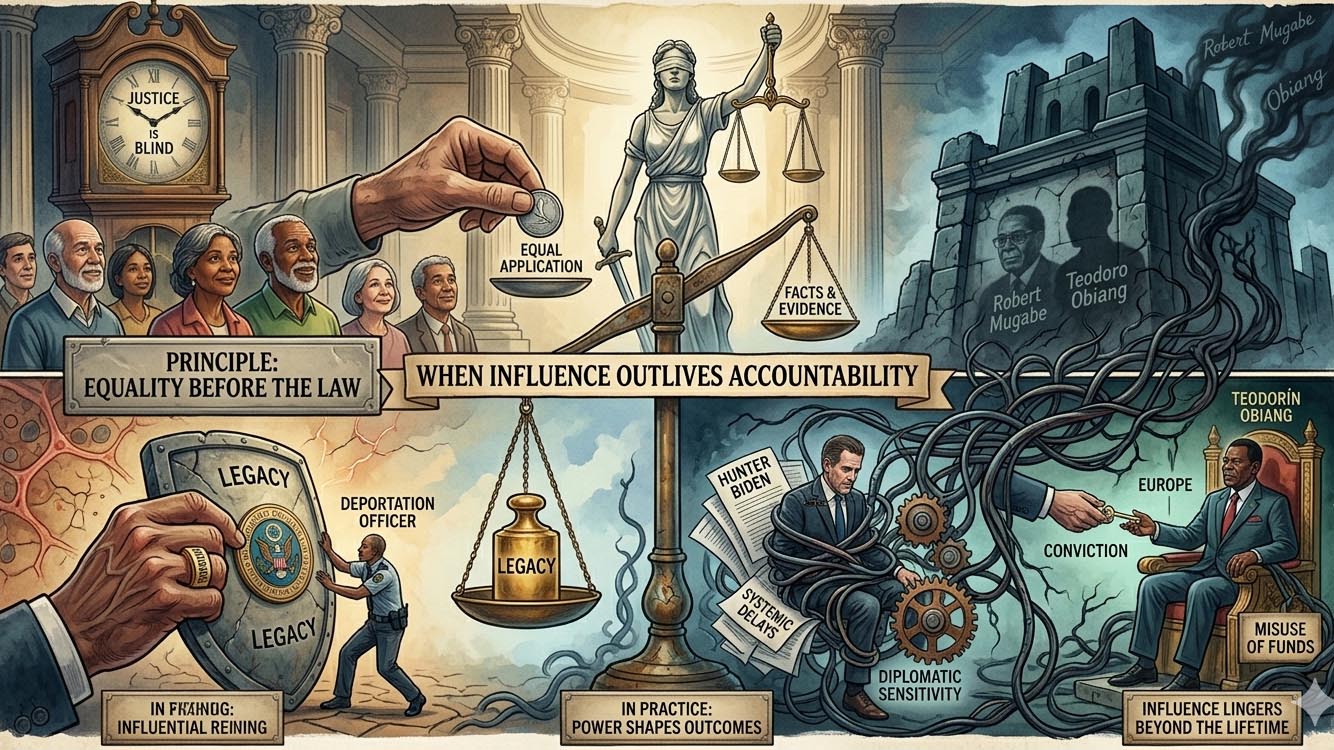
Justice is often portrayed as blind – impartial, consistent and untouched by status. In principle, the law should apply equally, whether one is a head of State or an ordinary citizen. In practice, however, global headlines continue to reveal a more complicated reality, one where power shapes outcomes and influence lingers far beyond the lifetime of those who once wielded it.
A recent case involving Robert Mugabe’s son brings this issue into sharp focus. Bellarmine Mugabe was deported from South Africa, following a firearms-related offence and fined E 600 000. Authorities have taken steps to remove him from the country, presenting an image of a system acting decisively.
On the surface, deportation suggests accountability. However, would a young man without a powerful surname have experienced the same process, with similar delays, diplomatic sensitivity and public restraint? Or would the response have been swifter, harsher and less restrained?
This is where the conversation shifts from a single case to a broader global pattern.
Across different political systems and continents, the children of influential figures often appear to operate within a different framework of consequence, one shaped not only by law, but by legacy.In the United States, Hunter Biden has faced legal challenges ranging from tax issues to firearm-related charges. His case has been highly publicised and legally complex, with critics arguing that his position as the son of a sitting president influenced both the pace and handling of proceedings. Supporters, on the other hand, point to the fact that he has faced prosecution as evidence that institutions still function.
Meanwhile, in Central Africa, Teodorín Obiang, son of long-serving leader Teodoro Obiang Nguema Mbasogo, has been convicted in European courts for corruption and the misuse of public funds. Despite these convictions, his political standing at home has largely insulated him from serious repercussions, allowing him to retain power and influence.These examples reveal a troubling continuity: Influence does not simply open doors, it shields, delays and at times redirects justice. The systems meant to enforce accountability can become entangled with the very power structures they are supposed to regulate.
What makes the Mugabe case particularly eye-opening is the dimension of legacy. Robert Mugabe is no longer alive, but his name still carries weight across the region. Decades of political authority, diplomatic relationships and historical influence do not simply disappear. They echo through institutions, perceptions and decisions.
Then, should influence extend into the next generation when it comes to justice?If the answer is yes, even implicitly, then the principle of equality before the law begins to fade. Justice becomes uneven, shaped not only by facts and evidence, but by identity and lineage. It introduces the idea that consequences are negotiable for some, while unavoidable for others.For many African countries, where democratic institutions continue to evolve and assert independence, such dynamics carry serious implications. Confidence in the legal system depends on consistency. When citizens perceive that certain individuals receive preferential treatment, belief in institutions weakens.In societies where inequality is already a pressing concern, the perception of a two-tier justice system can deepen divisions.
It creates a sense that the law is not a neutral force, but a flexible tool, firm for the ordinary citizen, adaptable for the connected.
At the same time, it is important to recognise that not every case involving the children of powerful figures is handled with bias. Some do face prosecution, conviction and penalties. However, the broader pattern, the delays, the diplomatic caution and the public hesitancy often suggest that influence remains a factor, even when it is not openly acknowledged.
The Mugabe case, therefore, is not simply about one individual or one legal outcome. It highlights a wider global tension between power and accountability. It asks whether legal systems are strong enough to stand independently of historical influence or whether they remain vulnerable to it.
Ultimately, the credibility of any justice system rests on its ability to apply the law evenly. That means ensuring that a name, no matter how prominent, does not become a shield. It means recognising that while political power may be inherited socially or economically, it should not be inherited legally.If justice is to retain its meaning, it must resist the pull of legacy. It must remain anchored in fairness, not familiarity, in principle, not proximity to power.
Otherwise, the idea of blind justice becomes little more than an ideal admirable in theory, but compromised in practice. When that happens, the real danger is not just individual cases slipping through the cracks, but an entire system gradually losing its authority. When influence outlives accountability, justice itself begins to fade.


















Leave a comment