

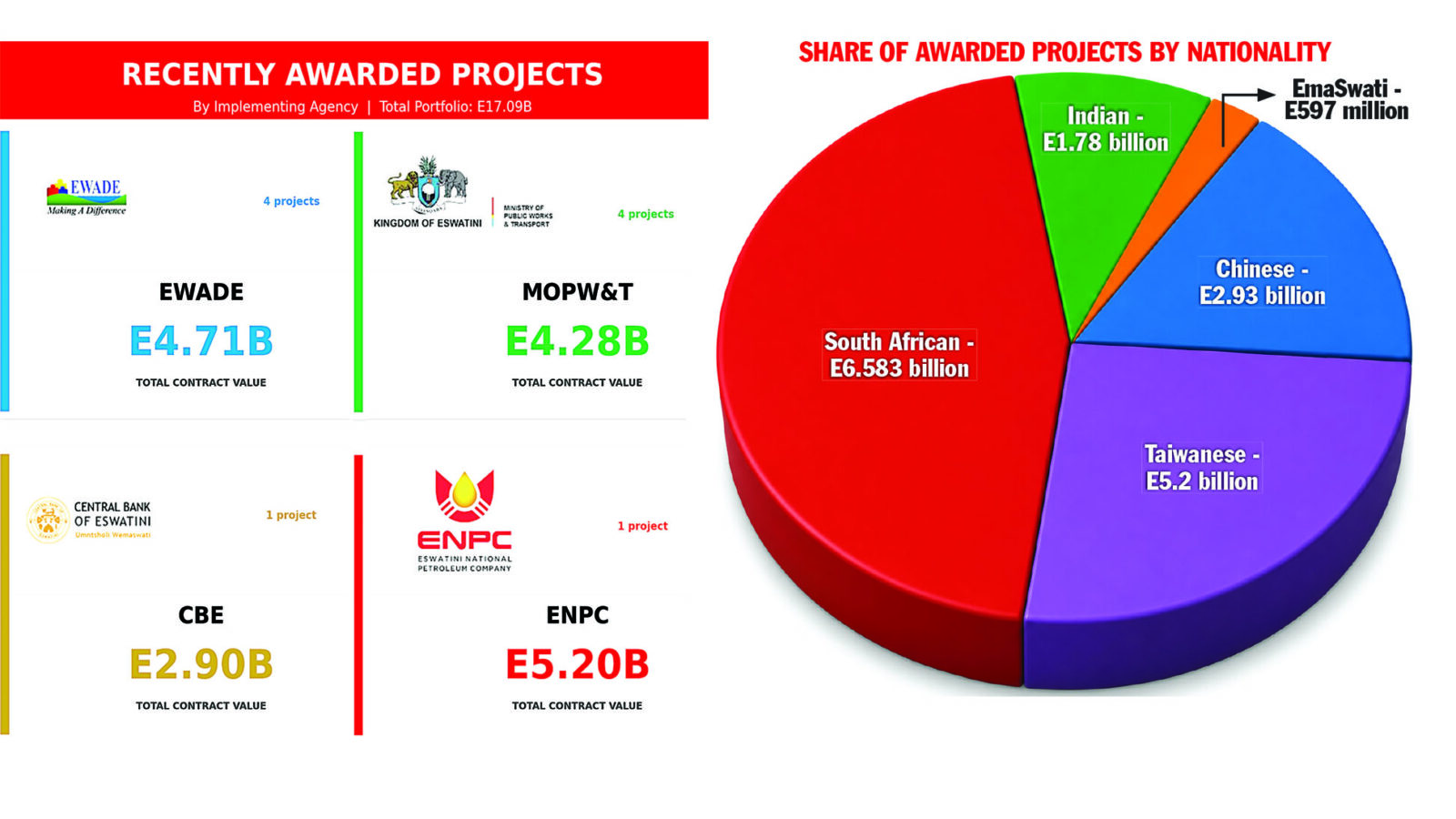
The past week has left a E17.09 billion economic development question hanging over our heads. It urgently needs answers that make sense to every taxpayer.
This follows an investigation by our Times of Eswatini into the implementation of government’s economic growth policies, which has revealed a mind-blowing E17.09 worth of tenders being awarded to foreign companies. Questions have emerged, all bordering on who is really benefitting from this massive transfer of national wealth.
As reported by the investigation led by our Deputy Weekend Editor, Mfanukhona Nkambule, these tenders represent nearly 20 per cent of our gross domestic product (GDP). This figure is no small change for an economy like ours, which reportedly has one of the highest unemployment rates in the world. Undoubtedly, infrastructure development ranks among the top catalysts for economic growth in any country. Economists educate us that when a local contractor wins a tender, every Lilangeni paid circulates within our borders; salaries are spent at local shops, materials are bought from local suppliers and taxes get paid to the Eswatini Revenue Service (ERS), which helps government fulfil its obligations such as ensuring there is adequate health care, education facilities, scholarships, payment of suppliers, public servant salaries, infrastructure maintenance, etc.
An example given by an economist in the article is how a E10 million payment to a contractor could generate E50 million worth of economic activity as it changes hands multiple times. Yet, when foreign firms take our contracts, they import their own labour, bring in materials from abroad and repatriate their profits to headquarters in South Africa, China or Europe.
“The money enters our economy and leaves immediately, like water through a sieve,” as one economist put it. He explained that the physical asset remains, but the financial ecosystem that should flourish around it is destroyed.
Unless, of course, the country’s policies and legislation can achieve the right balance. Across the globe, nations have implemented policies to ensure that public funds largely benefit their own citizens. We would do well to study the examples used by the Times.
Nigeria, through the Nigerian Oil and Gas Industry Content Development Act of 2010, mandates local sourcing of workforce and materials by promoting a ‘Nigeria First’ policy to enhance indigenous capabilities. South Africa’s Broad-Based Black Economic Empowerment policy obliges foreign firms to engage with black South Africans, ensuring local input in its procurement processes. Rwanda’s ‘Made in Rwanda’ strategy shows a significant increase in local procurement, with government tenders favouring local value addition. The United States enforces the Buy American Act and the Jones Act to prioritise domestic products and shipping within its markets.
As indicated, the solution does not involve isolating ourselves from the global community. Foreign expertise has value, which we need for our local contractors to grow.
The way forward lies in mandatory joint ventures and effective local content policies. Eswatini already possesses the legislative framework. The Public Procurement Act of 2011 and the Construction Industry Council Act of 2013 provide for local participation thresholds. What is lacking is enforcement.
We must ensure that all major foreign contractors partner with local firms through joint ventures, with a minimum 40 per cent local equity stake. The Maguga Dam project, as noted in the Times investigation, demonstrated that emaSwati can work alongside international partners successfully.
Why, as a country, can we not ensure that large projects are broken into smaller work packages to enable lower categorised Swati-owned contractors to participate meaningfully? The procurement manual of the African Development Bank (AfDB), which is a major funder of recent development projects, allows for such an approach.
We deserve to know why existing laws requiring skills transfer, local employment and procurement of materials are not being implemented. Are the penalties for non-compliance substantial enough to deter violations? Is there a transparent monitoring mechanism in place? What, then, is the role of the Eswatini Public Procurement Regulatory Agency (ESPPRA), if it cannot track and report on local content compliance in every major project?
The majority of the E17.09 billion leaving our shores represents a significant loss of opportunities. It is capital that could have seeded a new generation of Eswatini entrepreneurs, funded tertiary education for our engineers and expanded our tax base. The Consumer Forum and several business organisations, as well as economists, have rightly raised serious concerns about what they describe as the disenfranchisement of emaSwati.
These concerns speak to lost employment and children dropping out of school. We cannot build local capacity by excluding locals from the biggest projects.
As one analyst quoted in the same investigation observed: “How is a local construction firm supposed to grow from a E10 million company to a E500 million company if government refuses to give them a chance? We are stuck in a cycle of dependency.” It is time for a serious review of the country’s approach to development.
This model seems to be directing that Eswatini must rent its future from abroad. Those responsible for this trajectory now need to tell us, WHY?


















Leave a comment