

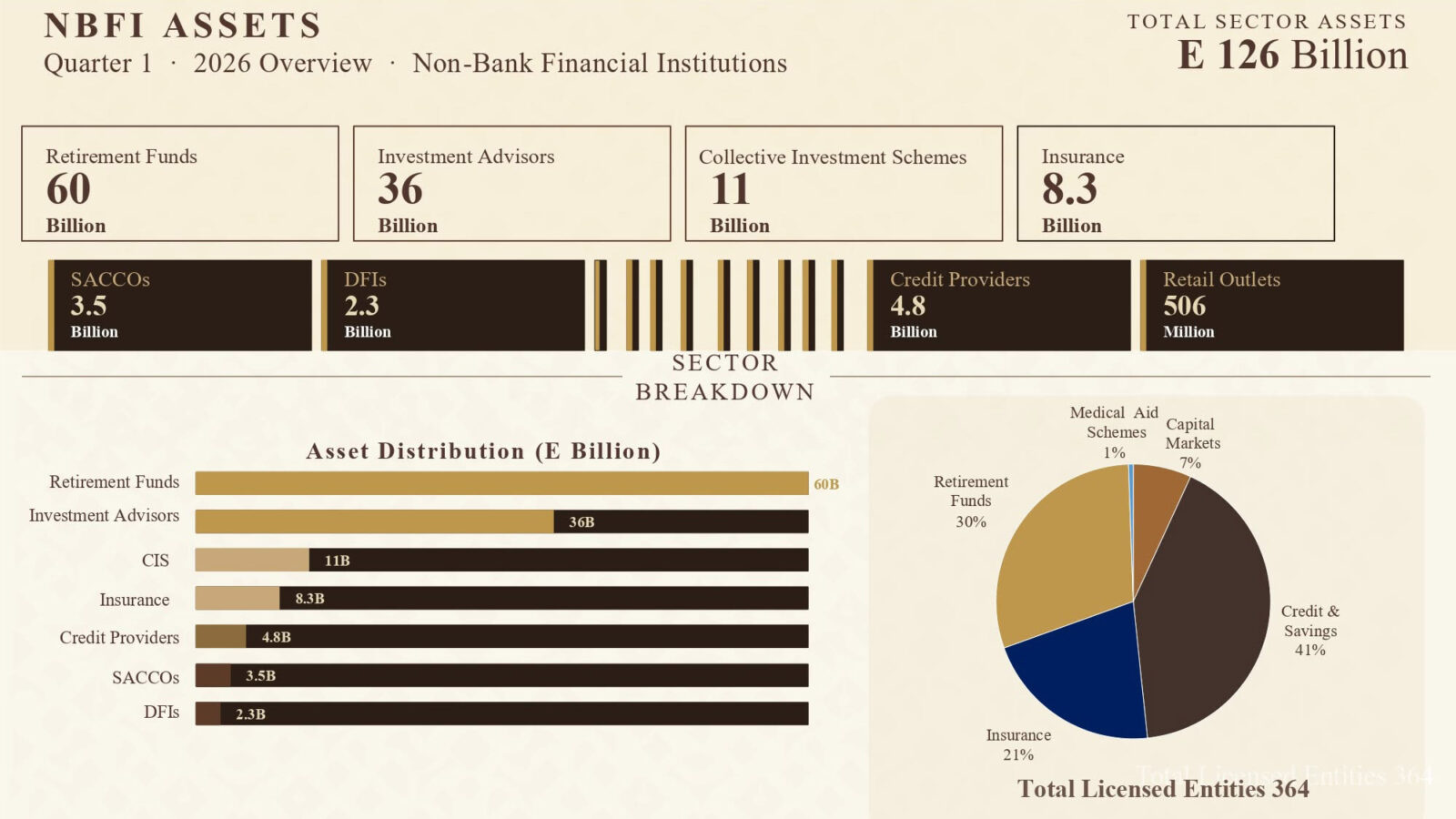
MBABANE – The Non-Bank Financial Institutions (NBFI) sector continued to demonstrate resilience during the first quarter of 2026.
The sector maintained a strong asset base of E126 billion despite a slight decline from E128 billion recorded in the fourth quarter of 2025.
According to the Financial Services Regulatory Authority (FSRA), the sector remains stable and well-positioned to withstand external economic pressures and market volatility.
The regulator noted that while fluctuations continue to affect financial markets globally and regionally, the country’s NBFI industry has maintained its strength and adaptability.
“Despite ongoing volatility and fluctuations within the markets, the Non-Bank Financial Institutions sector continues to demonstrate resilience and stability.
It remains well-positioned to withstand external pressures and market dynamics, maintaining its strength and capacity to adapt to evolving economic influences,” the FSRA stated.
The latest figures show that total sector assets stood at E126 billion at the end of March 2026, representing a marginal decline of E2 billion, or about 1.6 per cent, from the E128 billion reported at the end of December 2025.
Despite the slight reduction in overall assets, several key segments recorded growth, highlighting the sector’s underlying strength and diversification.
Investment advisors strengthened their position as the second-largest asset class, with assets increasing from E35 billion in the fourth quarter of 2025 to E36 billion in the first quarter of 2026.
The growth reflects continued investor confidence and the increasing role of professional fund management services within the country’s financial system.
Collective Investment Schemes (CIS) maintained assets of E11 billion, showing stability despite prevailing market uncertainties.
The insurance industry also registered growth during the quarter, with assets increasing from E8.1 billion to E8.3 billion.
The increase points to continued expansion within the insurance market and stronger asset accumulation by insurers.
Savings and Credit Co-operative Organisations (SACCOs) were another bright spot, recording asset growth from E3.3 billion in the fourth quarter of 2025 to E3.5 billion in the first quarter of 2026.
*Full article available on Pressreader*




















Leave a comment