


By understanding how maize feeds, grows and responds to nutrients, farmers can dramatically improve yields without increasing costs.
According to Soil Science and Plant Nutrition Research Officer in the Ministry of Agriculture, Department of Agricultural Research and Specialist Services, Bongani Mvubu, split fertiliser application remains one of the most efficient ways to get more from every bag of fertiliser.
The approach ensures that nutrients are supplied when the crop needs them most, reducing waste and protecting the investment made in fertiliser.
What is split side-dressing?
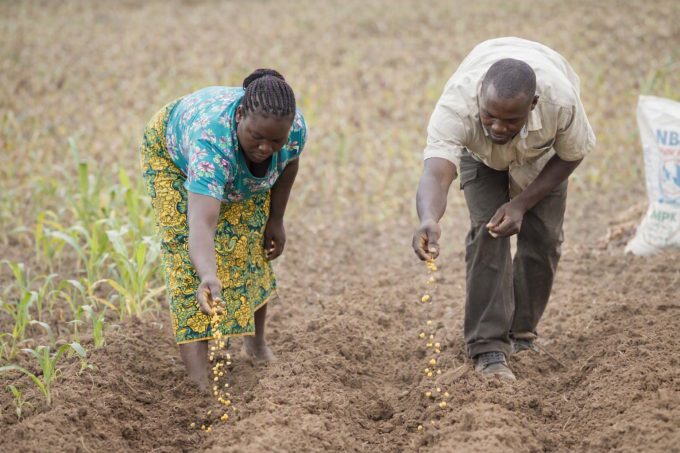
Split side-dressing involves dividing the crop’s fertiliser requirement into several applications, instead of applying everything at planting.
A portion, mainly phosphorus and sometimes nitrogen, is placed at planting as a basal dose. The remaining fertiliser, usually nitrogen, is applied in one or more side-dressings during the maize plant’s vegetative growth.
Mvubu notes that timing is crucial because maize displays nutrient deficiencies early. Nitrogen shortage shows as pale-yellow older leaves forming a ‘V’ pattern along the midrib.
Phosphorus deficiency results in stunted plants with dark green to purplish leaves, while potassium deficiency typically scorches leaf edges, eventually weakening stems and reducing grain filling. Side-dressing helps prevent these stress symptoms by feeding the crop steadily.
Why split applications matter
Mvubu highlights several advantages:
Reduced nutrient losses: Applying all fertiliser at planting often leads to leaching or volatilisation, especially under heavy rains. Splitting reduces these losses significantly.
Better alignment with crop demand: Maize takes up most nitrogen during rapid vegetative growth and early grain filling. Split applications ensure nutrients arrive at the right time.
Higher yields and improved grain quality: Avoiding nutrient stress during critical stages like leaf development, tasselling and grain formation leads to vigorous plants and fuller cobs.
Weather-responsive management: In seasons of erratic rainfall, split applications allow farmers to delay top-dressing until soil moisture improves.
Flexibility and correction: Farmers can adjust fertiliser amounts based on leaf colour, tissue test results, or visible nutrient deficiencies.
HOW TO APPLY SPLIT FERTILISER (STEP-BY-STEP)
- Conduct a soil test: This sets the foundation. Tests show pH, phosphorus, potassium and residual nitrogen levels. All fertiliser plans should begin here.
- Set total fertiliser requirements: Rates depend on yield targets and soil fertility.
- Apply basal fertiliser at planting: Use a phosphorus-rich fertiliser like compound NPK or DAP. Place it besides, not directly on, the seed.
- First side-dress at V4–V6: When maize has 4–6 fully emerged leaves, apply the first top-dress. This boosts leaf expansion and strong early growth.
- Second side-dress at V8–V10: Apply nitrogen again 30–45 days after emergence as the crop enters rapid vegetative growth.
- Optional third application: For high rainfall areas or high-yield targets, apply a final top-dress at tasselling (VT) or early silking (R1).
- Correct application method: Apply fertiliser 5–10cm from the row. Avoid placing product in the whorl to prevent burning. If using urea, always wait for rain or irrigation to help incorporation.
- Follow safety guidelines: Wear protective gear, keep fertiliser away from children and store in a dry place.
TIMING BY GROWTH STAGE
Growth stage, not calendar days, provides the most reliable guide:
Basal: At planting
1st top-dress: V4–V6 (2–3 weeks after emergence)
2nd top-dress: V8–V10 (4–6 weeks after emergence)
Optional: VT–R1 (tasselling to silking)
HOW MANY SPLITS SHOULD FARMERS USE?
Mvubu recommends adjusting frequency according to rainfall:
- High rainfall areas (>1 000 mm/year): Basal + V4–V6 + V8–V10 + optional VT/R1. Frequent small doses prevent nitrogen leaching.
- Medium rainfall areas (600–1 000 mm/year): Basal + V4–V6 + V8–V10. This provides a good balance between efficiency and labour.
- Low rainfall areas (<600mm/year): Basal + 1 top-dress at V6–V8. If rains are uncertain, only apply when moisture is expected.
TYPICAL NITROGEN RATES
Adjust depending on yield goals:
- Low yield (2–4 t/ha): 60–100kg N/ha
- Medium yield (4–6 t/ha): 100–150kg N/ha
- High yield (>6 t/ha): 150–220+ kg N/ha
EXAMPLE FOR A 5 T/HA TARGET (150KG N/HA TOTAL):
- Basal: 30–40kg N/ha
- First side-dress: 50kg N/ha
- Second side-dress: 60–70kg N/ha
RECOMMENDED FERTILISER MATERIALS
LAN (28 per cent): Ideal for side-dressing; less volatilisation and adds calcium.
Urea (46 per cent): Common but prone to evaporation; avoid overuse as it acidifies soil.
Ammonium sulphate (21 per cent + S): Best where sulphur deficiency exists.
ORGANIC AND BIOLOGICAL OPTIONS
Mvubu encourages integrating organics to improve long-term soil health:
- Well-composted kraal manure
- Vermicompost
- Legume cover crops (lablab, cowpea, mucuna)
- Compost teas and crop residues
- Reputable biofertilisers
Split fertiliser application gives farmers a powerful, flexible tool to protect fertiliser investment and push yields higher.
By aligning nutrient supply with maize demand, monitoring rainfall and incorporating organic materials, farmers can build healthier soils and more resilient crops.
With proper timing and the right fertiliser choices, Mvubu emphasises, “every maize farmer can achieve better yields, even under challenging conditions.”
















Leave a comment