

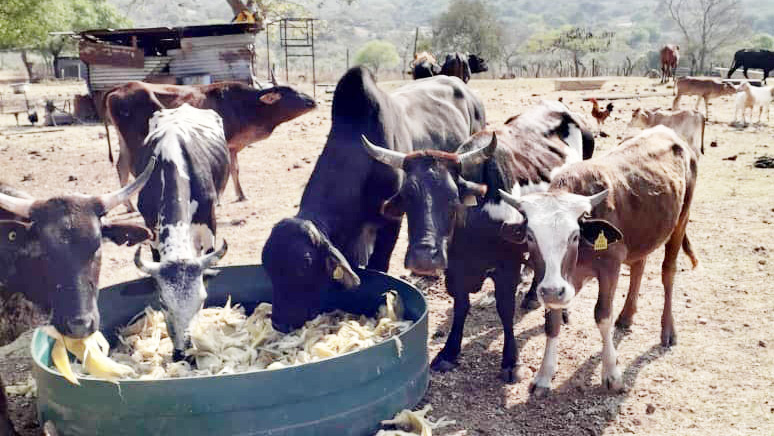
As winter has set in and grazing pastures dry up, ensuring proper nutrition for cattle becomes critical. Without adequate feeding strategies, livestock can lose weight, become more susceptible to disease and experience reduced productivity. Mbongeni Mabuza, a Livestock Nutritionist at the Ministry of Agriculture, shares expert insights into five essential pillars that every farmer should follow to keep their herd healthy and resilient during the cold season:
Control parasites in cattle (deworm and dip)
Cattle under nutritional and other stresses are less resistant to parasites than in normal conditions. Worms can be a serious problem with young cattle. During drought conditions, all cattle under 18 months of age should be treated for worms.
Ideally, deworming should be done once every three months. Deworming cattle is very critical in the beginning of the dry season to minimise competition for the limited nutrients in grazed forage. The deworming drugs and dose should be consulted with a qualified veterinarian.
Summer dipping should not be adhered to as a normal schedule but should adopt winter schedules i.e., dipping once every fortnight.
Supplement feed quality and quantity
Supplementation is defined in two ways:
- Supplement minerals (EPMB) and vitamins (AD3E)
- Supplement minerals and vitamins through provision of minerals licks and/or injectable solutions.
- Provide energy – protein mineral licks (e.g. Nutritub, rumevite) at free will to enhance rumen function for efficient digestion of marginal feeds.
- Important minerals include phosphorus, copper, magnesium, iron, sodium, cobalt, selenium and zinc. Contact the ministry for assistance on how to make licks on-farm.
Critical injectable vitamins for the winter season are Vitamin A, D and E.
Separate animals to be supplemented based on their body condition, that is, thin animals, suckling animals and calves should be fed separate to protect them from bullying by those in good condition.
Supplement forage
supply and concentrate feeding
Forage quantity is supplemented with roughage feeds which include hay bales, crop residues like cereal straws, legume straws; agro by-products like citrus/pineapple pulp, brewer’s grain, molasses-hominy chop-chicken litter mixtures and sugar cane tops.
Farmers are encouraged to correctly store crop residues after harvesting and seek technical advice within the Ministry of Agriculture on recommended technologies of using feed-grade urea, salt and molasses to improve digestibility, nutritional quality and palatability of such crop residues.
A mixture of 4 per cent urea (4kg dissolved in 100L) water can treat 200-250kg straw incubated under airtight conditions for 4-5 weeks. This raises the digestibility to over 60 per cent and 10 per cent Crude Protein.
Ratios of three parts (energy): 1 part (protein) + 1 per cent salt and 10 per cent molasses make good maintenance ration for cattle. Energy sources include hominy chop (Umhhungu/ emakhafitsi, crushed maize, wheat bran, etc. while protein sources include bean straws, fodder tree leaves, oil seed cakes and treated broiler litter. Agro by-products with high moisture content can be mixed with dry chopped straw to attain 55-60 per cent moisture content and conserved as silage.
Cull unproductive stock: It is critical for every farmer not to keep an animal that is unproductive. This helps to reduce grazing pressure in the rangelands, thus ensuring sustainable use of the grazing resources. Unproductive animals include steers or oxen not used for ploughing, old animals, aborting animals and those that are barren (not calving). Farmers can generate more money through selling steers to feedlotters.
Inoculate
animals against clostridia
Animals should be vaccinated against Clostridia, especially Blackquarter and Botulism during the dry season as advised by Animal Health experts.
This is because animals graze close to the ground and may eat vegetable waste or litter where they may pick bacterial spores of Clostridium chauvoei, Clostridium sodellii and/or toxin produced by Clostridium botulinum which are the main culprits causing Blackquarter and Botulism in cattle.
Clostridial diseases are highly fatal; hence farmers should adhere to vaccination programmes to prevent them.
Identification and
recommendable use of fodder trees
The most important aspect of fodder trees as a source of feed for farm animals is the high protein content which ranges from 14-29 per cent.
Farmers are advised to take note of important indigenous fodder trees that currently exist in their localities such as Leucaena leucocephala, Acacia tortilis, Gliricidia sepium, Melia azedarach (Umsilinga), Dychrostatches cenera fruits (Umcotfongo), Ziziphus mucronata (Umlahlabantfu), Umtfombotsi-for goats) and Acacia pods (Sitfwetfwe).
Leaves from these trees can be dried, crushed and mixed with energy sources (hominy chop, ground maize, molasses meal) and supplemented to animals at 2-4 kg/day for cattle and 250-600g/day for goats.
For more information contact the ministry’s Animal Nutrition Department at 2404 2731.


















Leave a comment