


MBABANE – Eswatini’s merchandise trade deficit widened to E397.69 million in June 2026, as import growth continued to outpace exports.
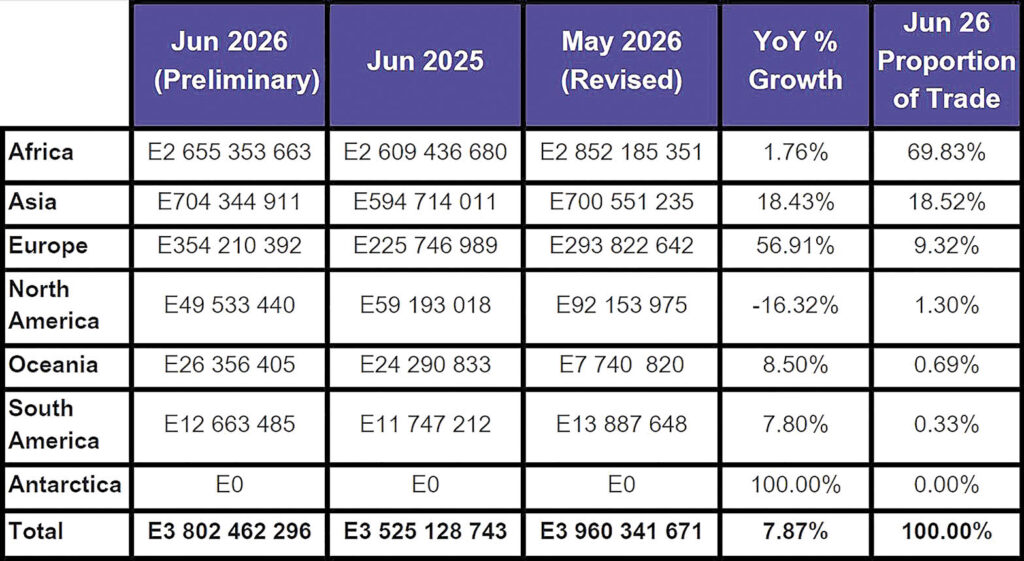
This was despite the country’s overseas sales climbing to more than E3.4 billion, latest trade statistics have revealed. Preliminary merchandise trade statistics released by the Eswatini Revenue Service (ERS) show that the kingdom exported goods worth E3.40 billion during June, while imports amounted to E3.80 billion, resulting in a trade deficit of E397.69 million.
The figures include trade with fellow Southern African Customs Union (SACU) members Botswana, Lesotho, Namibia and South Africa. Although exports increased by 4.24 per cent compared to June last year, imports grew at a much faster rate of 7.87 per cent, highlighting continued pressure on the country’s external trade position.
The latest figures also show that Eswatini’s cumulative trade deficit for the first quarter of the 2026/27 fiscal year has widened.
Between April and June 2026, the country recorded a preliminary cumulative merchandise trade deficit of E813.46 million, compared to E747.44 million during the corresponding period last year.
During the three-month period, cumulative exports increased by 9.16 per cent to E10.66 billion, while cumulative imports rose almost at the same pace, increasing 9.14 per cent to E11.47 billion. The higher value of imports ultimately outweighed export earnings, leaving the country with a larger trade gap.
Despite the widening deficit, the latest report points to continued resilience in Eswatini’s export sector.
Merchandise exports rose by E138.56 million from E3.27 billion in June 2025 to E3.40 billion in June 2026.
According to ERS, the improvement was largely driven by increased exports of chemical products and undenatured ethyl alcohol, both of which registered stronger international demand during the month.
Looking deeper into export categories, products of chemical or allied industries remained Eswatini’s single largest export sector, generating E1.28 billion, representing more than one-third of all merchandise exports during June.
Prepared foodstuffs, beverages and tobacco products followed with exports valued at E1.09 billion, while textiles and textile articles generated E359.61 million.
Other significant export earners included:
- Wood and wood products – E257.01 million
- Vegetable products – E84.07 million
- Mineral products – E79.29 million
- Machinery and electrical equipment – E70.67 million.
The export data reinforces the importance of Eswatini’s manufacturing sector, particularly chemical manufacturing, food processing and textiles, which continue to dominate the country’s export basket.
SACU continues dominating trade
MBABANE – Trade within the Southern African Customs Union continues to account for the overwhelming majority of Eswatini’s regional commerce.
During June, exports to SACU countries amounted to E2.46 billion, while imports from the customs union reached E2.57 billion, resulting in a SACU trade deficit of E109.21 million.
On a cumulative basis between April and June, exports to SACU reached E7.34 billion, while imports totalled E7.89 billion, producing a cumulative SACU trade deficit of E547.80 million.
Fuel imports continue driving import bill
MBABANE – While exports continued growing, imports expanded even faster.
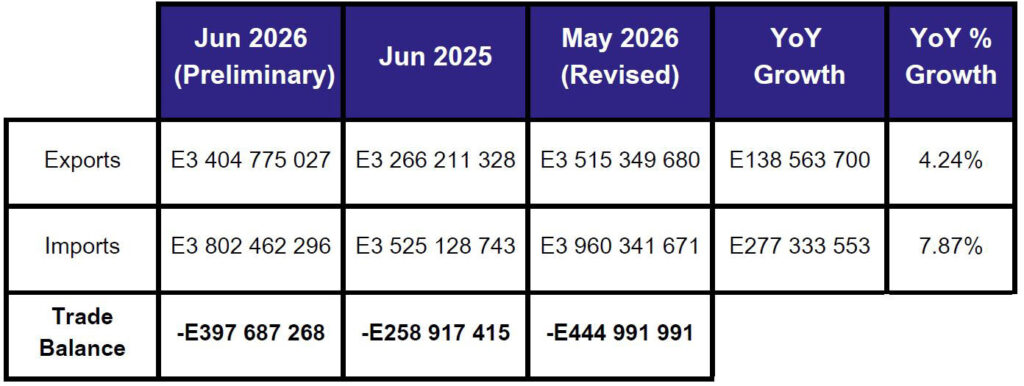
ERS attributed the year-on-year increase in imports primarily to higher purchases of petrol and diesel, underlining the country’s continued dependence on imported fuel. Total merchandise imports increased by E277.33 million to E3.80 billion in June. The largest import category remained mineral products, valued at E810.78 million,reflecting increased fuel imports.
Other major import categories included:
- Products of chemical industries – E553.17 million
- Machinery and electrical equipment – E438.12 million
- Prepared foodstuffs – E338.08 million
- Textile products – E305.42 million
- Vegetable products – E245.42 million
- Vehicles and transport equipment – E233.36 million.
- Base metals – E190.01 million.
The figures illustrate that petroleum products remain one of the biggest contributors to Eswatini’s import bill, making international oil price movements a key determinant of the country’s trade balance.
Africa remains Eswatini’s big trading partner
MBABANE – The latest statistics reaffirm Africa’s strategic importance to Eswatini’s international trade.
During June, the continent accounted for 94.71 per cent of all merchandise exports, equivalent to E3.22 billion.
On the import side, Africa supplied 69.83 per cent of Eswatini’s merchandise imports, valued at E2.66 billion.
This means nearly all goods exported by Eswatini continue to find markets within Africa, largely driven by trade with neighbouring SACU countries.
Europe emerged as Eswatini’s second-largest export destination after Africa.
Exports to Europe increased significantly to E120.77 million, representing 3.55 per cent of total exports and reflecting annual growth of more than 41 per cent.
North America also registered impressive export growth of nearly 60 per cent, although its share of overall exports remained relatively small at 0.63 per cent.
Meanwhile, exports to Asia declined by 18.37 per cent to E37.94 million, suggesting softer demand from Asian markets during the month.
On the import side, Asia remained Eswatini’s second-largest source of imports after Africa.
Imports from Asia totalled E704.34 million, accounting for 18.52 per cent of total imports.
Europe supplied imports worth E354.21 million, representing 9.32 per cent of total imports and recording robust annual growth of nearly 57 per cent.



















Leave a comment