

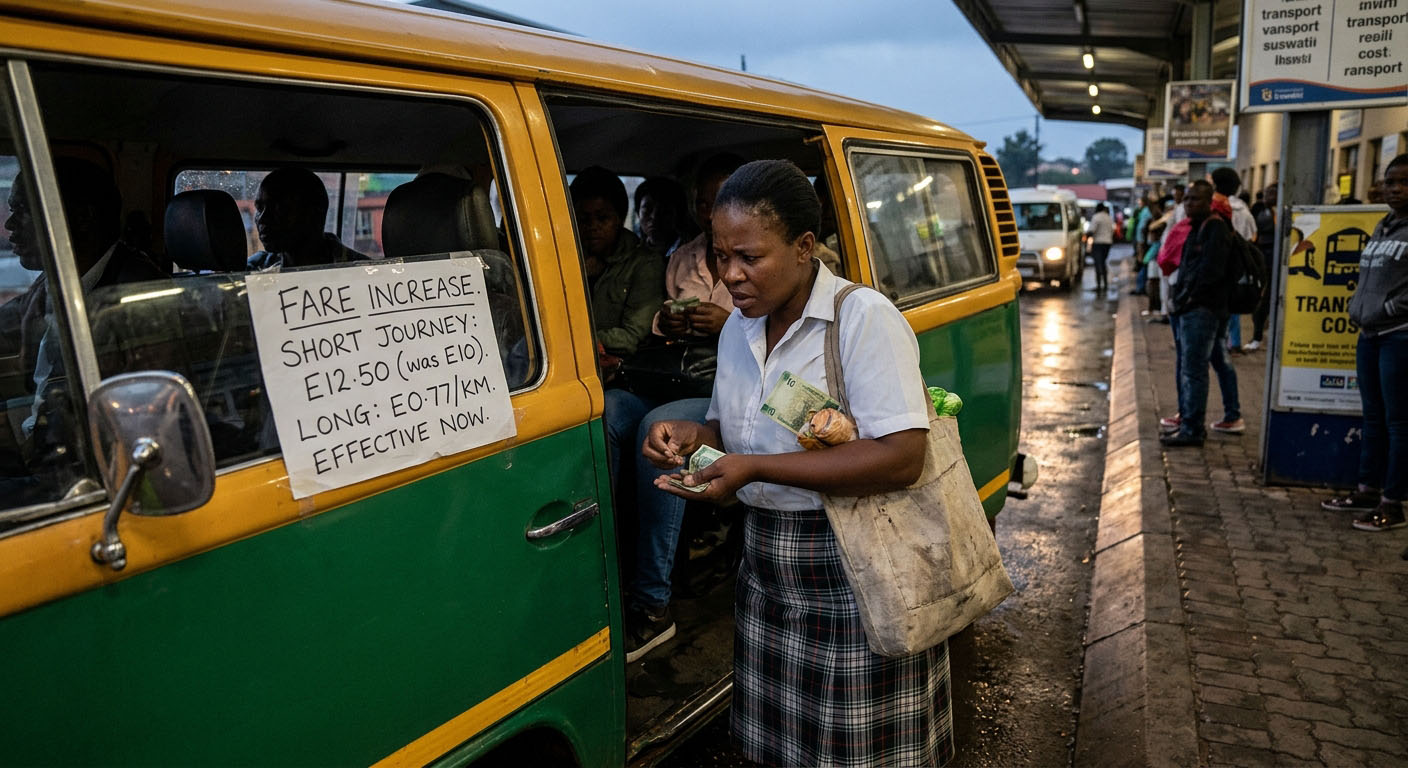
There is a peculiar arithmetic to poverty; sometimes, the harder you work, the less money you have left after paying to get to work.
That is the uncomfortable question raised by the proposed increase in public transport fares. Government proposes that commuters pay 25 per cent, while transport operators insist they are charging too little to keep their businesses alive. Both arguments are credible.
Under the proposed regulations, the maximum bus fare for journeys of up to eight kilometres would rise from E10 to E12.50. Journeys between eight and 50 kilometres would cost a maximum of E0.77 per kilometre, while longer journeys would attract E0.72 per kilometre. The maximum taxi fare for the first three kilometres would rise from E60 to E72, followed by E12.50 per kilometre.
These increases are lower than the National Road Transportation Council’s original demands; a 50 per cent increase on short bus journeys and 100 per cent on longer taxi fares. A smaller increase, however, is not the same as an affordable one. For a worker making two short bus journeys a day, the rise from E10 to E12.50 adds E5 to the daily cost of commuting. Over 22 working days, that is about E110 a month. E110 may not look catastrophic on a spreadsheet. Poverty, however, is rarely experienced on a spreadsheet. For a household facing higher costs for electricity, food, water and school expenses, the money has to come from somewhere. It is groceries, transport for a child or airtime — money already assigned another destination.
This is where inflation becomes more than a statistic. Higher fuel costs push up transport costs. Higher transport costs reduce disposable income and raise the cost of doing business. Businesses raise prices or cut costs, while workers seek higher wages. Those costs feed back into the economy, putting fresh pressure on operators. Each increase becomes the justification for another, eroding purchasing power and deepening poverty. But consumers cannot simply wish away the operators’ side of the ledger. A bus is not a charity vehicle. A kombi does not run on goodwill. Operators must buy fuel, maintain vehicles, pay drivers, obtain licences, insure their fleets and absorb the costs of tyres, repairs and financing. Fuel prices have risen sharply this year. An operator who cannot cover these costs must increase fares, reduce services or leave the industry.
None of those options serve commuters well. A cheap bus that does not run is not cheap transport. It is an expensive inconvenience, particularly for workers who risk losing wages, or employment, when they cannot reach work on time. So government must answer a question alongside the one posed by consumers: what is the sustainable price of keeping a bus on the road?
If operators cannot show that existing fares cover legitimate costs, increases become difficult to resist. But if commuters cannot understand how a fare was calculated, they become equally difficult to justify.
Without a scientific formula, operators cite losses and consumers cite hardship. That is not sound, sustainable regulation.
Public transport is one of the tracks on which the economy runs. Workers use buses and kombis to reach factories, shops, offices and schools. When transport becomes unreliable or unaffordable, productivity suffers. Businesses, families and the economy feel it. The ministry’s proposed fare formula is therefore more important than whether the fare should be E12.50. Fares should respond transparently when costs rise, but there should also be a mechanism for reducing them when costs fall.
Consumers should not have to remember only the upward direction of the meter.
Government should examine subsidies, tax relief and fleet renewal to reduce operators’ costs without transferring the entire burden to passengers. Such interventions would be an investment in the system that gets workers to work and customers to businesses. But regulation alone will not solve the problem.
Government must confront a larger question: Why should public transport be designed merely for people who cannot afford to drive?
Imagine clean, safe and frequent buses that arrive when promised, get workers to their destinations on time and return them home without an hour spent waiting beside the road. Such a system could persuade motorists to leave their cars at home.
That is where the economics changes.
Government should not think only about how much more it can charge each passenger. It should ask how many more passengers it can attract. Repeatedly raising fares may increase revenue per passenger while shrinking the overall market.
A modest fare paid by a large passenger base may generate more revenue than a high fare paid by fewer commuters. The motorist who leaves the car at home saves on fuel, maintenance, tyres and parking. Households retain more disposable income; businesses gain a more reliable workforce and roads experience less congestion.
Public transport would then become not merely a service for people who cannot afford cars, but a rational choice for people who can.
That should be the goal.
If public transport operators want commuters to accept higher fares, they must give them a transport system worth paying for. The real measure of success is not whether a commuter can absorb another E2.50. It is whether a motorist considers the cost of driving and decides that the bus is the better deal.
That is when public transport stops being a poverty tax and becomes an economic asset. The sustainable system may not be the one that charges the most. It may be the one that moves the most people.
















Leave a comment