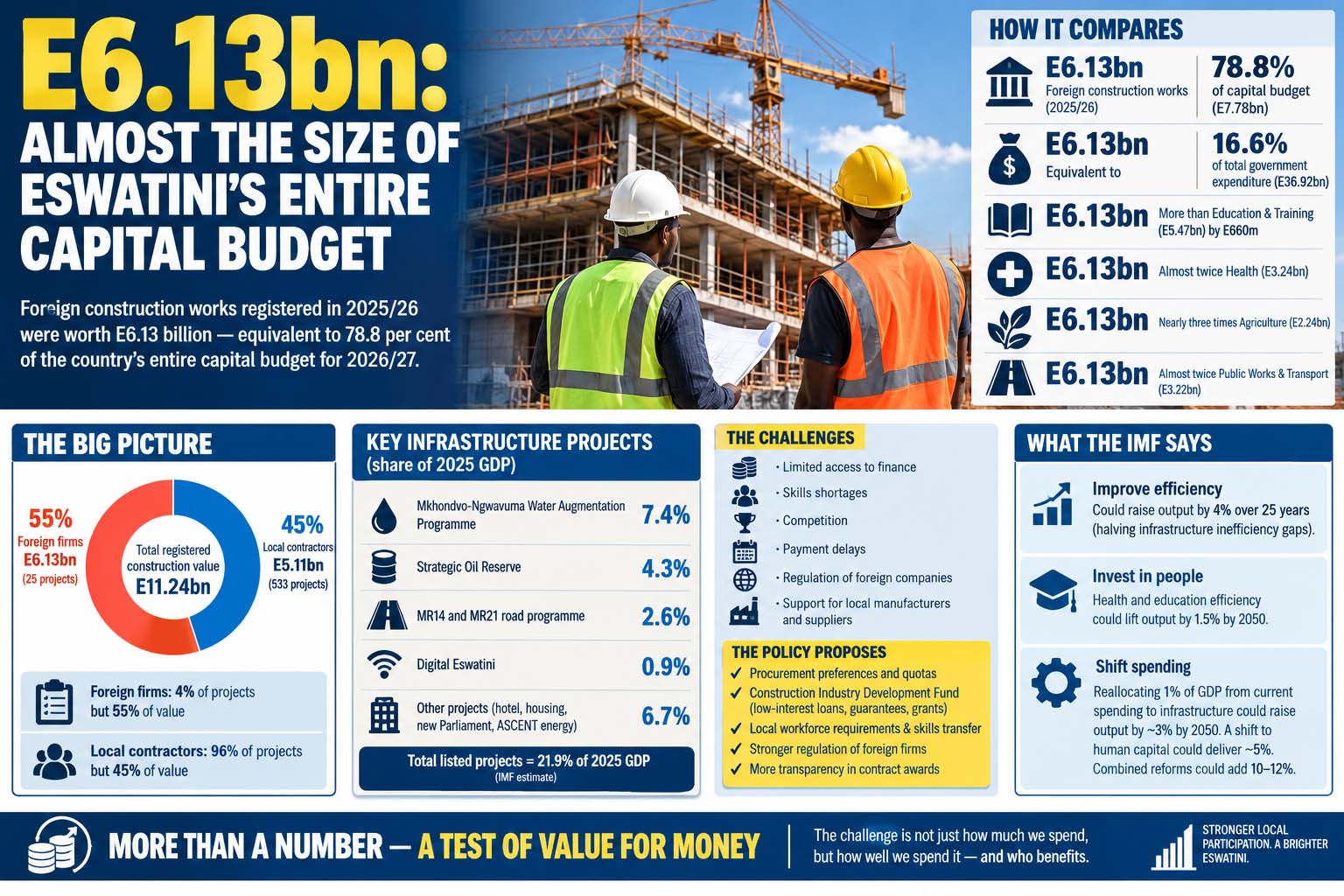
MBABANE – The E6.13 billion paid to foreign construction companies in 2025/26 was equivalent to about 79 per cent of the entire amount planned for capital projects in the national budget this year.
This is because the Construction Industry Council (CIC) recorded E6.13 billion in construction works undertaken by foreign firms during the 2025/26 financial year.
Government has allocated E7.78 billion for capital expenditure in the 2026/27 national budget. This covers development projects such as roads, water infrastructure, buildings and other long-term investments.
The two figures relate to different financial years and spending categories. The E6.13 billion represents the value of construction works registered under foreign firms, not government expenditure alone.
The value of the foreign works was also equivalent to about one-sixth of the E36.92 billion in total government expenditure budgeted for 2026/27.
It exceeded the annual allocations for several ministries, including Education and Training, which received E5.47 billion; Health, E3.24 billion; Agriculture, E2.24 billion; and Public Works and Transport, E3.22 billion.
However, these comparisons do not mean that the construction works were funded by government or that their value represents money paid directly to foreign companies.
Meanwhile, the CIC report shows that foreign firms accounted for 25 of the 558 construction projects registered during 2025/26, representing about four per cent of the total number of projects.
Projects
Despite their small share by number, the projects accounted for 55 per cent of the total registered construction value of E11.24 billion.
Local contractors accounted for 533 projects, or 96 per cent of the total, valued at E5.11 billion, equivalent to 45 per cent of the registered value.
The figures show that local contractors undertook most of the registered projects, while foreign firms accounted for the larger share of their combined value.
The concentration of foreign construction value in civil and specialised works raises questions about the capacity of local firms to compete for large, technically demanding contracts.
Competing for such projects may require substantial financing, equipment, guarantees, specialised skills and sufficient cash flow to meet costs while awaiting payments.
It also reports that contractors rely on imported materials where local supplies are unavailable. These constraints can affect the ability of smaller firms to finance operations, purchase materials and invest in equipment needed to undertake larger projects.
The Construction Industry Policy 2024–2030 identifies limited access to finance, skills shortages, competition, payment delays, regulation of foreign companies and support for local manufacturers and suppliers among the industry’s challenges.
The policy proposes measures including procurement preferences and quotas for local contractors and consultants, financial assistance through a proposed Construction Industry Development Fund, and stronger regulation of foreign firms.
Skills-transfer
It also proposes local workforce requirements for joint ventures, alongside skills-transfer and capacity-building targets.
Meanwhile, the Construction Industry Policy 2024–2030 proposes measures to increase the participation of local contractors, manufacturers, suppliers and workers in Eswatini’s construction industry.
The proposals include procurement preferences, financial assistance, local workforce requirements and greater transparency in the awarding of construction contracts.
The policy proposes giving preference to local companies, manufacturers and suppliers on government-funded infrastructure projects.
It also proposes quotas for local contractors and consultants on national and international infrastructure projects.
The measures are intended to increase the participation of domestic businesses in construction work.
The policy proposes establishing a Construction Industry Development Fund (CIDF) to support local construction businesses.
Proposed forms of assistance include low-interest loans, loan guarantees and grants for equipment. The fund could also help contractors access credit for equipment and materials.
The policy proposes that the fund receive support from government, development partners and a levy on large projects.The policy proposes requirements for joint ventures involving foreign firms, including targets for local employment, skills transfer and capacity building.
The measures are intended to help local workers acquire technical skills and enable domestic companies to develop the capacity to undertake more complex projects.
Support
The policy promotes the use of locally sourced construction materials and proposes stronger support for domestic manufacturers and suppliers.
It also calls for the regulation of imported construction materials and supplies to promote fair competition and compliance with quality standards.
The extent to which local producers benefit would depend on their ability to supply materials that meet the required specifications, prices and delivery schedules.
The policy proposes public disclosure of construction contracts, bidding processes, winning bids and contract terms.
It also proposes a centralised platform for advertising and allocating construction projects.
In addition, it calls for anonymous reporting channels for suspected corruption, collusion and other irregularities. These measures are intended to improve transparency and public access to information about construction procurement.
The policy proposes that construction projects be registered with the CIC from the beginning.
It also calls for stronger coordination between the Ministry of Public Works and Transport, the CIC, procurement authorities and other government institutions.
The proposals seek to improve project planning, monitoring and implementation.
Contracts
The policy aims to strengthen the domestic construction industry by improving access to contracts, finance, skills and materials.
It is worth noting that construction projects can generate demand for locally supplied materials, transport, equipment, financial services and labour.
The extent to which local businesses and workers benefit depends on factors including procurement arrangements, the availability of domestic suppliers, employment practices and the use of local subcontractors.
The CIC warns that heavy reliance on foreign firms can limit opportunities for local skills development, business growth and the retention of economic value within Eswatini.
The proposed measures in the Construction Industry Policy seek to increase local participation.