Home Business SARFED warns rising debt poses policy risks for economy
Business

SARFED warns rising debt poses policy risks for economy

Share
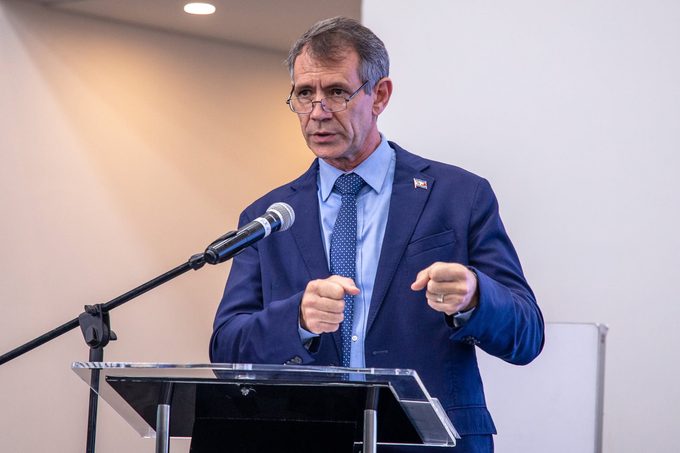
Finance Minister Neal Rijkenberg. Although Eswatini’s debt-to-GDP ratio of 40.2 per cent remains within the 41 per cent benchmark, the country has little room left to manoeuvre. (Pic: File)
Share

MBABANE – Eswatini’s rising public debt is pushing the economy into a danger zone, warns Dr George Choongwa, Regional Coordinator at SARFED, calling for urgent fiscal discipline.

The Coordinator at the Southern African Research Foundation for Economic Development (SARFED), Dr Choongwa, has warned that Eswatini’s rising public debt is pushing the economy into a danger zone that could compromise long-term growth, stability and social progress.

Responding to Finance Minister Neal Rijkenberg’s defence of the nation’s E38 billion debt earlier this month, Dr Choongwa said that although Eswatini’s debt-to-GDP ratio of 40.2 per cent remains within the 41 per cent benchmark, the country has little room left to manoeuvre.

 “Eswatini is effectively operating with less than a 2 per cent debt-free margin, which is a high-risk position in an unpredictable global environment,” Dr Choongwa said.

According to the Ministry of Finance’s 2024/25 Annual Performance Report, the country’s external debt stands at about 40.2 per cent of GDP. While technically below the safety threshold, Dr Choongwa cautioned that international experience shows debt levels in the 40–50 per cent range are widely considered a red flag.

He further pointed out that Eswatini is grappling with vulnerabilities ranging from global geopolitical tensions such as the Russia-Ukraine war, to domestic challenges like climate shocks and high poverty levels, currently estimated at 53 per cent.

Despite this, Eswatini continues to attract foreign investment in mining, infrastructure and technology — a trend that Dr Choongwa said could be undermined if debt reliance deepens.

Dr Choongwa emphasised that Eswatini’s public finance policy must become more forward-looking rather than reactive if it is to shield the economy from widening fiscal risks.

 “Short-term fiscal fixes may keep the numbers in line, but they do not provide the stability that long-term investors are looking for,” he cautioned.

Full article available in our publication.

Share
Written by
Nhlanganiso Mkhonta

Nhlanganiso Mkhonta serves as Business Editor at the Times of Eswatini. He reports on business, economics, finance, investment, entrepreneurship and public policy, producing insightful coverage and analysis of the issues driving Eswatini’s economy and the wider African business environment.

Leave a comment

Leave a Reply

Your email address will not be published. Required fields are marked *

Don't Miss

New bus fares to take effect next week

MANZINI – Commuters will start paying higher bus fares next week after transport operators begin displaying notices announcing the revised tariffs. The new...

Illegal foreign-owned businesses given 1 year to close

LOBAMBA – Foreign-owned businesses found operating in violation of the country’s laws and regulations have been given 12 months to regularise their operations...

President hosts Team Eswatini to dinner in Dakar

DAKAR – Team Eswatini athletes received words of encouragement from the country's Olympic leadership during a special dinner hosted by the EOCGA President ...

Another cup final for MaMkhize’s Eswatini team

(At Somhlolo National Stadium) Highlanders AM.....(0)0 Ubombo Sugar........(0)0  Highlanders won 5-3 on penalties) MBABANE - Mbabane Highlanders AM reached the PLE Charity Cup...

FNB offers more incentives to attract new customers

MBABANE - FNB Eswatini has introduced a campaign offering qualifying customers repayment holidays, cash-back incentives and additional family protection benefits. This comes as...

Related Articles

Sugar, soft drink concentrate exports lift trade surplus to E687.9m

MBABANE - Eswatini’s trade surplus widened to E687.9 million in September as...

Eswatini ranks 32nd in Africa governance index

MBABANE - Eswatini’s governance performance has barely shifted over a decade, with...

ESCC uncovers weaknesses across Eswatini beef value chain

MBABANE – Eswatini’s beef industry is characterised by low productivity, limited investment,...

Domestic revenue collection reaches E8.2bn at half-year

MBABANE - Domestic revenue collection reached E8.2 billion at mid-year, representing 47...