

If all goes well, hundreds of public servants will smile all the way to automated teller machines (ATMs) when payday comes in October.
This is if the pre-final draft report of the salary review conducted by Enterprise Growth and Umelusi Partners is ultimately implemented as is.
It still has to get Cabinet approval.
The 444-page report was presented to government representatives last Wednesday, creating a buzz at all levels of the civil service.
It was also shared with representatives of the public sector unions (PSUs), which represent a large number of the 44 000 civil servants.
Even though some of the report’s contents require critical analysis, we now know that about 75 per cent of the government workforce will remain in the same salary grades they were in before this exercise. Other grades have been revised downwards, laying bare the fact that a review does not always necessarily mean an upward adjustment of salaries.
However, they are all expected to benefit from the various recommended salary increments, regardless of whether their pay grade was revised or not.
Nurses and teachers are among those who hope that Cabinet approves the recommendations as they are. Both professions have people who hold diploma and degree qualifications.
It has been reported that degree holders in these two critical professions will earn between E20 584.50 and E23 168 as gross salaries, that is, before deductions for pay-as-you-earn tax, pension and others. Low-ranking staff like typists, clerks, immigration officers and secretaries also stand to have their salaries raised to as high as E11 000 per month.
The excitement and anticipation are not only on salary adjustments, but also on allowances.
Teachers, for example, will now be paid hardship allowances.
These will mostly be enjoyed by those posted to special and rural schools where even basic amenities like water, accommodation and electricity are scarce.
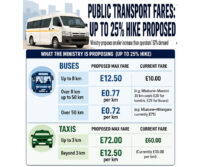
Travel allowances, which were at an unreasonably low 17 cents per kilometre, stand to be raised to 76 cents per kilometre.
I am not here to punch holes in the consultants’ report but this means for a distance of about 34 kilometres, say from Mbabane to Manzini, a teacher will be paid E25.84 as travelling allowance.
This might not be bad if travelling by public transport, but for those who use their own vehicles, it might still be a bit on the low side.
It is still a significant improvement from the current E5.78 a civil servant gets for the same trip, though. Police officers who were recently boosted by salary adjustments of between three and eight per cent, plus 24 months backpay, also stand to benefit from the salary review.
A recommendation has been made for the allowance paid to plain-clothes security officers, like police detectives, to be increased from E100 per month E200 per month. The allowance is for them to purchase civilian clothing.
There is a lot one could say as far as the salary review pre-draft report is concerned.
However, as I read through it, my mind drifted back to a report earlier in the week, about 3 000 emaSwati who trained as teachers, but are now unemployable.
There are improvements in the conditions of service within the profession they hoped to join but they will not be benefitting.
Reading stories of salary and allowance increases is bound to worsen the palpitations triggered recently by news that the colleges they were trained at broke certain rules and regulations.
In case you missed it, the Times of Eswatini reported on Friday, September 5, 2025, that about 3 000 emaSwati who graduated from various institutions of higher learning in the last few years cannot be employed. This is because they enrolled at private colleges even though they did not meet the requirements for admission.
The entry requirement for a Teaching Diploma programme in Eswatini is a minimum of three credits, two of which should be in the subjects the candidate wishes to major in, plus a credit pass in English Language and at least three passes.
These standards were set by the Eswatini Qualifications Authority (EQA), whose responsibilities include verification and evaluation of qualifications (local and foreign) and the creation of a database for qualifications awarded in the country, so as to create trust.
It has been revealed that some of these colleges, even though approved by the Eswatini High Education Council (ESHEC) did not adhere to the standards set by the EQA and approved applications for candidates who did not meet the minimum entry requirements.
Believe it or not, some of the applicants were admitted even though their O-level certificates showed that they had only obtained one or two credit passes.
Others had the minimum number of credits but not the required passes.
Some were weirdly advised to simultaneously upgrade their high school marks, while also studying to become teachers.
Now, with diplomas hanging on their walls or safely kept in their bedroom drawers, these graduates cannot be employed.
Unless they restart the arduous and expensive journey of obtaining the required O-level passes and then reapply to legitimate colleges, they cannot call themselves teachers. The pertinent question is: Who is to blame for this shameful development?
Is it the ‘graduates’ themselves, the EQA or ESHEC? Is it the administrators of these colleges?
For its part, ESHEC says it regularly issues public warnings, alerting aspiring college students to know their Eswatini Qualification Framework (ESQF) baseline before applying for any programme offered by a college.
Nanikie Mnisi, Principal Secretary (PS) in the Ministry of Education and Training, says this issue will be investigated and institutions found to have enrolled students who did not meet the requirements face automatic shutdown.
While we watch to see if this is done with immediate effect, it would not be a bad idea to examine if criminal charges cannot be preferred against administrators of these colleges.
I am thinking of fraud and theft by false pretences because they took money from applicants knowing fully well that the certificates they would be awarded would be worthless.
At the same time, school leavers should keep it in mind that they can study up to degree, masters or even doctorate level, but their O-level, Matric or other school-leaving certificate will always be required.













Leave a comment