

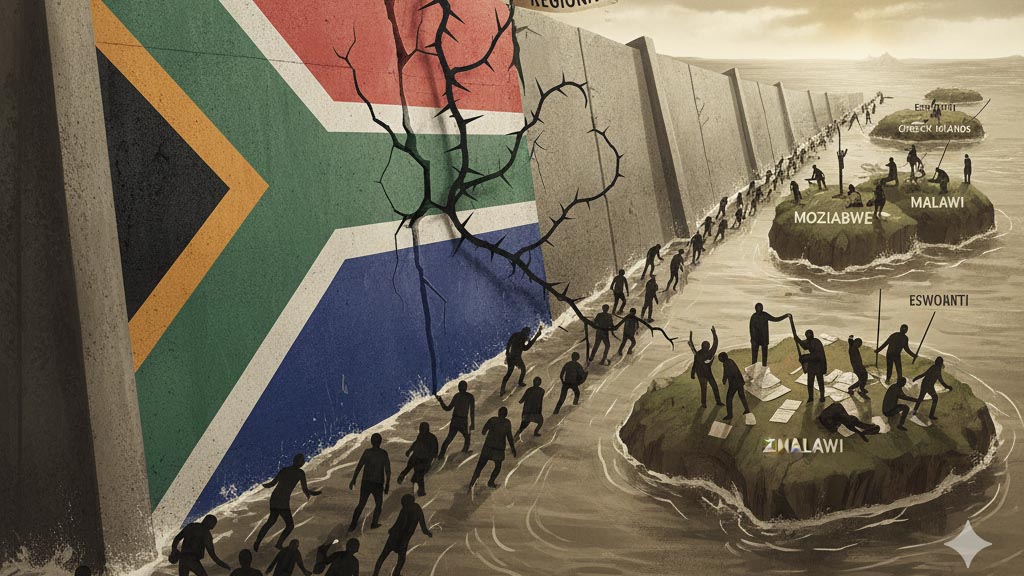
Policy shifts within one country seldom remain confined within its border perimeters. In Southern Africa, where economies, labour markets and social systems are almost inherently interconnected, changes in national policy often trigger regional consequences. A current example is South Africa’s proposed First Safe Country principle, contained in its draft White Paper on Citizenship, Immigration and Refugee Protection. While framed as a domestic response to migration pressures, the proposal carries implications not only for Eswatini but for the Southern African Development Community (SADC) as a whole.
The First Safe Country principle seeks to bar asylum claims from individuals who have already passed through, or could reasonably have sought protection in another country deemed ‘safe’. The intention is to reduce the number of asylum seekers entering South Africa and to ease pressure on its overburdened refugee system. However, such a policy assumes a level of protection and administrative capacity across the region that does not exist uniformly.
For the kingdom, the implications are conspicuously loud. South Africa has long been the primary destination for migrants and asylum seekers in the region due to its comparatively stronger economy and more developed institutions. When access to asylum is restricted there, pressure does not disappear; it shifts. Smaller neighbouring States may experience increased numbers of migrants unable to proceed southwards, creating new social and administrative demands for which they are often unprepared. At a regional level, this raises serious concerns for SADC. The bloc promotes principles of cooperation, shared responsibility and regional integration. A unilateral policy shift by a dominant member State could very well undermine these principles by effectively exporting migration pressures to weaker economies. Countries such as Mozambique, Zimbabwe, Malawi and Eswatini may find themselves absorbing populations without corresponding resources, legal frameworks or international support.
Historical precedents are clear indicators of how such dynamics unfold. When Nigeria closed its land borders in 2019 to curb smuggling and protect local industry, neighbouring Benin suffered immediate economic consequences. Trade collapsed, government revenue fell and informal traders were pushed into hardship. Although Nigeria acted in its perceived national interest, the decision disrupted regional economic stability. Similarly, South Africa’s proposed asylum restrictions could destabilise migration management across SADC by redirecting flows, as opposed to resolving root causes.
The European Union offers another instructive comparison. Its adoption of ‘safe country’ designations and externalisation of asylum responsibilities has shifted migration burdens onto border States such as Greece and Italy, while neighbouring non-EU countries have been pressured to act as buffers. These policies have stretched regional relations and showed lapses in collective responsibility. SADC could face similar tensions if migration policies become increasingly inward-looking and uncoordinated.Within SADC, disparities in legal protections further complicate matters. Some member States lack comprehensive asylum systems or adequate safeguards for vulnerable groups. Declaring a country ‘safe’ on paper does not guarantee protection in practice. As a result, asylum seekers may find themselves trapped in States unable to process their claims or provide meaningful protection, raising humanitarian and legal concerns across the region.
Economically, the knock-on effects are also notable and cannot be swept under the carpet. Migration and remittances are a key survival mechanism for many households across SADC. When movement is restricted or redirected, remittance flows decline, affecting food security and household sustenance. Countries already at war with unemployment and fiscal pressure may struggle to absorb returning or stranded populations, increasing chances of social tension.
For SADC as an institution, the proposed policy points to the need for stronger regional frameworks on migration and asylum. While protocols exist promoting free movement and cooperation, implementation remains uneven. Without collective standards and burden-sharing mechanisms, individual States will continue to adopt defensive policies that shift problems rather than solve them. Eswatini’s position within this landscape is delicate. While not a primary destination for asylum seekers, it is part of the regional system that will absorb the indirect effects of policy changes elsewhere. Increased transit migration, administrative pressure and diplomatic expectations may emerge, requiring careful planning and engagement. Ultimately, South Africa’s First Safe Country proposal highlights a broader challenge facing SADC: The creation of the ever-elusive equilibrium between national interests with regional stability. Sustainable solutions lie in coordinated approaches that recognise shared responsibility.
This again, shows how developments elsewhere in the region shape outcomes at home. For emaSwati and SADC alike, the lesson is clear: Regional challenges demand regional solutions, not fragmented responses that can worsen inequality and instability across Southern Africa. Comments: 7927 8210


















Leave a comment