

I sat on the veranda while Uncle Titus negotiated with his morning coffee. He does not drink coffee; he conducts a bilateral summit with it. Thirty years in diplomacy had left him fluent in five languages and bureaucracy. He took a slow sip, adjusted his linen sleeve and looked at me over the rim of his porcelain cup.
“You look like a man who has just read the budget,” he said. “Or did your football team lose again?”
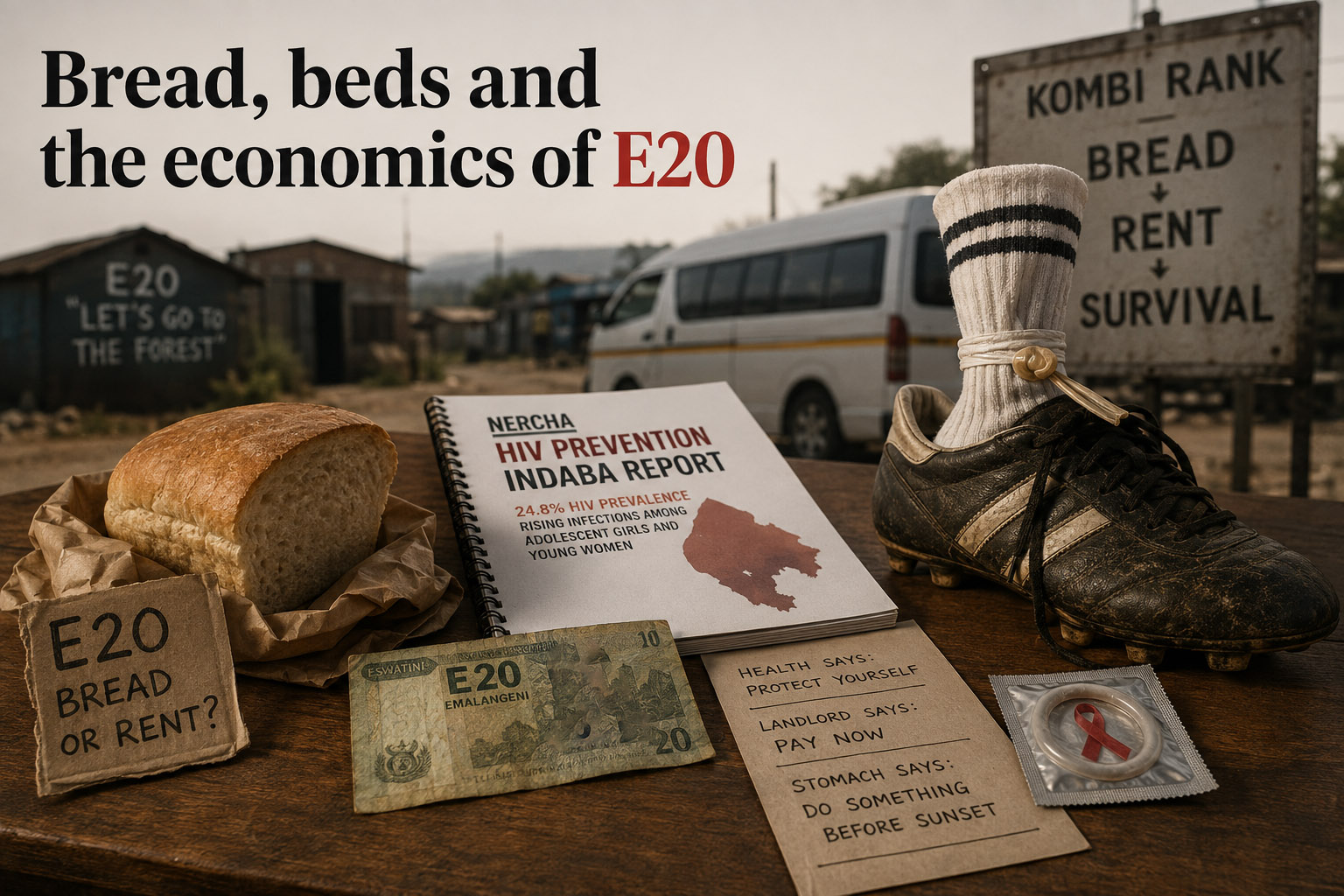
“Neither,” I said, laying the NERCHA HIV Prevention Indaba report on the glass table. “Broe, the report reads like a government experiment in desperation. Textile workers in Matsapha are trading their bodies for E20. A minibus conductor tells a woman, ‘With the E20, let’s go to the forest,’ because she needs the exact fare for bread or rent. If she misses the bus, she misses work. If she misses work, she isn’t paid.” Titus set his cup down with a deliberate clink. He didn’t blink.
“Twenty Emalangeni,” he murmured, swirling the dark liquid in his cup. “Tell me, broe… is this a health crisis or have we simply established the open market value of human dignity?” “It’s structural, Uncle,” I argued, leaning across the table. “The report says HIV prevalence is at 24.8 per cent. Infections are spiking among adolescent girls and young women.”
Titus held up a single, elegant finger. The silence lasted four full seconds. “Broe,” he said. “Do not explain the wound to me. Just tell me where the money goes. So, the Ministry of Health teaches people how to avoid HIV while the economy teaches them what E20 is worth? Brilliant inter-ministerial synergy.” “They actually hosted the Editors’ Forum at Emafini to present this,” I added. “Of course they did,” Titus smiled, leaning back into his wicker chair. “Nothing solves poverty quite like a four-course buffet at a hilltop conference centre. I have attended poverty summits on four continents. The poor remain poor, but the conference lunches have improved dramatically. Did they offer actionable policy or just exquisite braaied lamb?” “They recommended ‘economic empowerment strategies’ and ‘youth-friendly services’.’’ Titus stared at me. He picked up his cup, took a tiny sip and set it down again. “‘Youth-friendly services’,” he repeated. “What a delightful diplomatic euphemism for doing nothing while young people starve. And what about the university students? Are they also benefitting from these ‘services’?”
“Actually, delayed government allowance payments are driving students into inter-generational relationships. Over 30 per cent of undergraduate health science students sampled are in them.” “Ah,” Titus nodded. “‘Inter-generational relationships.’ Another magnificent phrase. It allows everyone in the room to discuss the arrangement without mentioning who has the money, who has the hunger and who gets to call it a choice.” He uncrossed his legs and leaned forward slightly.
“The government delays the allowance, creating the hunger and then expresses official shock when private investors fill the liquidity gap.”
“It gets worse,” I said, turning the page. “Dr Bongani Masango from NERCHA said they supply free condoms everywhere, but when they visit local soccer pitches, they find players using the condoms to tie up their football socks.” Titus froze. His hand hovered over the silver sugar bowl. He didn’t speak for a long moment. He just stared into the middle distance. “They tie… their socks?” he asked gently. “With latex?” “Yes.”
“Broe,” Titus said, his voice dropping an octave. “We have finally conquered HIV. The condom has been successfully promoted to athletic wear.” He shook his head slowly. “The market simply conducted its own needs assessment. We have 97 per cent treatment coverage, but our premier league relies on barrier contraception to keep their socks from falling down.” “Well, sex workers in the study said clients offer double the money to forgo protection entirely,” I pointed out. “It’s all driven by unemployment.”
“That is not a behavioural gap, broe,” Titus noted. “That is an invoice. When desperation meets cash, the cash writes the terms. It reminds me of a bilateral trade negotiation in Geneva – except in Geneva, both parties wear suits before screwing each other over.” “The Nation Magazine Editor, Bheki Makhubu, actually challenged NERCHA at the forum,” I said. “He asked why research always focuses on low-income earners, while wealthy middle-class folks fly abroad for business trips, engage in risky behaviour and import infections back home.” Titus raised an eyebrow. “And Dr Masango’s response?”
“He said the selection was informed by gap analysis in previous incidence surveys.” “Ah,” Titus chuckled. “Translation: ‘We followed the data.’ Good. For a moment, I was worried the data followed the budget. It is always safer to study the poor, broe. The poor don’t hire lawyers and they don’t revoke research grants.” He picked up the French press and slowly poured himself a fresh cup. The rich aroma filled the space between us. “You see, the core delusion of our policy class,” Titus said, staring at the rising steam, ‘is the assumption that people are suffering from a lack of information. They treat a worker in Matsapha as if she simply forgot how viruses work. They send a team in a 4×4 to hand her a pamphlet’.
He looked up. “She knows how viruses work. She also knows how hunger works. Hunger operates on a much tighter deadline.” He paused, letting the silence settle over the veranda. “The health department says, ‘Protect yourself.’ The landlord says, ‘Pay now.’ The stomach says, ‘Do something before sunset.’ Three voices. Only one of them has money.” He took a slow, measured sip. “So, when you write your column this week, broe, do not lecture the woman standing by the kombi rank.
“Do not write a sermon on ‘making better choices.’ Every society tells poor people to make better choices, while ensuring they have no good choices to make.” Titus set his cup down, adjusted his cuff and picked up his newspaper. “Until E20 can buy a loaf of bread without forcing a woman to choose between tonight’s meal and tomorrow’s health, all your government statistics are just expensive ways of counting people who cannot afford to say no.”















Leave a comment