

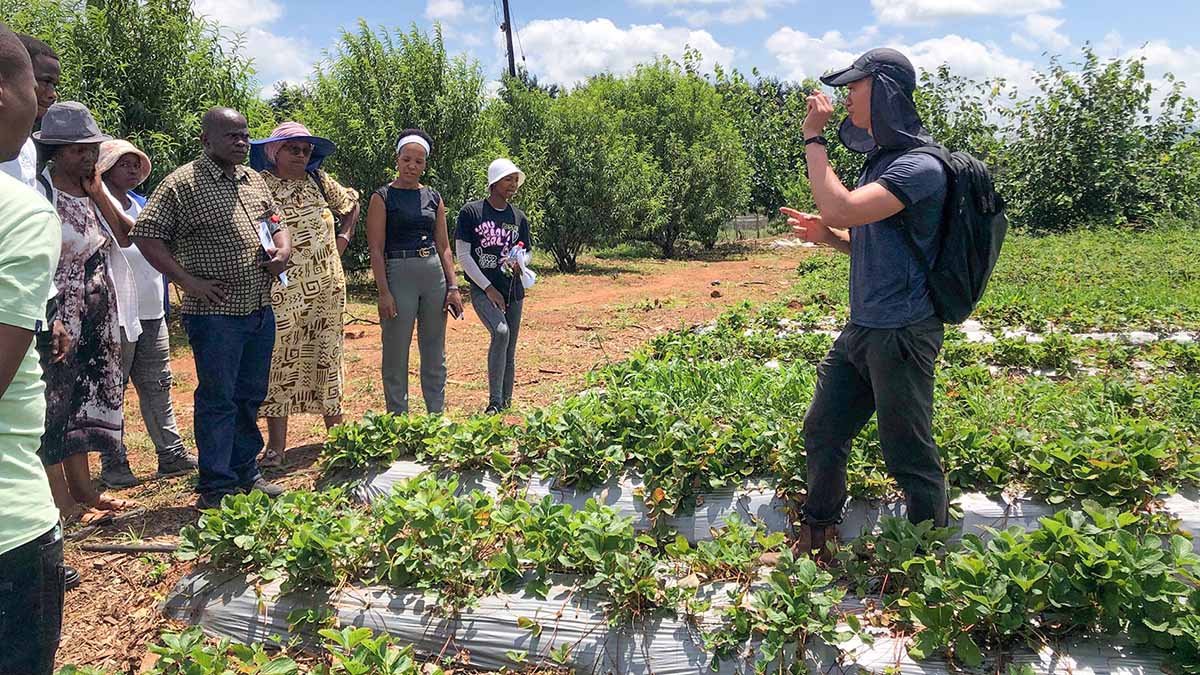
To support farmers in improving strawberry cultivation management and responding to the increasing challenges posed by climate variability, the Taiwan Technical Mission’s Emerging Fruit Tree Production, Marketing and Capacity Building Project organised two strawberry cultivation training workshops on January 30, 2026, at the Malkerns Research Station and February 5, 2026, at Motshane.
Farmers from various regions participated enthusiastically, reflecting the growing interest in strawberry production and the strong demand for practical agricultural knowledge.
The training sessions were led by Project Specialist Alex Lin, who designed the programme to integrate both theoretical instruction and hands-on field practice.
Beginning with classroom-based explanations and continuing with field demonstrations, Lin guided farmers in observing strawberry plant growth, including leaf development, flowering stages and fruit formation.
He provided on-site diagnosis and solutions for common cultivation challenges such as uneven growth, unstable yields and pest and disease issues, helping farmers develop practical problem-solving skills.
Through live demonstrations and interactive discussions, participants were able not only to learn cultivation principles, but also to see how techniques are applied directly in the field.
This approach effectively narrowed the gap between theory and practice. Many farmers noted that, in the past, strawberry cultivation relied largely on personal experience or informal knowledge-sharing.
The training provided them with a clearer and more systematic understanding of strawberry production.
The course covered the entire strawberry production cycle.
A key focus was guiding farmers to develop their own strawberry cultivation calendar, enabling them to plan land preparation, transplanting, fertilisation, irrigation, pest and disease control and harvesting according to different growth stages.
By adopting a more scientific and structured management approach, farmers can better align production with crop needs, reduce unnecessary inputs and improve yield stability and production efficiency. Addressing one of farmers’ greatest concerns, production costs, Lin also shared several low-cost improvement strategies.
These included practical methods for enhancing soil fertility, optimising fertiliser application timing and improving irrigation efficiency.
The goal was to help farmers allocate limited resources more effectively, investing in critical production stages to achieve cost reduction and efficiency gains.
These practical insights generated lively discussion, with farmers actively raising questions and exchanging experiences.
Given that this year’s rainy season has been marked by above-average rainfall and hail events in some areas, potentially jeopardising strawberry yield and fruit quality, Lin emphasised the importance of assessing the installation of simple protective structures, such as rain shelters, hail protection and bird nets.
He explained that shade nets, basic support frames and protective netting can significantly reduce the impact of extreme weather, while helping maintain fruit cleanliness and market value.
These recommendations resonated strongly with participants, many of whom expressed interest in gradually upgrading their field infrastructure based on their available resources.
Throughout both workshops, farmers demonstrated a high level of engagement, actively sharing their own cultivation experiences and challenges while participating in open, two-way exchanges with the technical team.
The Taiwan Technical Mission highlighted that strawberries are a high-value crop with strong development potential in Eswatini. With continuous technical support and capacity building, farmers can improve fruit quality, strengthen market orientation and enhance overall industry competitiveness.
The mission further stated that it will continue to support farmers through training sessions, field demonstrations and on-site technical guidance.
These efforts aim to help farmers adapt to climate uncertainty, improve production resilience and transition toward more stable, market-driven production systems.
The strawberry cultivation training workshops not only strengthened farmers’ technical knowledge and practical skills, but also demonstrated their strong expectations for the future of the strawberry industry.
By laying a solid foundation for the upcoming production season, the Taiwan Technical Mission hopes that continued collaboration and knowledge transfer will support Eswatini farmers in building a more resilient and sustainable fruit production sector, contributing to long-term rural economic development.












Leave a comment