

There is a peculiar kind of poverty that does not announce itself through empty stomachs or collapsing buildings. It appears in shiny new roads, schools and bridges – infrastructure that looks like development, but leaves surprisingly little development behind.
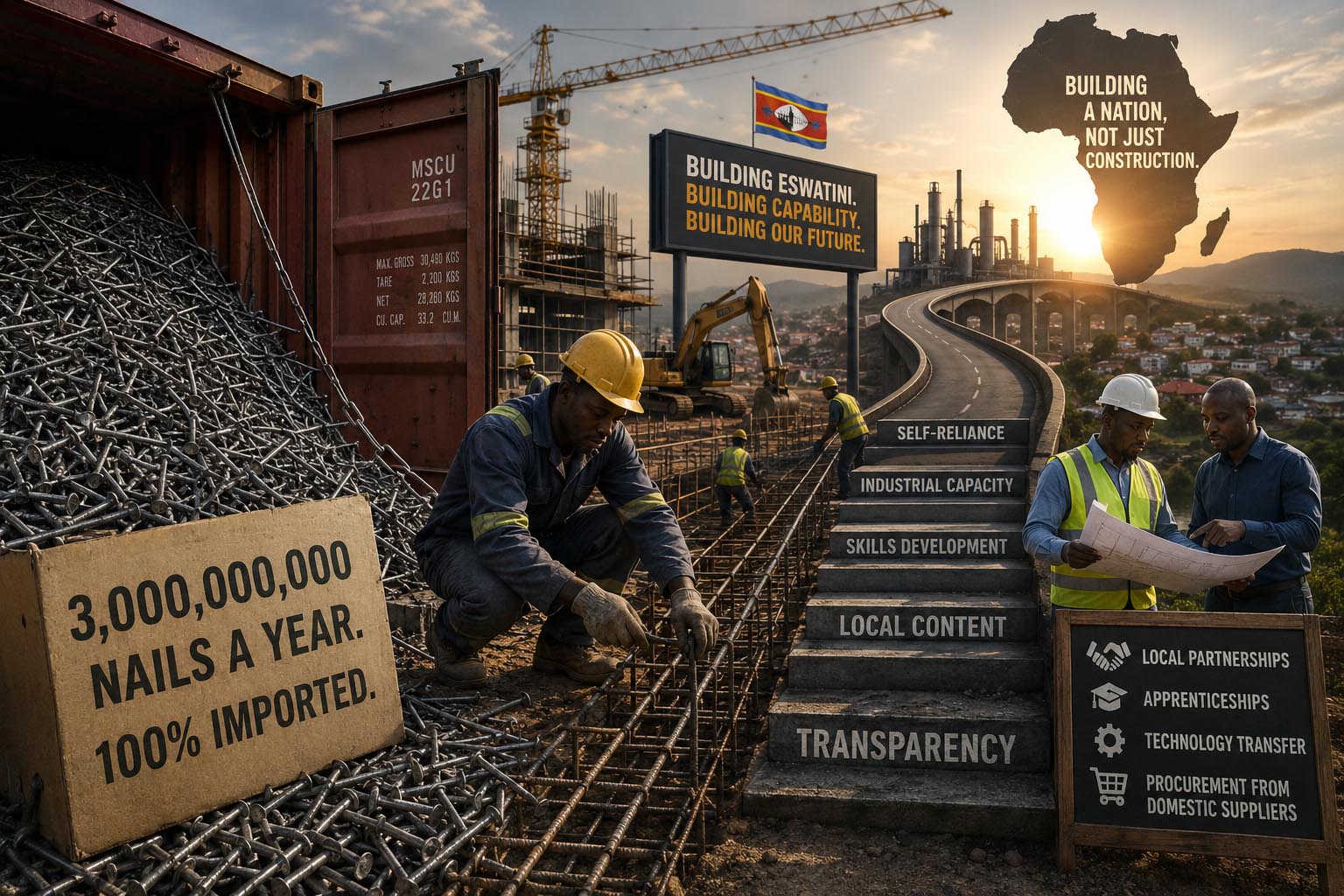
Consider the nail. Eswatini uses more than three billion nails a year without manufacturing a single one. Three billion. There is something almost absurd about borrowing money to build a nation while importing the tiny pieces of metal that hold its buildings together. However, the joke disappears when we understand what those nails represent. They are evidence of an economy that can spend billions on construction without necessarily building the industrial capacity to construct its own future.
This is the poverty of economic leakage. We borrow money to build, hire expertise from elsewhere to build it and import the materials with which it is built. Then we repay the debt with money generated by an economy that never received the full benefit of the original spending. It is development as a revolving door. The National Construction Industry Policy 2025–2031 recognises an uncomfortable fact: Government controls about 77 per cent of the construction market, yet the country remains heavily dependent on imported materials and foreign expertise.
The proposed requirement that 80 per cent of construction materials for public projects be sourced locally is, in principle, a sensible answer. Countries that successfully industrialised did not simply sit back and hope that globalisation would make them rich. South Korea and Taiwan used State policy and public procurement to build domestic capabilities. They made a more intelligent choice: Identify the industries they could realistically build, protect them long enough to develop and then make them competitive. The lesson is not that Eswatini should copy any of these countries wholesale. It is that each used state power strategically to build capabilities it did not want to import forever. A road is not merely a road. A road can be a classroom. A bridge can be a technology-transfer programme. Local content can become local entitlement.
An 80 per cent quota will not magically transform a small domestic industry into a competitive one. If local firms cannot supply materials at the required quality, quantity or price, the policy could produce inflated costs, delayed projects and contractors spending more time navigating exemptions than constructing anything. Protection without performance is simply expensive patriotism. This is why the policy must be treated as a staircase rather than an elevator. Local businesses should not be protected indefinitely from competition. They should be protected long enough and challenged hard enough to become competitive.
It requires government to pay local contractors on time. A small construction company cannot compete for large contracts when delayed payments turn its bank account into a crime scene. The policy itself acknowledges corruption, collusion and so-called construction mafia tactics. These are not side issues. They are potentially fatal to the entire project. Imagine creating a system designed to favour local companies, only to discover that the same companies must have the right connections to benefit from it. That would not be industrialisation.
It would be patronage wearing a hard hat. The answer is simple to describe, if difficult to execute open books. A centralised digital procurement platform, public disclosure of contract awards, stronger whistleblower protection and rigorous monitoring should accompany local-content requirements. Successful industrial policy is rarely about simply keeping foreigners out. It is about making foreigners useful.
Foreign companies possess capital, technology, expertise and international networks. Eswatini should negotiate for something in return.
If a foreign contractor wins a major specialist project, why should the contract not require meaningful local partnerships, apprenticeships, technology transfer and measurable procurement from domestic suppliers?
If foreign expertise is brought into the country, it should leave behind more than an invoice.
This is where nation-building becomes different from construction. Construction ends when the building is handed over. Nation-building begins when the building changes what the country is capable of doing. Eswatini’s construction sector demonstrates the problem. According to figures contained in the National Construction Industry Policy 2025–2031, contracts in 2022/23 included about E300.5 million in foreign works, with foreign firms dominant in high-value technical fields. Meanwhile, 68 per cent of construction jobs are temporary. How many Eswatini-owned companies grew because of it? How many engineers gained specialist experience? How many apprentices became qualified artisans?
The world has already demonstrated that government spending can either reproduce dependency or create productive capacity. The difference is not whether a country spends money. It is whether that spending leaves behind something the country can do for itself. Eswatini now has the chance to choose; but the choice will demand discipline. Local firms must be protected from unfair competition, not protected from the consequences of poor performance.
Foreign firms must be welcomed where they bring genuine value but required to leave behind skills and capabilities.
Self-reliance is not isolation. It is the ability to negotiate.
What remains is the difficult part. We have to build it. And unlike a road, this construction project cannot be outsourced.

















Leave a comment