

First, I would like to offer my condolences on the passing of high-ranking government officials, Princess Lindiwe and the Chief Justice Bheki Maphalala. Condolences go to the royal and Maphalala families and Bishop Robert Kasaro for this massive loss. I extend sympathy to the Church, colleagues in the justice system, friends and, of course, government.
May they find comfort in the knowledge that ‘The Lord is close to the broken-hearted and saves those who are crushed in spirit,’ Psalm 34:18.
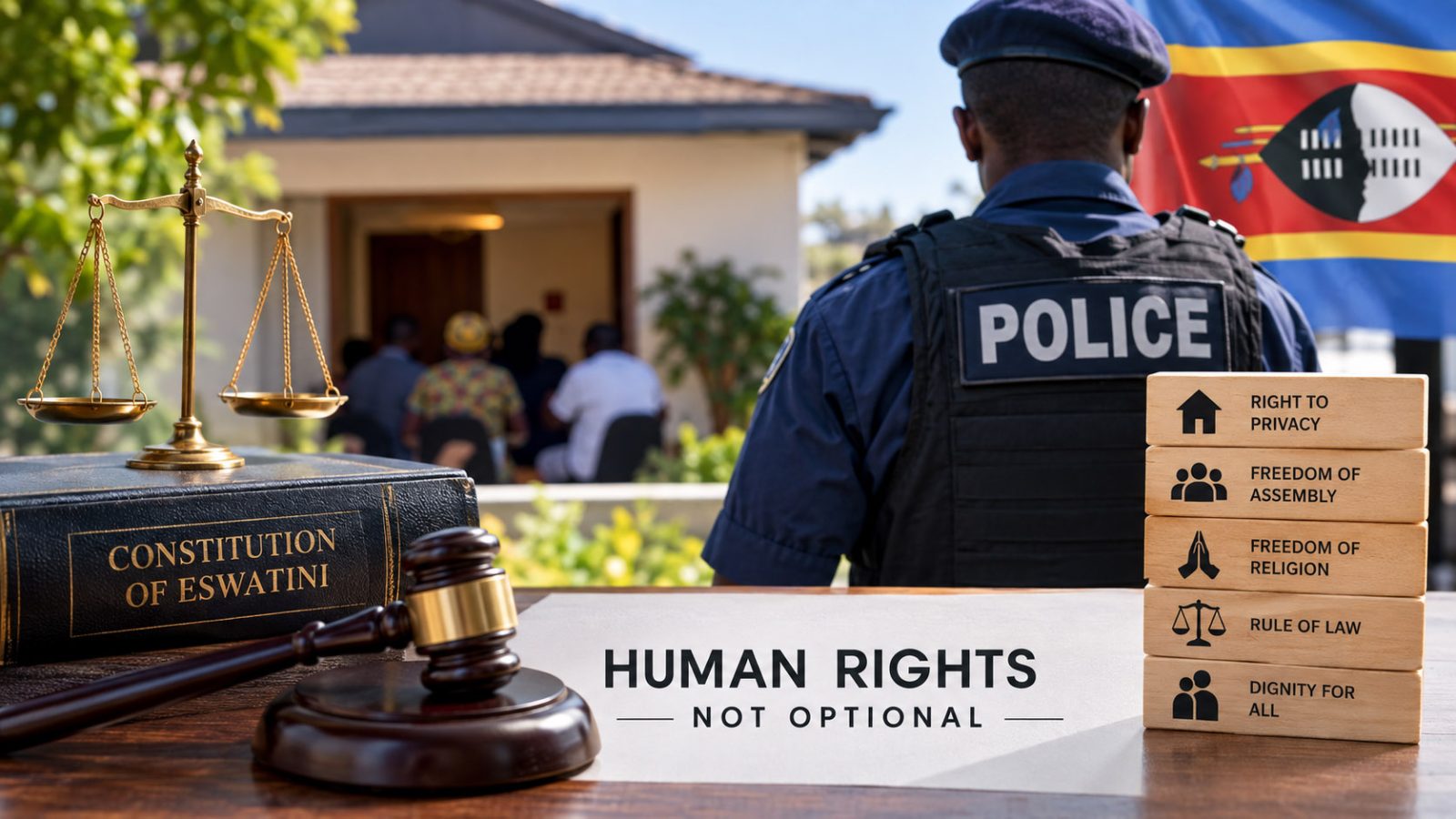
Back to the topic of the day. A troubling incident unfolded at the private residence of Member of Parliament Nomalungelo Simelane, widely known as MP LaZwide, when police disrupted a peaceful prayer gathering. The action has ignited widespread outrage and raised urgent questions regarding the limits of State power, the sanctity of private home life and the fundamental human rights guaranteed to every citizen.
The intervention by police officers to disperse citizens engaged in quiet worship inside a private home represents a serious overreach. Article 12 of the Universal Declaration of Human Rights explicitly guarantees that no one shall be subjected to arbitrary interference with their privacy, family or home.
This is affirmed in the Eswatini Constitution, which states explicitly:
“The fundamental human rights and freedoms of the individual enshrined in this chapter are hereby declared and guaranteed, namely – respect for life, liberty, right to fair hearing, equality before the law and equal protection of the law; freedom of conscience, of expression and of peaceful assembly and association and of movement; protection of the privacy of the home and other property rights of the individual; protection from deprivation of property without compensation; protection from inhuman or degrading treatment, slavery and forced labour, arbitrary search and entry; and respect for rights of the family, women, children, workers and persons with disabilities.”
When law enforcement breaches the threshold of a private residence to shut down a non-violent gathering, it directly undermines the constitutional right to privacy and freedom of association.
Freedom of assembly and religious expression are not mere privileges granted at the discretion of the State; they are fundamental freedoms.
A prayer meeting, held behind closed doors on private property, poses no threat to public order, public safety or national security. Halting such a gathering signals a dangerous precedent where fundamental civil liberties are subordinated to arbitrary authority.
In fact, Section 2 of Chapter III of the national Constitution states:
“The fundamental rights and freedoms enshrined in this Chapter shall be respected and upheld by the Executive, the Legislature and the Judiciary and other organs or agencies of government and, where applicable to them, by all natural and legal persons in Swaziland and shall be enforceable by the courts as provided in this Constitution.
A person of whatever gender, race, place of origin, political opinion, colour, religion, creed, age or disability shall be entitled to the fundamental rights and freedoms of the individual contained in this Chapter, but subject to respect for the rights and freedoms of others and for the public interest.”
Law enforcement agencies exist to protect the rights and safety of the public, not to infringe upon them. For police to maintain public trust and legitimacy, their operations must be strictly guided by human rights principles, proportionality and the rule of law. Enforcing laws without due regard for basic freedoms degrades the social contract and weakens democratic institutions. In fact, it violates the very Constitution that the Police Service is called upon to protect.
It is also concerning that an elected Member of Parliament should be treated in a manner that suggests she is a national security risk. What does this mean to those who voted for her? Clearly, this situation dents the country’s image.
The disruption of the prayer service at MP LaZwide’s home serves as a stark reminder that human rights are non-negotiable.
Authorities must hold officers accountable to the law they are sworn to uphold, respect the sanctity of private homes and ensure that citizen gatherings—whether for prayer, dialogue or community support—can occur without fear of State interference.
We were encouraged to see the Human Rights Commission visiting the Psychiatric Centre in Manzini to investigate complaints about poor services and ultimately their effects on the rights of patients. We are hopeful that the Human Rights Commission has noted this incident and will investigate it with a view to advising the Police Service’s leadership on the need to deliver services within the confines of human rights and the law in general.
EmaSwati dignity should never be compromised. The police are at the centre of assuring emaSwati that their rights are protected.
“Peace can only last where human rights are respected, where the people are fed and where individuals and nations are free.” 14th Dalai Lama.















Leave a comment