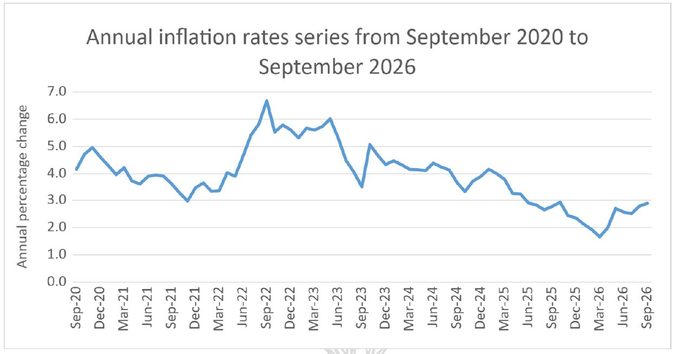

MBABANE – Eswatini households could face increased cost-of-living pressures as higher fuel, transport and fertiliser costs threaten to push prices higher across Sub-Saharan Africa over the next two years.
Households across Sub-Saharan Africa are expected to face renewed cost-of-living pressures, with inflation projected to rise over the next two years as higher fuel and transport costs combine with increasingly expensive agricultural inputs to threaten food affordability and security. This is according to Zeine Zeidane, Director of the African Department at the International Monetary Fund (IMF), who delivered the introductory remarks at the fund’s African Department press briefing during the 2026 Annual Meetings, where the IMF released its October Regional Economic Outlook Update for Sub-Saharan Africa, titled ‘Resilient Growth, Clouded Outlook’.
According to the report, median inflation across Sub-Saharan African countries is projected to increase from 3.4 per cent in 2025 to 4.3 per cent in 2026 before reaching 5 per cent in 2027.
Although the IMF’s regional projections do not represent Eswatini’s individual inflation forecast, the developments outlined in the report are relevant to the kingdom, given the potential for higher international energy and agricultural input costs to affect domestic transport, food production and household expenditure.
The report identifies fuel and transport costs as the immediate sources of inflationary pressure, while higher fertiliser prices and other imported production inputs are expected to feed into food prices over time.
Zeidane said households were already feeling the effects of renewed cost-of-living pressures, warning that more expensive fertiliser could intensify the challenge of maintaining food affordability and security.
The IMF’s assessment suggests that the effects of the global energy shock could extend beyond the initial increase in fuel prices, as higher production and distribution costs gradually work their way through economies.
… fertiliser costs to increase by 26%
MBABANE – The report highlights fertiliser prices as a significant risk to food production across the region, with international supply disruptions contributing to higher costs for farmers.
The IMF projects that fertiliser prices will increase by 26 per cent in 2026 compared with 2025, reflecting disruptions to production capacity and shipments through the Strait of Hormuz amid the war in the Middle East.
The report states that these pressures are compounded by disruptions to grain shipments through the Black Sea, particularly wheat, adding to the burden on food-importing economies.
By August 2026, the Food and Agriculture Organization’s Food Price Index was approximately 6 per cent above its February level, although it remained about 17 per cent below its March 2022 peak.
The IMF warns that higher fertiliser costs could force farmers to reduce their use of agricultural inputs, potentially weakening planting activity and subsequent harvests. The effects could be more pronounced in countries where currencies depreciate, credit is scarce or farmers have limited alternatives to expensive inputs.
For Eswatini, these findings raise concerns about the potential transmission of higher international input costs into domestic agricultural production and food prices. However, the report does not provide a separate estimate of the effect on Eswatini.
The outlook is further complicated by the threat posed by El Niño, which the IMF expects to strengthen and persist through February 2027.
The report warns that Southern Africa faces elevated risks to food and electricity supplies during the 2026/27 period, with forecasts for October 2026 to March 2027 indicating below-normal rainfall across much of the region, including parts of neighbouring Mozambique, Zambia and Zimbabwe.
Potential crop and pasture losses could reduce rural incomes and increase food prices, while lower reservoir levels could constrain hydropower generation.
In a severe El Niño scenario, the IMF’s modelling indicates that Sub-Saharan Africa could experience a median reduction in economic growth of 0.5 percentage points and a median increase in inflation of 2.6 percentage points in 2027 compared with the report’s baseline projections.
These are regional scenario estimates rather than forecasts for Eswatini, but they highlight the potential consequences of adverse weather conditions coinciding with already elevated energy and agricultural input costs.