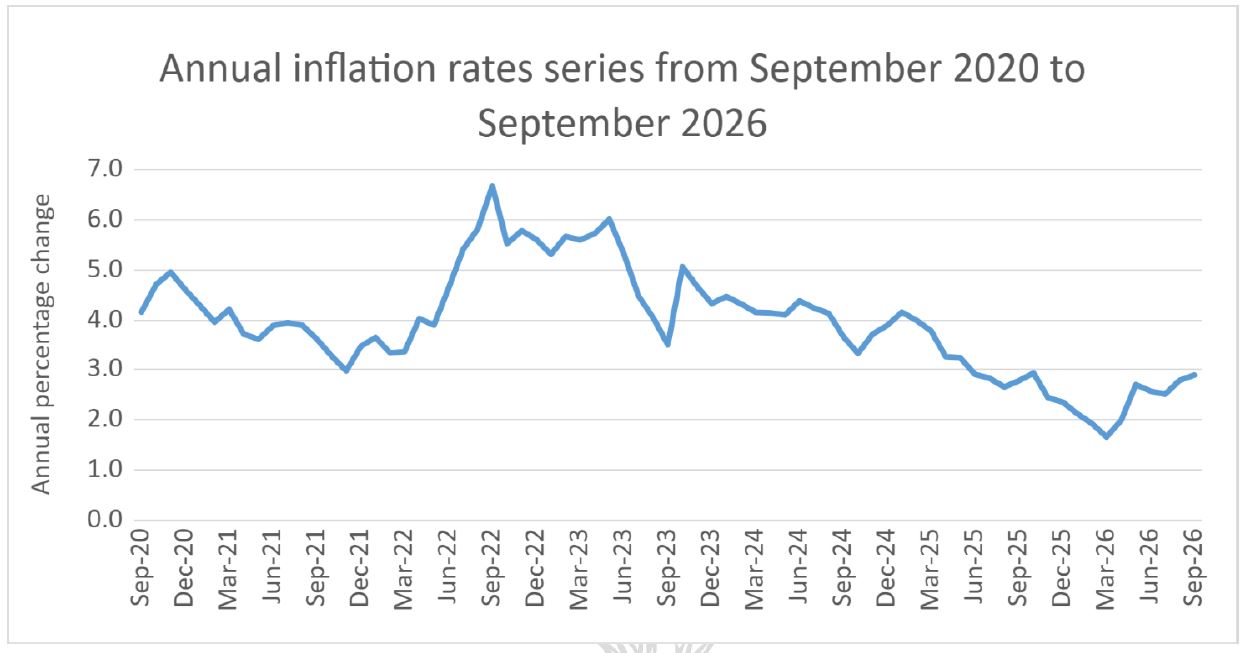
MBABANE — Eswatini’s headline inflation rate stood at 2.9 per cent in September 2026, registering a marginal increase of 0.1 percentage points compared to the 2.8 per cent recorded in August 2026.
This is according to the latest Consumer Price Index (CPI) report released by the Central Statistical Office (CSO).
The September 2026 figure mirrors the 2.9 per cent annual inflation rate observed twelve months prior in September 2025. While overall price growth remains subdued within a manageable band, underlying pressures from key consumer categories—particularly housing, utilities, and transport—continue to shape the domestic economic landscape.
A deeper analysis of the September 2026 basket indicates a persistent divergence between the cost of goods and services. The inflation rate for goods accelerated to 3.6 per cent, while services inflation remained considerably lower at 1.9 per cent.
On a month-on-month basis, consumer prices rose by 0.2 per cent in September 2026, matching the 0.2 per cent monthly rate recorded in August. Notable month-on-month movements included downward corrections in clothing and footwear (-1.0 per cent compared to a 0.4 per cent increase in August) and furnishings and household maintenance (-0.4 per cent), offset by increases in recreation and culture (0.4 per cent), education (0.8 per cent), restaurants and hotels (1.9 per cent), and miscellaneous goods and services (2.1 per cent).
The primary catalysts pushing the annual inflation rate to 2.9% were heavyweights in household consumption, led by housing, water, electricity, gas, and other fuels, as well as transport.
- Housing and Utilities: This dominant category, carrying a weight of 27.69 per cent in the CPI basket, recorded an annual inflation rate of 5.9 per cent, contributing a massive 1.7 percentage points to the headline figure. Within this group, electricity prices surged by 15.1 per cent year-on-year, while liquid fuels experienced a staggering 35.6 per cent annual jump. Water supply also exerted upward pressure, climbing 4.0 per cent.
- Transport: Accounting for 17.53 per cent of consumer spending, transport inflation climbed from 0.5 per cent in September 2025 to 4.2 per cent in September 2026, contributing 0.7 percentage points to headline inflation. This increase was spearheaded by fuels and lubricants for personal transport (which jumped 25.1 per cent annually) and passenger transport by air, which saw a 15.8 per cent increase.
- Education: Recording an annual inflation rate of 3.4 per cent and contributing 0.2 percentage points, education costs rose across pre-primary, primary (6.2 per cent), secondary (3.1 per cent) and tertiary levels (4.4 per cent).
Conversely, mitigating pressures came from categories like alcoholic beverages, tobacco, and narcotics, which saw annual inflation cool sharply from 10.2 per cent in September 2025 to 2.5 per cent in September 2026, dampening overall pressures due to slower beer growth and negative wine price trends.
Health sector inflation also softened drastically to 0.2 per cent, down from 3.5 per cent a year prior, aided by flat medical service fees.
The CSO’s analytical series underscores the heavy impact of government-regulated and administered pricing on the economy. While non-administered prices grew by a modest 1.4 per cent annually, administered prices surged by 8.6 per cent, with a notable 0.8 per cent monthly jump in September alone. This stark difference highlights how utility tariffs, fuel pricing adjustments, and regulated fees continue to outpace broader market-driven price shifts.