MBONGISENI NDZIMANDZE AND KWANELE DLAMINI
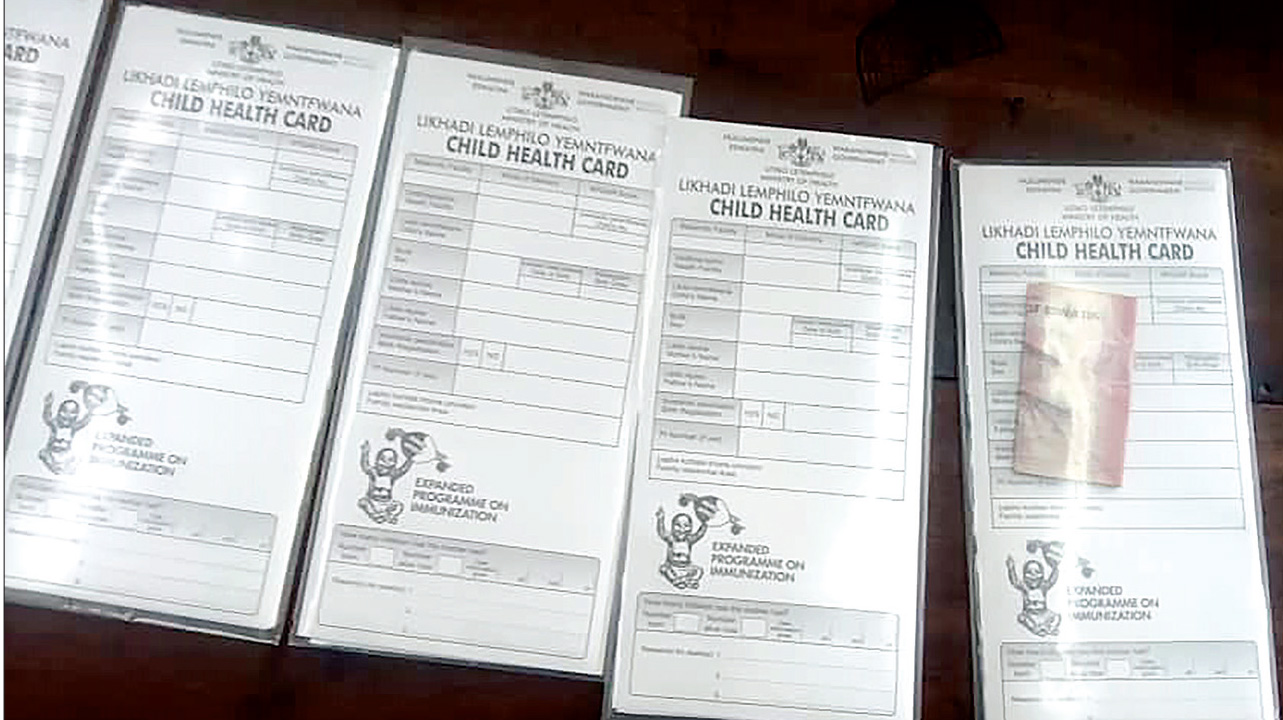
MBABANE – Free child health cards are being sold in the black market for E50 each, investigations by this publication have established.
The cards that end up being sold in the black market and social media platforms are ordinarily intended to help parents and healthcare workers keep records of children’s health, including immunisation and visits to healthcare facilities.
However, an investigation by this publication suggests that the documents were sought outside authorised channels for purposes other than their intended use.
The arrest of two women, Siphiwe Masangane (50) and Nokwanda Gulwako (24), both from Ludzeludze, in connection with the alleged theft and unlawful handling of child health cards has opened a can of worms.
Investigations have raised questions about how the documents found their way into unauthorised hands and whether other people may have been involved.
The charges against the two women relate to alleged theft and offences under the Official Secrets Act, 1968.
Preliminary police investigations indicate that Masangane is employed by one of the reputable printing companies based in Mbabane that are responsible for producing child health cards and other government documents. It has also been reliably gathered that she has since been suspended from work pending further investigations into the matter.
She is alleged to have taken a bundle of the cards home, where her daughter is said to have found them and subsequently advertised them for sale on Facebook. Masangane has reportedly worked for the printing company for more than 24 years.
The matter came to the attention of the police after they received a tip-off about someone allegedly offering the cards for sale. The information prompted an investigation that culminated in the arrest of the two women.
Police investigations are continuing, with officers reportedly examining whether the suspects could be linked to other cases involving the cards.
Further information gathered by this publication suggests that some people may have been interested in obtaining the cards because of the information that can be recorded in them, including details relating to a child’s parents.
Sources familiar with the investigation indicated that mothers who are uncertain about the paternity of their children may seek cards on which the details of men they wish to be recorded as the fathers can be entered.
This is one of the possible uses for which investigators believe the cards may have been sought.
Child health cards play an important role in monitoring a child’s healthcare needs. They allow parents and caregivers to keep track of immunisations and other healthcare visits while providing health workers with information that can assist them when attending to children.
In Eswatini, the cards are provided free of charge to women at hospitals after they give birth. Their purpose is to help ensure that important information about a child’s health is recorded and remains available as the child receives healthcare.
The alleged sale of these documents for E50 each has consequently raised questions about how cards supplied for public healthcare purposes may have found their way into unauthorised hands and whether there are weaknesses in the processes used to control their distribution.
Information gathered by this publication also suggests that child health records may be sought in connection with applications by emaSwati students wishing to study at some overseas learning institutions.
Some institutions reportedly request information about prospective students’ health backgrounds as part of their admission requirements. This has been cited as another possible reason why some people may seek documents containing details about a child’s background.
Child health cards are also required when pupils are registered at schools.
“There have been instances in which cards were reportedly unavailable at health facilities because stocks had run out,” sources said.
In such circumstances, women who had given birth were allegedly sometimes unable to leave the facilities with the documents intended for recording their children’s health information.
According to information gathered, some women may be told that they would be informed when new stock would arrive. However, allegations have emerged that certain hospital staff members may offer to provide cards earlier in exchange for payment.
Investigators are reportedly examining how the cards could have moved from the production process into private hands and subsequently offered for sale.
During the investigations, it was also discovered that some hospital staff members may have worked together to make the cards available to people willing to pay for them. However, the existence of such an arrangement has not been proven, and no syndicate has been established in connection with the matter.
Health Promotions Officer at the Ministry of Health Sidumo Lukhele said the ministry had previously warned the public against buying child health cards.
According to Lukhele, the warning followed information that some staff members were allegedly selling the cards at health facilities, despite the documents being available free of charge.
The ministry’s position is that members of the public should not pay for the cards. Women are supposed to receive them free of charge after giving birth at the country’s hospitals.
Lukhele also advised people who had lost their children’s cards to approach the health facility where the children were born and seek replacements rather than buying documents from unauthorised sources.
The advice is intended to direct members of the public to the appropriate channels for obtaining replacement documents and to discourage the purchase of cards from people who may not be authorised to distribute them.
The alleged sale of child-related documents in Eswatini brings to mind a separate case reported in South Africa in 2010, in which an investigation focused on a syndicate accused of selling fraudulent child birth charts.
The documents in that case were reportedly used to support applications for social grants. One suspect was said to have sold 130 birth charts, while another person, described as a hospital pharmacy worker, reportedly bought the documents for R10 each and resold them for R120 each.
Police reportedly recovered 15 blank charts bearing the official stamp of Bushbuckridge Hospital. Authorities estimated that the alleged fraudulent practices had cost provincial government departments approximately R174 000.
The South African case involved allegations concerning birth charts and their use in connection with social grant applications. It was separate from the current matter in Eswatini, and no connection has been established between the two cases.
Birth charts and child health cards also serve different purposes.
While the former may be used to establish or support information about a child’s birth, child health cards are intended to record healthcare information, including immunisations and visits to health facilities.
The South African case therefore provides a separate example of how documents associated with children can allegedly be diverted from their intended purposes.
It does not, however, establish that the same methods were used in Eswatini or that the women currently accused were involved in a similar scheme.
This publication has previously reported on cases involving alleged fraudulent government and official documents.
In August 2025, this publication reported on the arrest of five people in connection with the alleged manufacture of fraudulent documents, including bail receipts, motor vehicle registration certificates and fine receipts.
Another report concerned investigations by the Judiciary into allegedly fraudulent bail receipts. One such receipt was reportedly presented in connection with the release of a prisoner from Sidwashini Correctional Services.