

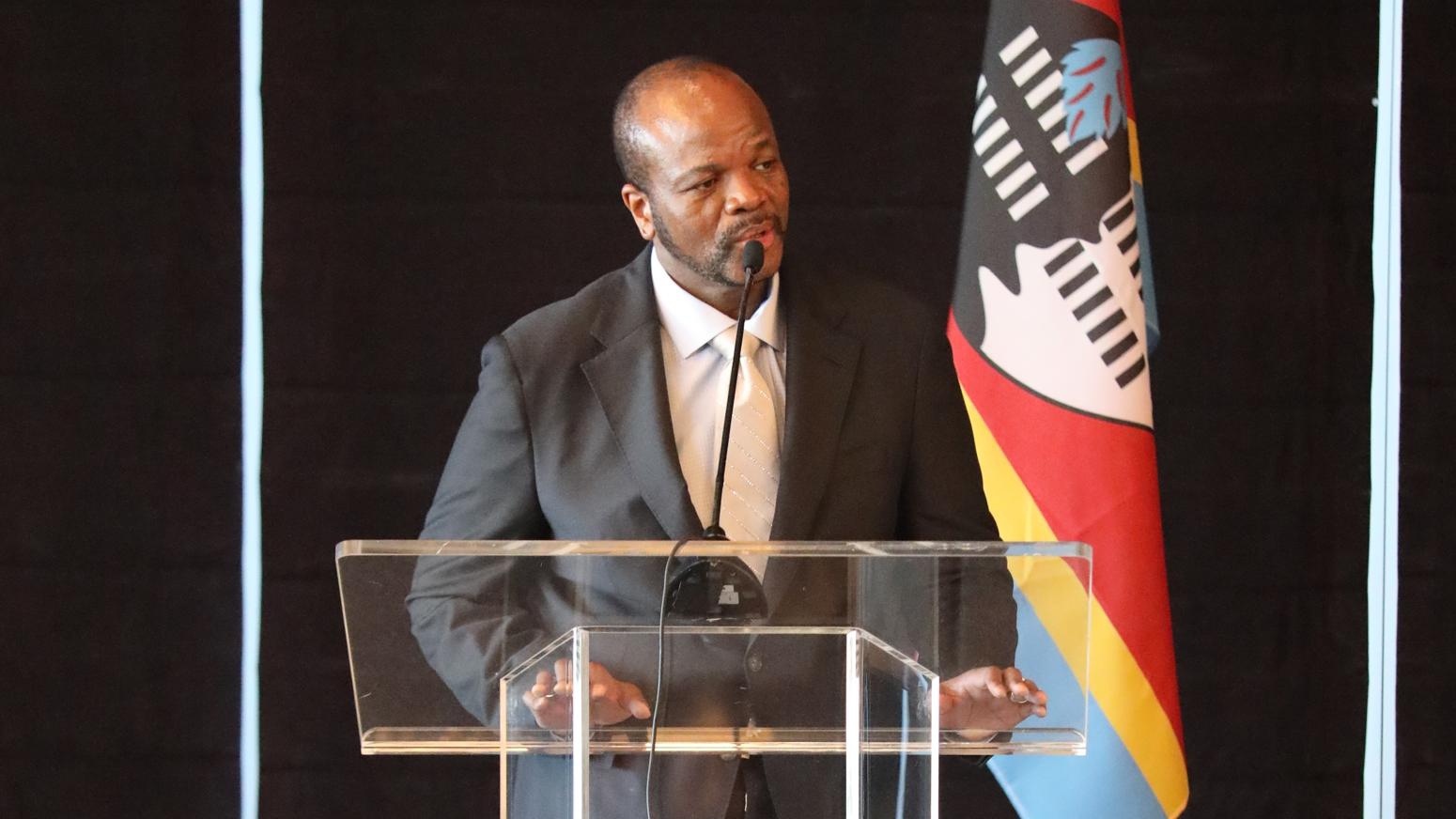
Call it divine wisdom or simply great minds thinking alike, but His Majesty the King’s suggestion to the United Nations General Assembly (UNGA) that ad hoc committees be considered to resolve global conflicts has found fertile ground. The President of the United States, Donald Trump, who is said to hold the key to the Israel-Palestinian conflict in Gaza, has announced a similar approach in establishing a ‘Board of Peace’.
His proposal is a committee of prominent figures, including the likes of former UK Prime Minister Tony Blair and will attempt the task with a different approach from the common use of envoys.
The King, like all peace-loving people, wishes for nothing but an end to conflict situations worldwide and this committee approach aligns with the great American Inventor Thomas Edison’s belief that, ‘there is a better way for everything; find it’.
The King, citing the wars in Gaza, Russia and Ukraine, Sudan, South Sudan, Somalia, the Sahel region and the Great Lakes, etc, has sought to find another way, as has Trump, both of which prove to be the same path. These contributions are vital to addressing these conflicts and we now await with hope for a lasting solution.
Addressing the African Union Peace and Security Council (AUPSC) on the sidelines of the UNGA, the King also called for a firm rejection of coups and any governments established unconstitutionally. As the incoming chairperson of the SADC Troika and member of the AUPSC, he rightly emphasised the necessity for the African Union and the United Nations to enforce consequences for those who attempt to overthrow legitimate governments, reiterating the AU’s commitment to not recognising forceful regimes. He, together with many leaders who spoke at the UN, reiterated the call for the long-proposed UN Security Council reforms as enshrined in the Ezulwini Consensus of 2005, to ensure Africa’s equitable representation. Perhaps, we need a different approach to bring this 20-year-old call to fruition.
His Majesty also returned home after launching a groundbreaking partnership with Google, Stardust and SHE Powers Africa, which aims to transform Eswatini into an innovation hub and dare to dream of space exploration going forward. If there was any doubt about this programme, the King has firmly put it aside with his endorsement.
Another key focus was climate change. We all witness the devastating effects of changing weather patterns on the kingdom, which is, incidentally, among the least contributors to greenhouse gas emissions. Despite this, the King pledged to reduce approximately 2.24 million tonnes of the country’s greenhouse gas emissions by 2035. This pledge was supported by the country being among the first 10 countries globally to submit the Paris Agreement-compliant Nationally Determined Contributions (NDCs) 3.0 plan, which outlines programmes and resources necessary to achieve this goal. The King stated that approximately E42 billion (US$2.4 billion) is needed for this purpose.
Contrary to claims that our head of State went ‘cap in hand’ begging for this money for personal gain, the Green Climate Fund (GCF), established in 2010 by the 194 parties of the United Nations Framework Convention on Climate Change (UNFCCC), exists to assist developing countries, like Eswatini, in transitioning towards low-emission and climate-resilient development; by mobilising financial resources for mitigation and adaptation efforts.
Under the Paris Agreement, all parties are required to submit NDCs, which outline their climate action plans to limit global warming. These funds are needed by institutions such as the National Disaster Management Agency (NDMA) and programmes for climate-smart agriculture, improved infrastructure and affordable technologies to ensure continued food production and support for farmers. We look forward to positive outcomes in this regard.
His Majesty was also invited to the 2025 Bloomberg Global Forum in New York, hosted by renowned Philanthropist Michael Bloomberg. The event, attended by leaders across sectors, aimed to address global challenges such as geopolitical shifts and economic fragmentation, focusing on Africa’s role in innovation and investment ahead of the G20 Summit to be hosted by South Africa. Key speakers included billionaire Bill Gates, with discussions highlighting the creation of sustainable job opportunities for the 1.2 billion young people entering the workforce in developing nations to combat poverty and promote growth. In addition to this business event, the King also made time to be part of the Eswatini-US Business Seminar hosted by the Ministry of Commerce, Industry and Trade where his presence boosted the confidence of the US businesspeople, some of whom gave endorsements, while others gave testimonials of their doing business in Eswatini.
The King’s attendance at these critical events played a central role in facilitating potential opportunities and partnerships, which are essential for the kingdom’s job creation projects. Shortly thereafter, he also put in some time to meet emaSwati residing in America, calling on their expertise to develop this country.
His Majesty’s programme was packed, but for good reason. All officials worked tirelessly to ensure its success. None could spare a moment to remain at the UN to listen to other speakers, such as Israel’s Benjamin Netanyahu and we were not part of countries said to have walked out on him.
What we look forward to is the follow-through and updates on the key initiatives that His Majesty has committed to. This responsibility lies with those the King has entrusted to deliver. It is time to set aside differences and build on this momentum for the greater good of emaSwati.













Leave a comment