

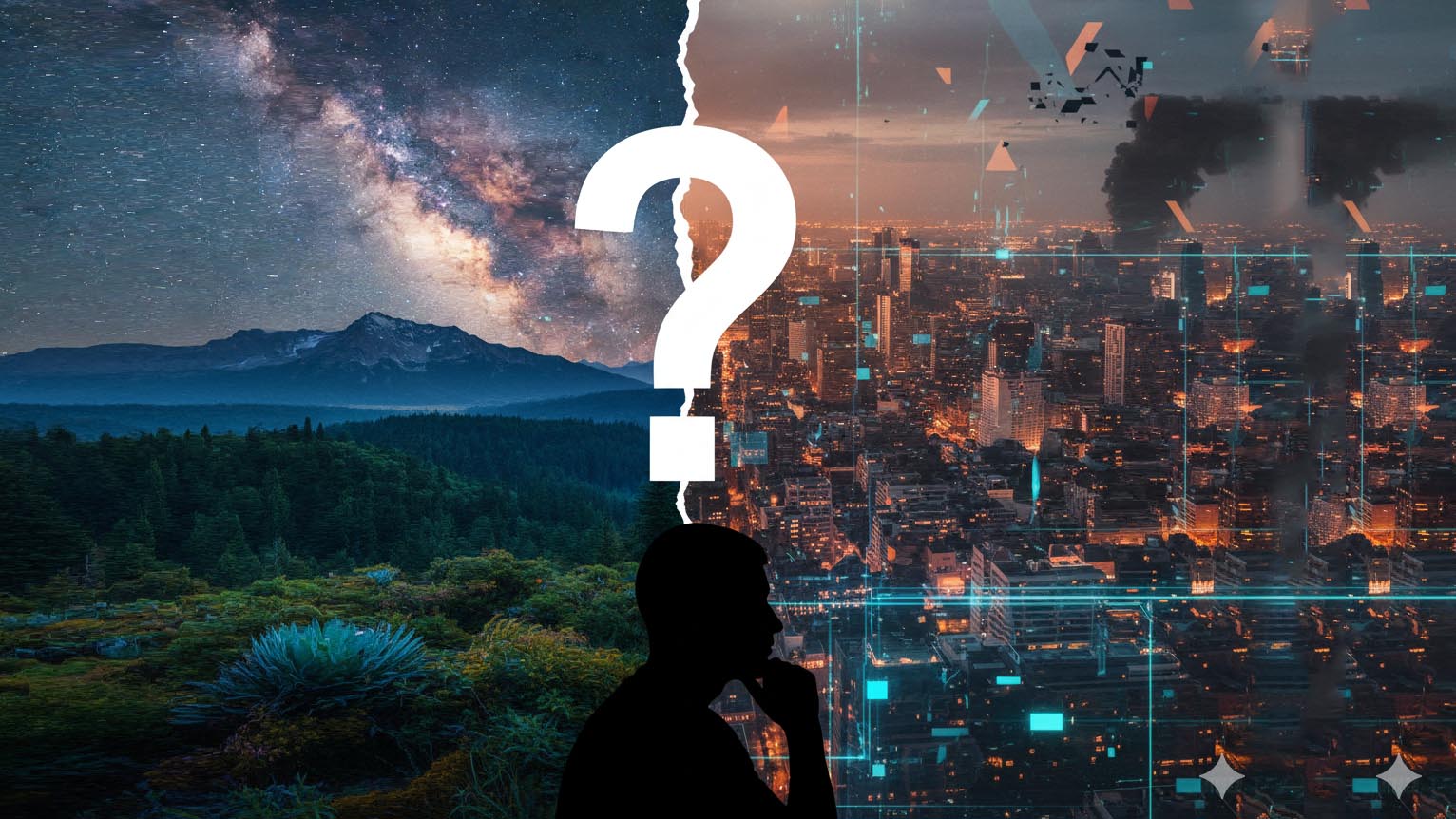
The reader is very welcome to respond to the question contained in the title. There are various media, especially a letter to the Times of Eswatini, through which a view can be expressed on the following article. Just remember that the word ‘rubbish’ is best spelt with two ‘b’s’. On second thoughts, a bee won’t help you spell it. And doubling the number makes no difference at all.
Notwithstanding the frivolity of that first paragraph, the question in the title, albeit rhetorical, is serious and challenging. ‘We’ carries its global application. A world view of what’s going on. We can start by saying that we are all living on a beautiful planet and, daily, see ample evidence of that and have sufficiently open minds to feel grateful for what we see.
Nobody in their right mind has ever said we live in a perfect world. But, to most, the imperfections are heavily outweighed by what lies in the ‘flora and fauna’ of the natural world. But whatever God, or an evolving Darwinian-style society, have given us in natural form should not be confused with how they (mankind) have used it.
We have technological, scientific and medical advancement at an exponential speed that is difficult to put in perspective. In simple terms it’s mind-blowing. The range and reliability of organ transplants is amazing. And of substantial, even ominous, impact is the artificial intelligence (AI) that, for example, brings to the smartphone holder the most elaborate answer – and immediately – on highly complex issues. The thought that a bank of computers can sift through digital data on the internet and respond to the question immediately and very accurately, is mind-boggling. Also fascinating is the smug expression on an individual’s face when displaying a profuse ChatGPT apology for an inaccurate earlier response. And exposed by an ordinary human being!
The head is already spinning while taking into account what we have before us, the product of an industrial revolution and this subsequent exponential rate of human innovation, especially in the past 50 years. But we can at least make a broad-brush assessment of what is also not so good.
Well, we’re nowhere near controlling the hurricanes, cyclones and earthquakes that continue to bully parts of the world into a shattered state. And we don’t get encouraging updates on how well the world is managing climate change and countries’ performance against target.
Let’s digress to one gigantic question, the answer for which lies perhaps hundreds of years in the future. That is – what is the full physical extent of our world, that we know as the Universe? And what, in meaningful detail, lies in the vast spaces we are nowhere near measuring with any accuracy. In his multiple awards-winning book ‘A Short History of Nearly Everything,’ Bill Bryson reminds us that our galaxy, the Milky Way, has at least 100 billion stars and is itself one of 140 billion galaxies. Tucked in there will be billions of planets and perhaps even millions of advanced civilisations like our own. The Law of Averages (aka Law of Statistical Regularity or the Gambler’s Fallacy) points convincingly towards that. And some, even centuries ahead of us in terms of technological progress. That’s where I get off the bus.
The main imperfection on our planet is that of mankind (presumably now personkind). In terms of human behaviour, put simply, we just don’t learn. Or to put it in northern English vernacular ‘There’s nowt so queer as folk.’ We develop political models to provide the average individual with the opportunity to help make real changes in a country, but then lack the ability to achieve a consistently honest and collaborative degree of implementation. Our fore-fathers (and don’t forget the two-mothers) swore that never again would the world be subjected to the ideological bigotry of one individual like Adolf Hitler, who espoused the supremacy of the Aryan race of people and set out to exterminate any conspicuous opposites, mainly the Jews.
Yet, today we see a giant country known as Russia, 1 000 times larger than Eswatini and with 143 million people, almost entirely in submission to one man (and possibly his mates) obsessed with reconstituting the Soviet Empire. An empire that collapsed in 1991 because it couldn’t work. I’m not complaining about the collaboration by the Russian people. In their position most innocent civilians would behave the same. But they are forced into killing many thousands of innocent Ukrainians. And for what? The whim of one man. It’s just crazy, and technological innovation will do nothing to resolve that, other than offering more sophisticated weaponry, enhanced to kill more people.
It remains one of the most challenging questions for those of religious persuasion. Why would an omnipotent Almighty allow such devastation and elimination of innocent adults and children in Ukraine and Gaza. For others to learn? Perhaps. And improve? They don’t. After the First World War – ‘the war that ended all wars’ – the world added ‘never again!’ Here, one hundred years later, exactly the same is happening – many thousands killed and nothing gained. The only perceptible change in recent times is the new ‘populist’ Democratic leader who is travelling the world accumulating ‘brownie points’ for promoting peace initiatives, with nothing remotely sustainable to show for it. But Donald Trump might win yet, especially if he uses the tariff weapon on stakeholders to starve the Russians of the resources for their weaponry. Thereafter an achievable peace.


















Leave a comment