

We are living in an era of rapid global transformation.
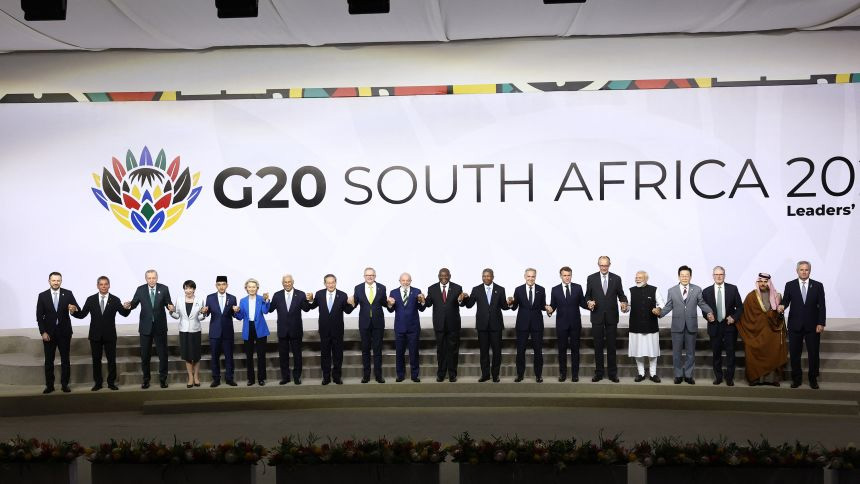
Platforms such as the G20, whose leaders are convened in neighbouring South Africa to address urgent global challenges and strengthen economic cooperation, are shaping the direction of the world economy.
Nations that fail to adapt risk being left irreversibly behind.
If Eswatini is to achieve meaningful development in the decades ahead, structural reforms must occupy the centre of the national agenda.
A Nation Rich in Potential, Yet Unable to Advance
On paper, Eswatini possesses everything a small African State requires for sustainable growth: A youthful population, a strategic geographic position, a stable currency (the Rand) pegged to a major economy (South Africa); fertile agricultural land, proximity to thriving regional markets and a skilled workforce in sectors such as finance and education.
However, the country struggles under the weight of high unemployment, particularly among young people, persistent corruption across multiple levels of governance, a distorted allocation of national resources, weak institutions incapable of enforcing accountability and widespread public disillusionment with government processes.
These factors create a profound development bottleneck. Credible investors, those capable of providing long-term capital, have demands that a host country must meet.
It is a global trend that when decision-making is concentrated within a narrow circle and public accountability mechanisms are weak, investors fear unpredictability.
Without transparent and predictable governance, no economy can flourish sustainably.
Let us be honest that Eswatini’s slow pace of reform is not merely a political concern, but an economic one with measurable consequences.
Countries with good governance typically gain the confidence of international investors because reforms often bring stronger property rights, greater transparency, predictable regulatory environments, merit-based leadership in key institutions and reduced corruption risk.
By contrast, governance models that operate without open public scrutiny tend to deter credible investors.
A nation of 1.2 million people does not require a flood of investment to experience transformational change – a handful of large-scale projects could shift employment, infrastructure and innovation trajectories almost overnight.
Yet, such investments cannot materialise without governance reform.
The middle class serves as the engine of any growing economy. In Eswatini, however, it remains thin and precarious.
Public sector salaries dominate the middle-income bracket, while private sector growth remains constrained by limited investment, inadequate industrial diversification and bureaucratic inefficiencies.
A strong, independent middle class thrives in systems where opportunity is determined by skills and fair competition rather than patronage.
Without accountability, nepotism flourishes and those with connections advance over those with qualifications.
This erodes productivity, innovation and trust in national institutions – a fundamental challenge for Eswatini’s development prospects.
Our country’s young intellectuals, academics, entrepreneurs and skilled professionals increasingly feel their contributions are valued.
When governance rewards loyalty over competence, the brightest minds depart for countries where their skills are welcomed, recognised and rewarded.
This may be the most devastating long-term consequence: A country cannot develop faster than the people driving its ideas.
When the intellectual class is excluded from national decision-making, the country effectively caps its own development potential.
We must acknowledge honestly that we are continuously losing brilliant, qualified personnel – graduates, judges, teachers, nurses, engineers – to neighbouring countries and increasingly, to destinations abroad. We must not allow this exodus – this brain drain.
Let us consider these voices from frustrated young citizens
Sipho shared: “I spent years studying, believing hard work would be rewarded.
“However, in this country, qualifications mean nothing if you lack connections. You become invisible. I cannot waste my youth waiting for scraps.”
Nontobeko explained: “Every day, I watch less experienced people earn promotions simply because they know the right people or flatter the right officials.
“It is demoralising. I have begun applying abroad – at least there, merit matters.”
Stufuza reflected: “I have started dreaming in foreign currencies. The opportunities here are not meant for us – they belong to those with names in the right circles.
“So, we leave, hoping someone will eventually change things.”
These testimonies from young patriots – now contemplating departure from the country of their birth – are deeply painful to absorb.
A society cannot progress when its citizens lose faith in the legitimacy of governance.
Our beautiful Eswatini today, confronts widespread frustration driven by unemployment, poverty, inequitable resource distribution; perceived corruption, inadequate service delivery and limited avenues for political expression.
When governance fails to adapt to the needs and voices of its people, instability becomes inevitable – not necessarily as a threat, but as a symptom of long-ignored grievances.
Development requires social cohesion; cohesion requires legitimacy and legitimacy requires democratic participation.
The G20 Moment: What It Means for Africa
This year’s G20 discussions in South Africa brought renewed attention to Africa’s place in the global economy.
Debt restructuring, climate finance, digital transformation and youth entrepreneurship featured prominently on the agenda.
African countries that are politically stable, reform-oriented and transparent stand to benefit enormously from these global shifts.
The uncomfortable truth, however, is that nations resisting democratic reform will struggle to capitalise on global opportunities, regardless of how well-intentioned the international community may be.
The G20 is a forum of economic heavyweights and they engage most effectively with nations demonstrating predictable governance, respect for the rule of law, strong institutions, independent oversight structures and transparent financial systems.
Our own country, Eswatini, requires strong, independent institutions: An autonomous anti-corruption commission, an independent Judiciary, transparent procurement systems and parliamentary committees with genuine oversight authority.
Corruption thrives where oversight is weak.
Development thrives where accountability is strong.
To unlock economic productivity, the country must ensure transparent recruitment for public offices, competitive appointments to leadership positions, performance-based promotions and elimination of nepotistic practices.
A merit-driven government operates more efficiently and proves far more attractive to investors.
Foster a Culture of Accountability
Leaders must answer to the public – not merely to internal structures. This requires annual public performance reports, community consultations, open budget processes and protection for whistle-blowers.
Accountability reduces public disillusionment and strengthens trust.
Rebuild public confidence through transparency:
Government must demonstrate openness in public expenditure, contracts and tenders, management of State-owned enterprises and land allocation processes.
Transparency is the currency of trust:
Should these reforms be embraced, Eswatini could witness a surge in regional and global investment, significant job creation, economic diversification, retention of skilled professionals, improved public services and renewed social cohesion.Progress is not beyond reach. Implementation requires political courage.
The Time for Action Is Now
To the open-minded people of Eswatini, we need to understand that we are at a crossroads.
The path of stagnation is worrisome.
The alternative path, though more demanding, promises transformative progress.
Democracy, transparency and inclusive governance are not luxuries reserved for wealthy nations.
They are the foundations upon which prosperity is built.
A country with Eswatini’s potential should not lag behind nations that gained independence, decades later. It should be thriving.
For that to happen, uncomfortable truths must be confronted and the structural reforms long demanded by citizens must be embraced.
The future belongs to nations that listen to their people, harness their talent and open their governance systems to participation, accountability and innovation.
This country – our great Eswatini – can be among them.
Peace! Shalom!



















Leave a comment