

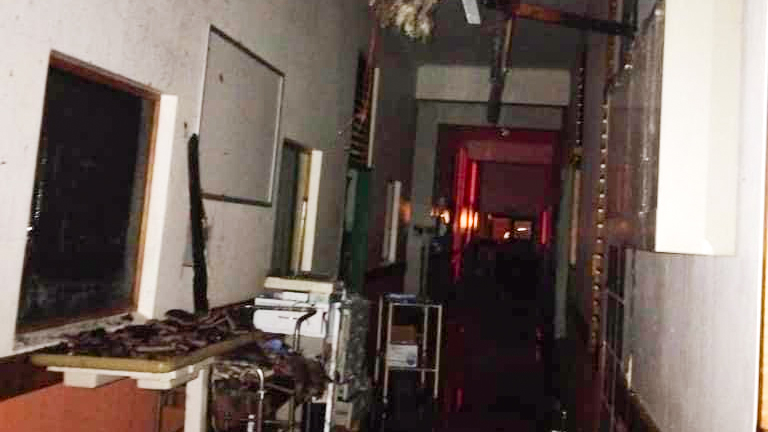
The unity among all government structures, which Prime Minister Russell Mmiso Dlamini spoke about a few days ago, is exactly what the doctor ordered on the issue of the damaged Mankayane Government Hospital.
I shall explain why the rehabilitation of this hospital should be a national priority.
The health facility was gutted by fire last Sunday, resulting in it being shut down and patients evacuated.
They had to be transferred to other health facilities, like Hlatikhulu Government Hospital, Mbabane Government and even as far as Pigg’s Peak.
The fire reportedly broke out at the male surgical ward’s duty station and spread to two more wards.
The full extent of the damage was only realised the following day, as staff, government officials and technicians from the Eswatini Electricity Company (EEC) made assessments.
The Eswatini National Fire, Rescue and Emergency Services (ENFRES) was also on site. It was then decided that the facility should be closed until further notice.
However, a couple of days later, the hospital was reopened, apparently because assessments had revealed that there was no danger in resuming operations.
The Ministry of Health issued a statement on Tuesday, saying the interruption of service delivery had since been addressed and a decision taken to have the facility resume operations.
The statement said all admitted patients had been evacuated after the fire and temporarily transferred to various health facilities.
Spokesperson Nsindiso Tsabedze said an earlier assessment by the EEC had resulted in the advice that power could not be restored until certain measures had been put in place. There had been a possibility that faults could occur, leading to further damage.
The ministry revealed that it had `quickly’ engaged a contractor who assisted in that regard. According to the ministry, a follow-up assessment by the EEC on Wednesday concluded that the hospital was now ready for the reconnection of power. Through the statement, the public was notified that operations would resume as of December 10, 2025, which was Wednesday.
This was good news to many residents of areas within and around Mankayane.
Tsabedze said patients who had been moved to other health facilities after the fire would return to Mankayane Government Hospital on the same day.
Two wards, which had been used as an isolation space before the unfortunate incident, would be repurposed for use in place of those damaged by fire.
The isolation wards had once again been assessed by officers from the EEC and the ENFRES, who certified them ready for use as they apparently posed no risk to either staff or patients.
“We would like to assure Mankayane Government Hospital staff members and clients that the facility is safe and fit to resume operations,” read the ministry’s statement in part.
I must admit that I was one of those who were bowled over by the swiftness of the response to this calamitous event. This was really in the true spirit of ‘nkwe’.
Mankayane Hospital is not just a health facility but a lifeline for many emaSwati who come from all four corners of the country, in the true sense of the phrase.
This 226-bed facility has over the years earned itself the reputation of being one of the best, if not the best public hospital in the country.
It stands right up there with the likes of Good Shepherd Catholic Hospital in Siteki, which has also steadily carved itself a slot among the go-to health facilities of Eswatini.
Over the last decade or so, word of mouth has ensured that more patients flock to Mankayane for various services.
This hospital was regularly praised, not only for courteous service from staff, but also on the availability of various facilities and equipment required to treat various ailments. It became well-known for its orthopaedic services and chronic disease management programmes, among other services.
It also offers family planning services, and has reputationally developed strong programmes for the management of diabetes and hypertension.
These non-communicable diseases commonly affect middle-aged and senior citizens. Some may not be aware that this hospital also provides mental health services, which, while crucial for every community, are rare in many parts of the kingdom.
General medical care is provided to thousands of emaSwati from areas around Mankayane and accessible to anyone from any part of the country.
That is why it was disappointing a few months ago, when it emerged that patients were no longer pleased with the treatment they were getting from the hospital.
This was when it was revealed that patients were being made to wait in extra-long queues to access medical care.
Owing to both the popularity of the hospital and the widely reported healthcare crisis that rendered public hospitals mere consultation rooms where only prescriptions were issued, the lines got longer by the day.
Patients had to stand in line for four or more hours before they could be attended to. It was reported that as a result of the medical drug shortage crisis, staffers were scaling down operations and offering limited service.
People came from as far as Mbabane, Manzini and other distant areas to access services, only to find that the hospital they laid all their hopes on was also affected by the national healthcare crisis.
Fast-forward to the fire incident and the Ministry of Health saying operations can resume. However, this is not what staffers are saying.
A day after the ministry announced that the hospital had been reopened, healthcare workers came out to say the facility was not yet ready to resume operations.
Indeed, while it would be unacceptable to keep this lifeline closed for a protracted period on account of the fire, it is also not proper to resume operations if workers feel that they cannot perform to the expected capacity under admittedly abnormal circumstances.
That is why it is imperative that all relevant government ministries come together for a swift and permanent solution to the damage caused by the fire at Mankayane Government Hospital.
The ministries of Health, Finance and others should channel all available emergency resources towards the speedy rehabilitation of the damaged sections of the hospital. At most, it should take weeks, not months.
Let us see the unity the prime minister believes is in short supply in the country’s corridors of power, being demonstrated to foster cross-departmental synergy for this national endeavour.
The same unity should also prevail in ending the national medical drug shortage once and for all.
















Leave a comment