

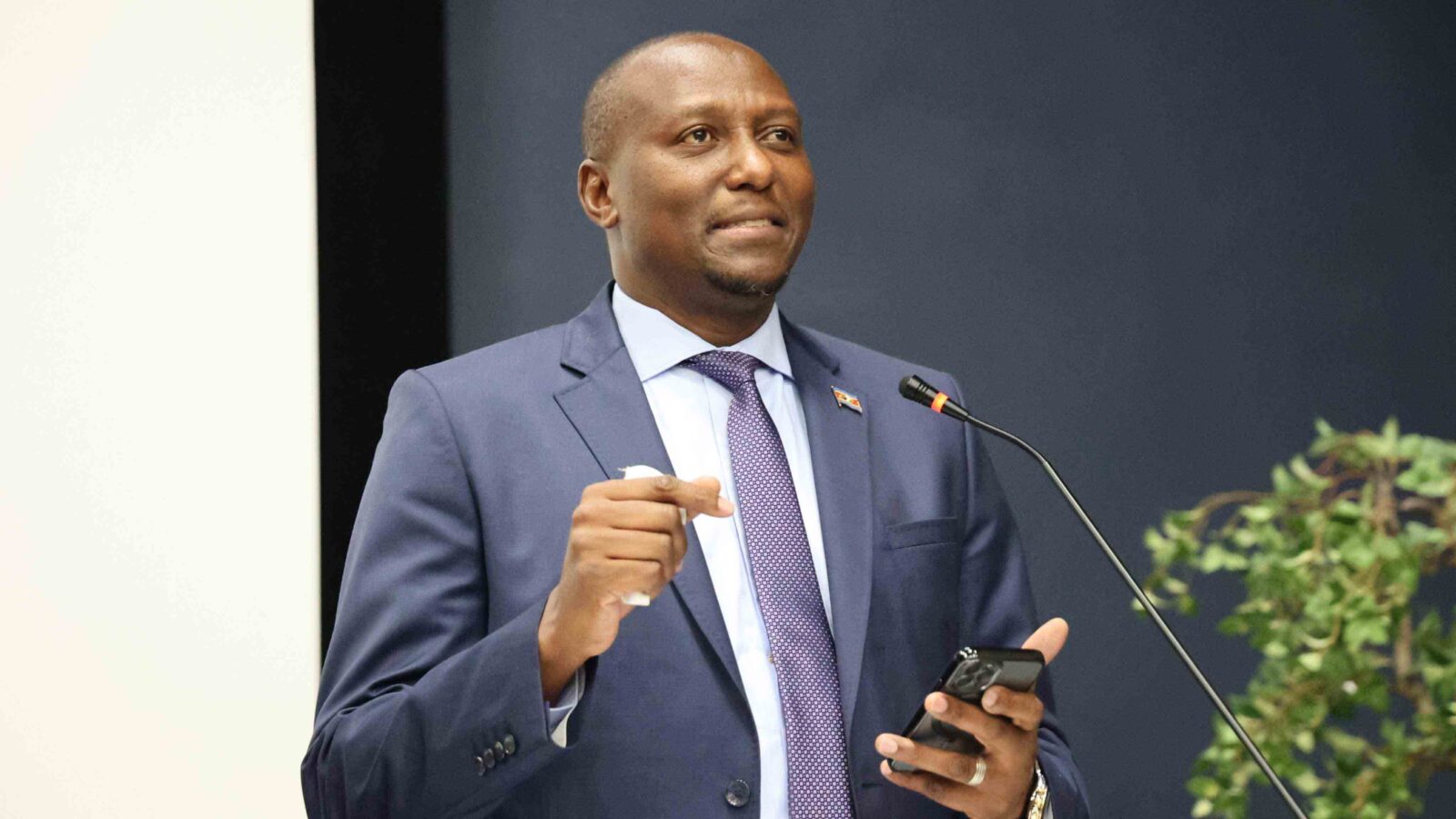
Prime Minister Russell Dlamini says healthcare, education reform and social protection formed a major part of government’s agenda in 2025.
In government’s end-of-year statement delivered at Cabinet offices in Mbabane last Tuesday, the prime minister also highlighted expanded support for vulnerable groups as one of the items that were prioritised.
The statement, traditionally issued by heads of government at the end of each calendar year, highlighted ‘notable progress’ in addressing key national challenges, while laying a solid foundation for long-term transformation. It spoke of inclusive development in the kingdom.
Dlamini outlined achievements across several sectors, including international affairs, economic performance, investment promotion, disaster risk management, youth empowerment and social protection. Legislative reform, health and education were also listed. He said these positives were beginning to stabilise economic and social trends, while positioning Eswatini for sustainable growth.
I am deliberately concentrating on education and healthcare because for one, we are at a crucial time in the education sector, when stakeholders are trying to make head or tail of the Competency-Based Education (CBE) curriculum, which has replaced the Outcome-Based Education. CBE was introduced at primary school level in 2018, apparently to ensure that pupils were equipped with relevant skills and knowledge that aligns them, as unique individuals, with the job market.
The first cohort of learners who were first to start learning under this system sat for their Grade VII external examination, now called as the Eswatini Primary School Assessment (EPSA) and not Eswatini Primary Certificate. This year, the curriculum, along with its contentious issues around application and implementation, will be rolled out at secondary schools.
The prime minister says education reform formed a major part of the country’s agenda last year. However, the myriad challenges and questions around the CBE syllabus makes it even more imperative that deliberate and decisive action be taken in 2026, to prevent the education system from imploding.
The Swaziland National Association of Teachers (SNAT) seems to be the lone voice in the wilderness raising the alarm about the complications presented by the introduction of CBE under the prevailing circumstances of staff shortages and lack of other resources.
From the outset, SNAT was critical of the ‘normal progression’ policy introduced by government back in 2018.
This framework basically instructed schools to push learners who ‘did not achieve the expected level of competency’ in one class to the next one. As a result, there were no failures from Grade I to Grade VII, which was not normal at all.
It is this policy that has seen the failure rate in the EPSA examination spiralling, with 4 100 children expected to go back to Grade VII this year because they failed. In 2024, there were 2 716 failures. First of all, this presents cognitive and mental challenges for the learners who have never known how to work hard to avoid failing or how to deal with failure if it becomes an eventuality.
They are bound to fall into deep depression as a result of this unfamiliar outcome. Secondly, this presents a major challenge for affected schools, as some recorded huge numbers of failures that could require additional classrooms to study in. If education delivery and reform constitute one of government’s priorities, the mistakes made in the ‘normal progression’ fiasco should be corrected. Learners should be made to repeat grades where they fail to grasp the basic concepts.
SNAT Secretary General Lot Vilakati says: “The sad part is that we cannot track back to establish in which class the child got left behind.” This means that some of the 4 100 could repeat Grade VII, but still fail to master the important basics. It is a tragedy.
These are the issues the country’s legislators should be calling government out on. Cabinet, for its part, would do well to read up on a recent report from a Stellenbosch University study, which found that learners who repeat Grades I to IV usually perform better over time, than those who are promoted after narrowly passing. The research findings were released in December 2025.
Data from primary school learners across six South African provinces was analysed and compared, revealing that children who repeat early grades demonstrated marked gains in language and mathematics.
Benefits of this policy last several years. “Over the last few decades, we have found positive effects of repetition,” Ros Clayton of Stellenbosch University’s Research on Socio-Economic Policy Group was quoted by Eyewitness News as saying.
Again, the prime minister says government filled 1 735 posts within the sector last year. Of these, 1 311 were temporary teacher positions that were converted to permanent status. There is no mention of assistant teachers, yet the 2018 Eswatini Curriculum Framework makes a provision for such.
It says under the CBE syllabus, schools should allow learners who did not achieve the expected level of competencies to progress to the next grade “with additional individualised or small group instruction from assistant teachers.” I have never heard of assistant teachers in our public school system. Maybe this is where the CBE wheels fell off, resulting in 4 100 learners being condemned to the doldrums of failure.
I thought I would also delve into the healthcare aspect, which the prime minister highlighted as one of government’s priorities in the midst of a continuous medical drug shortage we are carrying over into 2026. However, with schools opening in the next couple of weeks or so, issues around education are on everyone’s mind. They need to be addressed ASAP to avoid confusion for parents, learners and teachers when schools open for the first term.
Going forward, government should ensure that rolling out the CBE curriculum at secondary level is accompanied by relevant investment in human resources, adequate teacher training and digital infrastructure. My own research on the curriculum has revealed that in Africa, CBE has actually emerged as a powerful, transformative model capable of addressing the skills gaps learners face later in life, when they reach college or university.
The curriculum has been widely adopted in developed countries and African nations are being urged to integrate it into their education systems. So, there is no doubt that we are on to a good thing. We only need full financial and political commitment in implementing it, to be able to reap its numerous rewards.


















Leave a comment